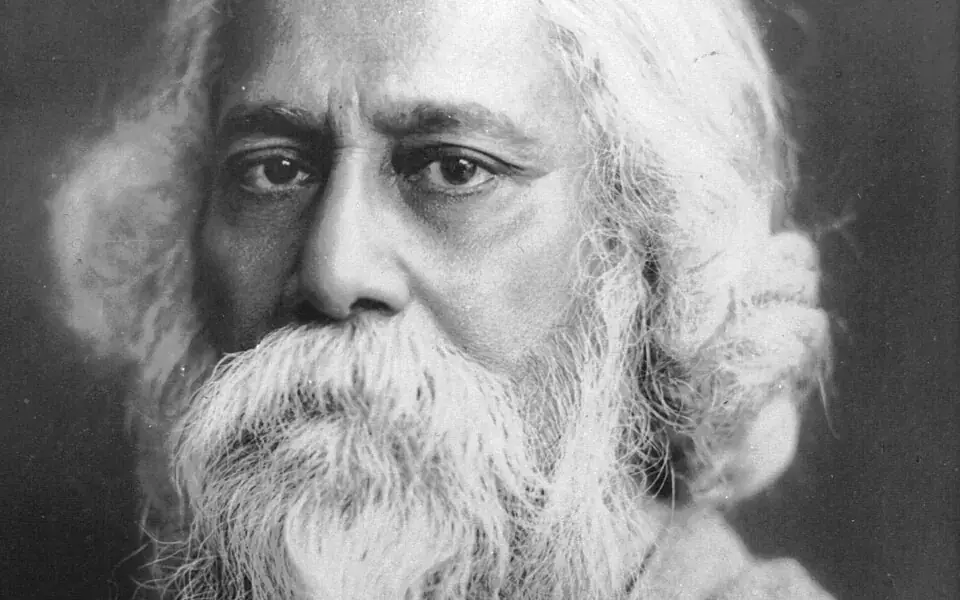
Rabindranath Tagore received the Nobel Prize in Literature in 1913, becoming the first Asian writer to win it. Poetry and translation brought his work to wider audiences.
He also worked in education, music, and painting. Different language versions shape readers' encounters with his writing, while international recognition coexisted with his activities in his own cultural setting.
Works
Known mostly for his poetry, Tagore wrote novels, essays, short stories, travelogues, dramas, and thousands of songs. Of Tagore's prose, his short stories are perhaps the most highly regarded; he is indeed credited with originating the Bengali-language version of the genre. His works are frequently noted for their rhythmic, optimistic, and lyrical nature. Such stories mostly borrow from the lives of common people. Tagore's non-fiction grappled with history, linguistics, and spirituality. He wrote autobiographies. His travelogues, essays, and lectures were compiled into several volumes, including Europe Jatrir Patro (Letters from Europe) and Manusher Dhormo (The Religion of Man). His brief chat with Einstein, "Note on the Nature of Reality", is included as an appendix to the latter. On the occasion of Tagore's 150th birthday, an anthology (titled Kalanukromik Rabindra Rachanabali) of the total body of his works is currently being published in Bengali in chronological order.
This includes all versions of each work and fills about eighty volumes. In 2011, Harvard University Press collaborated with Visva-Bharati University to publish The Essential Tagore, the largest anthology of Tagore's works available in English; it was edited by Fakrul Alam and Radha Chakravarthy and marks the 150th anniversary of Tagore's birth.
Poetry
Internationally, Gitanjali (Bengali:) is Tagore's best-known collection of poetry, for which he was awarded the Nobel Prize in Literature in 1913. Tagore was the first non-European to receive a Nobel Prize in Literature and the second non-European to receive a Nobel Prize after Theodore Roosevelt.
Besides Gitanjali, other notable works include Manasi, Sonar Tori ("Golden Boat"), Balaka ("Wild Geese" – the title being a metaphor for migrating souls)
Tagore's poetic style, which proceeds from a lineage established by 15th- and 16th-century Vaishnava poets, ranges from classical formalism to the comic, visionary, and ecstatic. He was influenced by the atavistic mysticism of Vyasa and other rishi-authors of the Upanishads, the Bhakti-Sufi mystic Kabir, and Ramprasad Sen. Tagore's most innovative and mature poetry embodies his exposure to Bengali rural folk music, which included mystic Baul ballads such as those of the bard Lalon. These, rediscovered and re-popularised by Tagore, resemble 19th-century Kartābhajā hymns that emphasise inward divinity and rebellion against bourgeois bhadralok religious and social orthodoxy. During his Shelaidaha years, his poems took on a lyrical voice of the moner manush, the Bāuls' "man within the heart" and Tagore's "life force of his deep recesses", or meditating upon the jeevan devata—the demiurge or the "living God within".
Art works
At sixty, Tagore took up drawing and painting; successful exhibitions of his many works—which made a debut appearance in Paris upon encouragement by artists he met in the south of France—were held throughout Europe. He was likely red, green colour blind, resulting in works that exhibited strange colour schemes and off-beat aesthetics. Tagore was influenced by numerous styles, including scrimshaw by the Malanggan people of northern New Ireland, Papua New Guinea, Haida carvings from the Pacific Northwest region of North America, and woodcuts by the German Max Pechstein. His artist's eye for handwriting was revealed in the simple artistic and rhythmic leitmotifs embellishing the scribbles, cross-outs, and word layouts of his manuscripts. Some of Tagore's lyrics corresponded in a synesthetic sense with particular paintings.
In 1937, Tagore's paintings were removed from Berlin's baroque Crown Prince Palace by the Nazi regime and five were included in the inventory of "degenerate art" compiled by the Nazis in 1941–1942.
List of works
Who are you, reader, reading my poems a hundred years hence? I cannot send you one single flower from this wealth of the spring, one single streak of gold from yonder clouds. Open your doors and look abroad. From your blossoming garden gather fragrant memories of the vanished flowers of an hundred years before. In the joy of your heart may you feel the living joy that sang one spring morning, sending its glad voice across an hundred years.
The SNLTR hosts the 1415 BE edition of Tagore's complete Bengali works. Tagore Web also hosts an edition of Tagore's works, including annotated songs. Translations can be found at Project Gutenberg and Wikisource. More sources are below.