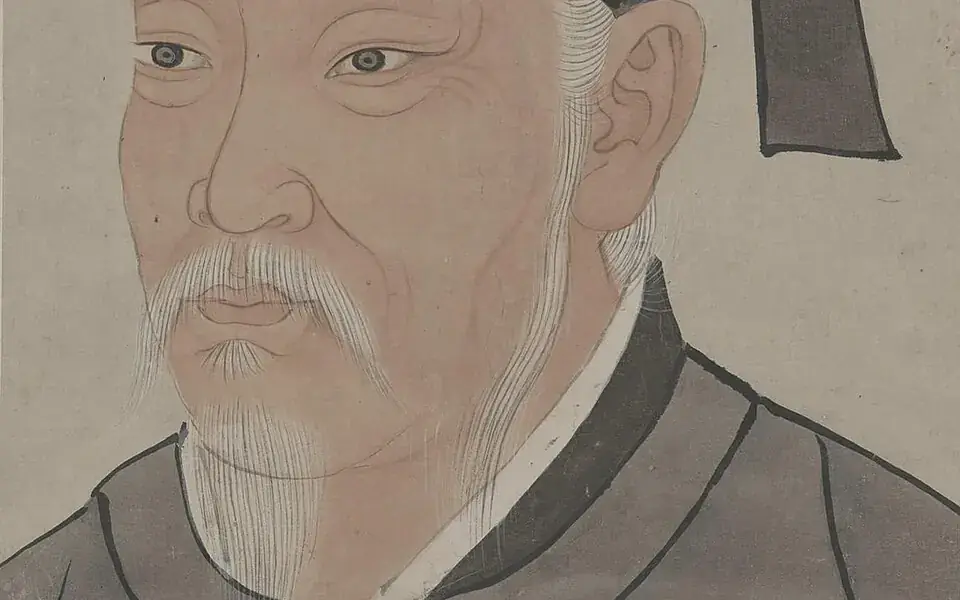
The new yuefu works of Bai Juyi and others used particular characters and situations to discuss social affairs. Taxes, labor, and people's livelihoods became subjects for poetry.
Bai Juyi also wrote romantic narratives, landscape poems, and works about everyday life. His style is not defined by a single plainspoken quality, as subjects and purposes differ.
Exile
While serving as a minor palace official in 814, Bai managed to get himself in official trouble. He made enemies at court and with certain individuals in other positions. It was partly his written works which led him into trouble. He wrote two long memorials, translated by Arthur Waley as "On Stopping the War", regarding what he considered to be an overly lengthy campaign against a minor group of Tatars; and he wrote a series of poems, in which he satirized the actions of greedy officials and highlighting the sufferings of the common folk.
At this time, one of the post-An Lushan warlords (jiedushi), Wu Yuanji in Henan, had seized control of Zhangyi Circuit (centered in Zhumadian), an act for which he sought reconciliation with the imperial government, trying to get an imperial pardon as a necessary prerequisite. Despite the intercession of influential friends, Wu was denied, thus officially putting him in the position of rebellion. Still seeking a pardon, Wu turned to assassination, blaming the Prime Minister, Wu Yuanheng, and other officials: the imperial court generally began by dawn, requiring the ministers to rise early in order to attend in a timely manner; and, on July 13, 815, before dawn, the Tang Prime Minister Wu Yuanheng was set to go to the palace for a meeting with Emperor Xianzong. As he left his house, arrows were fired at his retinue.
Works
Bai Juyi has been known for his plain, direct, and easily comprehensible style of verse, as well as for his social and political criticism. Besides his surviving poems, several letters and essays are also extant.
History
One of the most prolific of the Tang poets, Bai Juyi wrote over 2,800 poems, which he had copied and distributed to ensure their survival. They are notable for their relative accessibility: it is said that he would rewrite any part of a poem if one of his servants was unable to understand it. The accessibility of Bai Juyi's poems made them extremely popular in his lifetime, in both China and Japan, and they continue to be read in these countries today. His writings are also popular in Korea and Vietnam.
Famous poems
One of Bai's most famous poems is "Chang hen ge" ("Song of Everlasting Sorrow"), a long narrative poem that tells the story of the famous Tang dynasty concubine Yang Guifei and her relationship with Emperor Xuanzong of Tang.
Another of Bai's famous poems is "The Song of the Pipa Player". Like Du Fu, Bai had a strong sense of social responsibility and is well known for his satirical poems, such as The Elderly Charcoal Seller. Also he wrote about military conflicts during the Tang dynasty. Poems like "Song of Everlasting Sorrow" were examples of the peril in China during the An Lushan rebellion.
Bai's works were also highly renowned in Japan, and many of his poems were quoted and referenced in The Tale of Genji by Murasaki Shikibu. Zeami Motokiyo also quoted from Bai, in his Noh plays, and even wrote one, Haku Rakuten, about the Japanese god of poetry repelling the Chinese poet from Japan, in opposition to Bai's (perceived) challenge to the country's poetic autonomy.
Poetic forms
Bai Juyi was known for his interest in the old yuefu form of poetry, which was a typical form of Han poetry, namely folk ballad verses, collected or written by the Music Bureau. These were often a form of social protest. And, in fact, writing poetry to promote social progress was explicitly one of his objectives. He is also known for his well-written poems in the regulated verse style.