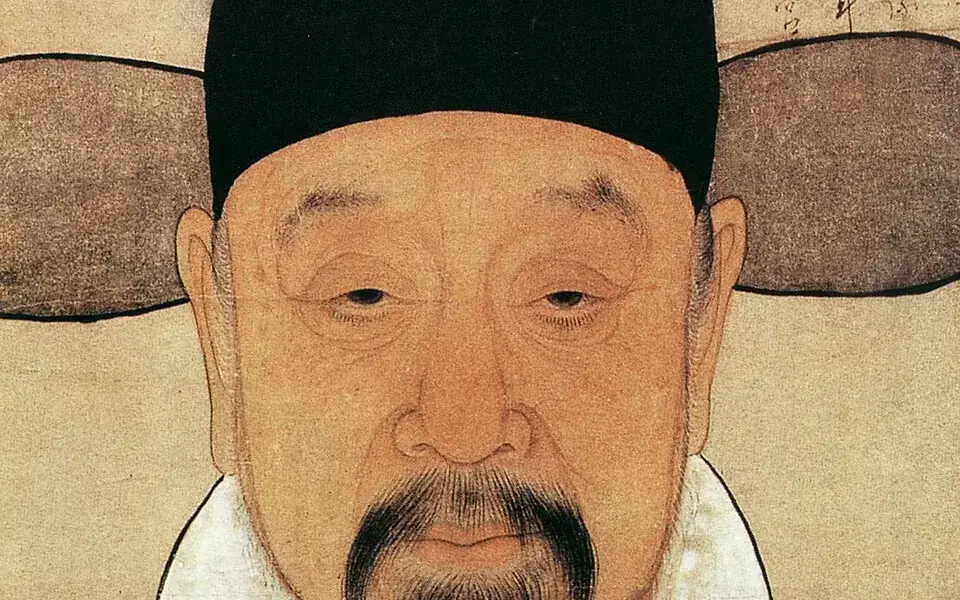
Xu Guangqi and Matteo Ricci collaborated on a translation of the first six books of Euclid's Elements. It introduced Euclidean geometry, and its Chinese terminology influenced later mathematics education.
The translation emphasized relationships among definitions, propositions, and proofs. It was an important event in late-Ming exchange between Chinese and European knowledge, as well as a mathematical work.
Early life
Xu Guangqi was born in Shanghai in Southern Zhili's Songjiang Prefecture on April 24, 1562, under China's Ming dynasty. At the time, Shanghai was merely a small walled county seat in the old quarter around the present city's Yu Garden. His family, including an older and younger sister, lived in the Taiqing Quarter at the south end of the town. Guangqi's branch of the Xu clan were not related to those who had passed the imperial examinations and joined Shanghai's local gentry. His father Xu Sicheng (died c. 1607) had been orphaned at age 5 and seen most of his inheritance lost to "Japanese" pirate raids and insolvent friends in the 1550s.
At the time of Guangqi's birth, his father worked twenty mu (1¼ ha) or less south of the city wall. About half of this would have been used to feed the family, with the rest used to supplement his income from small-scale trading. By the time Guangqi was 6, the family had saved enough to send him to a local school, where a later hagiographer records him piously upbraiding his classmates when they spoke of wanting to use their education for wealth or mystical power.
His mother died on May 8, 1592, and he undertook the ritual mourning period in her honor. His whereabouts over the next few years are uncertain but he seems to have failed the provincial exam at Beijing in 1594, after the mourning period was over.
Mathematics
In 1607, Xu and Ricci translated the first parts of Euclid's Elements (a treatise on mathematics, geometry, and logic) into Chinese. Some Chinese scholars credit Xu as having "started China's enlightenment".
Astronomy
After followers of Xu and Ricci publicly predicted a solar eclipse in 1629, Xu was appointed by the Chongzhen Emperor as the leader of an effort to reform the Chinese calendar. The reform, which constituted the first major collaboration between scientists from Europe and from the Far East, was completed after his death and became known as the Chongzhen calendar. It's notable for systematically introducing the concepts and development of European mathematics and astronomy to China for the first time, including extensive translations and references to Euclid's Elements and the works of Nicolaus Copernicus, Johannes Kepler, Galileo Galilei, and Tycho Brahe, whose Tychonic system was used as its main theoretical basis.
Agriculture
Xu Guangqi wrote the Complete Treatise on Agriculture, an outstanding agricultural treatise that followed in the tradition of those such as Wang Zhen (wrote the Wang Zhen Nong Shu of 1313 AD) and Jia Sixie (wrote the Chi Min Yao Shu of 535 AD). Like Wang Zhen, Xu lived in troubled times, and was devoted as a patriot to aiding the rural farmers of China. His main interests were in irrigation, fertilizers, famine relief, economic crops, and empirical observation with early notions of chemistry. It was an enormous written work, some 700,000 written Chinese characters, making it 7 times as large as the work of both Jia Sixie and Wang Zhen. Although its final draft was unfinished by Xu Guangqi by the time of his death in 1633, the famous Jiangnan scholar Chen Zilong assembled a group of scholars to edit the draft, publishing it in 1639.