Journey to the West absorbed pilgrimage legends, drama, and folk stories before becoming a long supernatural novel. Its material came from more than a single travel account.
The usual attribution is to Wu Cheng'en, but documentary evidence and authorship remain subjects of study. The novel should not be directly confused with Xuanzang's actual journey.
Creation and authorship
The modern 100-chapter form of Journey to the West dates from the 16th century. Embellished stories based on Xuanzang's journey to India had circulated in China through oral storytelling for centuries. They appeared in book form as early as the Southern Song dynasty (1127–1279). The Yongle Encyclopedia, completed in 1408, contains excerpts of a version of the story written in colloquial Chinese. The earliest surviving edition of Journey to the West was published in 1592 in Nanjing. Two earlier editions were published between 1522 and 1566, but no copies of them survive.
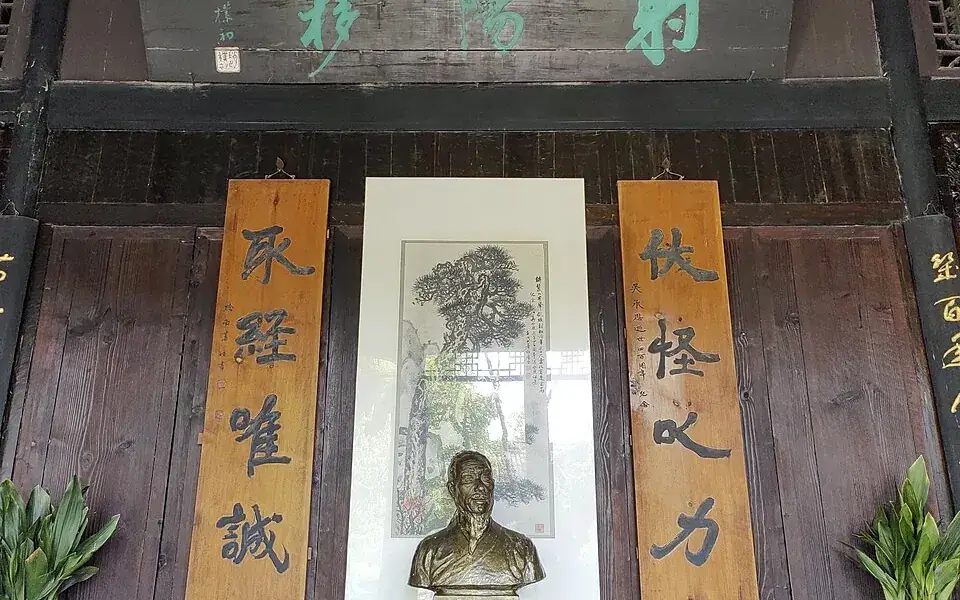
The authorship of Journey to the West is traditionally ascribed to Wu Cheng'en, but the question is complicated by the fact that much of the novel's material originated from folk tales. Anthony C. Yu, writing in 2012, warned that "this vexing dispute over the novel's authorship, similar to that on the priority of its textual versions, see-sawed back and forth for nearly a century without resolution." Hu Shih, literary scholar, former Chancellor of Peking University, and then Ambassador to the United States, wrote in 1942 that the novel was thought to have been written and published anonymously by Wu Cheng'en. He reasoned that the people of Wu's hometown attributed it to him early on, and kept records to that effect as early as 1625; thus, claimed Hu, Journey to the West was one of the earliest Chinese novels for which the authorship is officially documented.
One interpretive tradition views Journey to the West as the outcome of a writing game which was popular among Chinese literati.
The overall plot of Journey to the West was already a part of Chinese folk and literary tradition in the form of "folk stories with informal language", a poetic novelette, and a six-part drama play series, which was transcribed and written down, before the current version was written. Fragments of an earlier text, Journey to the West as Storytelling, are recorded in other texts. The narrative threads from this earlier text which survive are the wager between the Dragon King of the Jing River and fortune teller Yuan Shoucheng and the contest between the pilgrims and the three Taoist demons in Cart Slow Kingdom.
Regardless of the origins and authorship, Journey to the West has become the authoritative version of these folk stories, and while the cumulative authorship of the text is acknowledged, Wu is generally accepted as the author of the 1592 printed version widely considered canonical.
Historical basis
Although Journey to the West is a work of fantasy, it is based on the actual journey of the Chinese monk Xuanzang (602–664), who traveled to India in the 7th century in order to seek out Buddhist scriptures and bring them back to China. Xuanzang was a monk at Jingtu Temple in the imperial capital Chang'an (present-day Xi'an) during the late Sui dynasty and early Tang dynasty. He left Chang'an in 629, in defiance of Emperor Taizong of Tang's ban on travel. Helped by sympathetic Buddhists, Xuanzang traveled via Gansu and Qinghai to Kumul (Hami), thence following the Tian Shan mountains to Turpan. He then crossed regions that are today Kyrgyzstan, Uzbekistan and Afghanistan, into Gandhara, in what is today northern Pakistan, in 630.