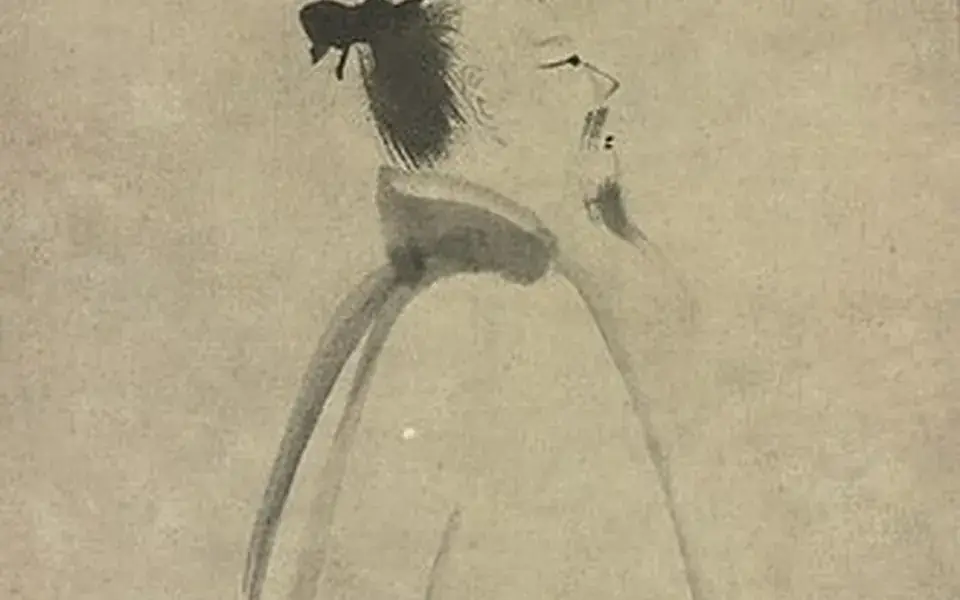
Li Bai used exaggeration, mythology, and shifting images to create a distinctive poetic style in subjects such as landscapes, drinking, and parting. His poems do more than record personal itineraries.
His life was connected with the Tang court and literary friendships. Later legends, such as his drowning while trying to embrace the Moon, lack reliable evidence; poetry and legend should be distinguished.
Themes
Critics have focused on Li Bai's strong sense of the continuity of poetic tradition, his glorification of alcoholic beverages (and, indeed, frank celebration of drunkenness), his use of persona, the fantastic extremes of some of his imagery, his mastery of formal poetic rules—and his ability to combine all of these with a seemingly effortless virtuosity to produce inimitable poetry. Other themes in Li's poetry, noted especially in the 20th century, are sympathy for the common folk and antipathy towards needless wars (even when conducted by the emperor himself).
Poetic tradition
Li Bai had a strong sense of himself as being part of a poetic tradition. The "genius" of Li Bai, says one recent account, "lies at once in his total command of the literary tradition before him and his ingenuity in bending (without breaking) it to discover a uniquely personal idiom..." Burton Watson, comparing him to Du Fu, says Li's poetry, "is essentially backward-looking, that it represents more a revival and fulfillment of past promises and glory than a foray into the future." Watson adds, as evidence, that of all the poems attributed to Li Bai, about one sixth are in the form of yuefu, or, in other words, reworked lyrics from traditional folk ballads.
Rapt with wine and moon
John C. H. Wu observed that "while some may have drunk more wine than Li, no-one has written more poems about wine." Classical Chinese poets were often associated with drinking wine, and Li Bai was part of the group of Chinese scholars in Chang'an his fellow poet Du Fu called the "Eight Immortals of the Wine Cup." The Chinese generally did not find the moderate use of alcohol to be immoral or unhealthy. James J. Y Liu comments that zui in poetry "does not mean quite the same thing as 'drunk', 'intoxicated', or 'inebriated', but rather means being mentally carried away from one's normal preoccupations..." Liu translates zui as "rapt with wine". The "Eight Immortals", however, drank to an unusual degree, though they still were viewed as pleasant eccentrics.
Burton Watson concluded that "early all Chinese poets celebrate the joys of wine, but none so tirelessly and with such a note of genuine conviction as Li ".
The following two poems, "Rising Drunk on a Spring Day, Telling My Intent" and "Drinking Alone by Moonlight", are among Li Bai's most famous and demonstrate different aspects of his use of wine and drunkenness.
We are lodged in this world as in a great dream; Then why cause our lives so much stress? This is my reason to spend the day drunk And collapse, sprawled against the front pillar. When I wake, I peer out in the yard Where a bird is singing among the flowers. Now tell me, what season is this?— The spring breeze speaks with orioles warbling. I am so touched that I almost sigh, I turn to the wine, pour myself more, Then sing wildly, waiting for the moon, When the tune is done, I no longer care.
Here among flowers one flask of wine, With no close friends, I pour it alone. I lift cup to bright moon, beg its company, Then facing my shadow, we become three. The moon has never known how to drink; My shadow does nothing but follow me. But with moon and shadow as companions the while, This joy I find must catch spring while it's here. I sing, and the moon just lingers on; I dance, and my shadow flails wildly. When still sober we share friendship and pleasure, Then, utterly drunk, each goes his own way— Let us join to roam beyond human cares And plan to meet far in the river of stars.