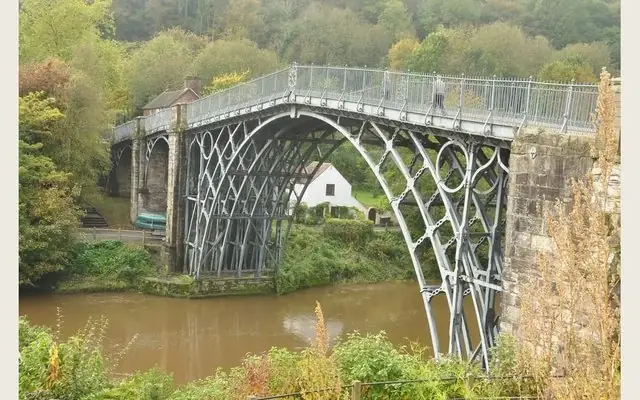
A crossing in an industrial landscape
When the Iron Bridge opened across the River Severn in 1781, its importance extended beyond the convenience of another crossing. The structure made a conspicuous argument for a material whose possibilities were expanding with industrial production. Iron could form the principal structure of a substantial bridge, rather than simply reinforce a building made from something else. Yet the bridge was also an experiment, assembled by people drawing on familiar practices. Looking closely at its ribs and connections reveals a transition in engineering knowledge, not a sudden replacement of everything that had come before.
The surrounding gorge helps explain why the experiment happened here. Coal, ironworking, river transport, workshops, and settlements occupied a landscape already shaped by industry. At nearby Coalbrookdale, Abraham Darby I had successfully used coke to smelt iron in 1709. That development belonged to a longer story of changing production rather than to the bridge's own construction campaign. Decades later, Thomas Farnolls Pritchard proposed an iron crossing. He supplied an architectural and engineering conception, while Abraham Darby III took responsibility for carrying the project forward. The structure emerged from that local combination of resources, ambitions, and expertise.
Timber knowledge cast in iron
Construction began in 1777, and Pritchard died before the work was completed. The main ironwork was erected in 1779, two years before the crossing opened to traffic. Those dates describe different stages and should not be treated as competing accounts of a single ceremony. Five principal semicircular ribs support the span. Cast components had to be made, brought to the site, raised, and connected into a working structure. The finished curve can make this sequence look inevitable, but each operation presented practical questions for which there was little directly comparable experience on the same scale.
Some of the most revealing details are in the joints. Connections drew on techniques familiar from timber construction, including forms associated with dovetails and shoulders. Many components were individually fitted rather than interchangeable examples of a perfectly standardized system. That combination makes the bridge especially valuable as evidence. The builders did not possess a complete modern vocabulary of iron bridge design and then simply apply it. They adapted existing knowledge to a different material, learning through manufacture and assembly. Innovation here included continuity: an old way of understanding how pieces could meet helped make an unfamiliar structural experiment possible.
An experiment that needed care
The construction process itself has required historical investigation. A watercolour by Elias Martin, identified in Stockholm in 1997, helped researchers understand how parts of the ribs could have been lifted using a temporary framework and a vessel on the river. Such evidence is useful precisely because the standing bridge cannot answer every question about its own erection. A completed structure preserves some traces of its making while concealing others. Images, physical surveys, and documentary records therefore contribute different kinds of information. They can refine an explanation without removing every uncertainty about what workers actually did on particular days.
The crossing also had a life after its celebrated opening. It carried traffic, collected tolls, and endured the effects of its setting. Movement at the abutments and stresses within the structure required attention over time. Its survival should not be described as proof that the original experiment needed no correction. Road vehicles were excluded in 1934, and later conservation included measures to stabilize the crossing. The bridge that visitors encounter is a historical structure whose continued existence depends on inspection and care. Maintenance is part of its engineering story, rather than an interruption to an otherwise untouched achievement.
Reading a bridge as historical evidence
Conservation has also changed what can be known about the fabric. Detailed surveys recorded joints, casting features, and evidence of alterations, while the major conservation campaign completed in 2018 addressed the condition of the ironwork. These activities connect preservation with research. Treating the bridge only as a picturesque symbol would overlook its value as a collection of physical clues. Equally, treating it only as a technical diagram would separate it from the people, transport needs, and industrial landscape that made the crossing worth building. The wider Ironbridge Gorge World Heritage Site preserves that relationship between monument and setting.
The bridge's lasting fascination lies in this combination of boldness and adaptation. Its builders demonstrated an important possibility without possessing all the knowledge that later engineers would develop about iron structures. Their work was neither a modern bridge accidentally built early nor a simple enlargement of a wooden one. It was a specific response to a specific place, made through choices whose traces remain visible. The iron arch became a symbol of industrial change because it embodied that change in an everyday activity: getting people and goods from one side of a river to the other.