Two cities and one difficult river
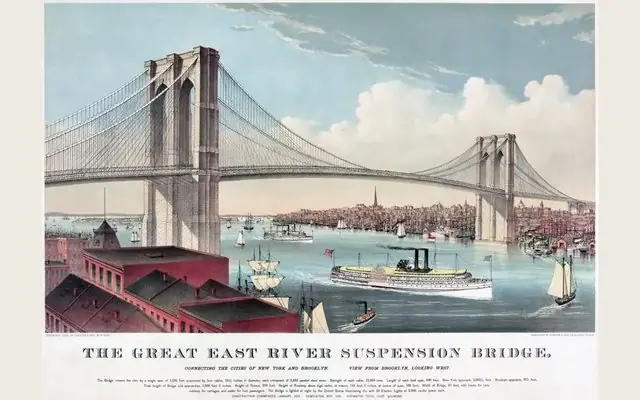
Brooklyn Bridge opened on May 24, 1883, linking New York and Brooklyn across the East River. At that moment they were separate cities; the familiar description of a connection between two New York City boroughs belongs to a later political arrangement. The crossing became a visual emblem almost immediately, but its engineering significance was more than a striking silhouette. A high suspended roadway had to carry people across a busy waterway while allowing shipping to pass beneath it. The project required its builders to coordinate work above the river, below it, and well inland on either shore.
John A. Roebling developed the design but died before construction began. His son Washington became chief engineer and oversaw the difficult work that followed. Construction extended from 1869 to 1883. Washington's illness later restricted his ability to be physically present at the site, making communication and the organization of responsibility particularly important. Emily Warren Roebling took on substantial duties in the enterprise. Her contribution should neither disappear behind the names of the chief engineers nor be turned into a simplified claim that one person independently built the whole bridge. The crossing depended on a much larger working community.
The bridge beneath the skyline
The stone towers draw the eye upward, yet their foundations direct attention in the opposite direction. Building stable supports in a river required caissons: large structures through which workers could reach and excavate the riverbed under compressed air. Such operations made possible work that ordinary dry construction methods could not accomplish. They also exposed laborers and engineers to serious hazards. The spectacular completed bridge can obscure this stage because the foundations are largely invisible to a person crossing the roadway. Understanding them changes the view. The towers are not isolated monuments but the visible continuation of structures rooted beneath the water.
Height created another set of problems. The roadway needed sufficient clearance for vessels using the East River, but the adjoining shores were comparatively low. Long approaches carried the route inland so that it could rise to the required elevation. Those approaches made the bridge an urban intervention as well as a river crossing. Its footprint extended into streets and neighborhoods, connecting structural geometry with the organization of everyday movement. The recognizable central span is therefore only part of the project. Approaching roads, anchorages, towers, cables, and deck all had to work together as a continuous means of transport.
Four cables and a shared undertaking
The suspension system used four great cables made from thousands of individual steel wires. Steel offered advantages over the iron wire associated with earlier bridge practice, including the possibility of reducing weight for a given structural task. The individual wires had to become a dependable collective system, with forces transmitted through the cables to massive anchorages. This relationship between many small elements and one apparently simple sweeping curve is central to the bridge's appearance. What looks like a line drawn across the sky is actually an organized material assembly whose effectiveness depends on manufacture, placement, connection, and inspection.
The main span measured about 1,595 feet, making it the longest suspension span when completed. That record should be understood as a comparison within a particular structural category and moment in time, rather than a timeless claim of supremacy. The bridge also brought together masonry, metalwork, transport planning, and construction management. Its achievement cannot be reduced to one unprecedented component. The demands came from coordinating the components at a scale large enough that failures of communication, supply, or workmanship could have serious consequences. Celebrating the design without considering the conditions of its realization leaves much of the historical problem unexplained.
Opening day was only a beginning
Opening festivities did not remove all the dangers associated with a new mass crossing. The Library of Congress's newspaper guide records the fatal stampede of May 30, only days after the inauguration. Contemporary reporting provides evidence of public excitement as well as anxiety and loss. Later decades brought different demands. A major reconstruction between 1944 and 1954 strengthened and altered the bridge, with changes to transport arrangements and roadway capacity. The structure familiar from photographs was thus continually adapted. Its long service was supported by intervention, not by leaving every detail exactly as the first users encountered it.
Brooklyn Bridge remains compelling because its public image and its less visible history belong together. The towers and cables invite admiration, while foundations, approaches, workers, and subsequent repairs explain how the crossing became usable and remained useful. A historical view does not diminish the beauty of the silhouette. It gives that beauty a material and social setting. The bridge joined two cities through an extraordinary engineering undertaking, and its continuing presence records the less dramatic work required after an opening ceremony: inspecting, adjusting, maintaining, and deciding how an inherited structure should serve another generation.