A fast ship for a competitive cargo
Cutty Sark was built in Scotland in 1869 for a business in which time could affect the value of a cargo. The clipper was intended to bring tea from China to Britain quickly under sail. Its famous speed therefore belonged to a commercial setting rather than to a sporting contest conducted for its own sake. Buyers' demand for newly arrived tea encouraged competition among ships and their crews. Yet the trade for which the vessel had been designed was already changing. The long career that followed would depend on finding other uses for the ship's capabilities.
Owner John Willis and designer Hercules Linton were central to the original enterprise, with construction undertaken at Dumbarton. The vessel's composite construction combined an iron framework with timber planking. That arrangement is important because the ship does not fit a simple story in which wooden sailing vessels were suddenly replaced by iron steamships. Builders selected materials for particular tasks and combined them within one hull. The resulting structure carried a demanding sailing rig, whose performance depended on the lines of the vessel, the state of the sea, and the work of the people handling the sails.
Changing routes changed the competition
The maiden voyage began from London in February 1870. Tea trading linked the ship to distant ports, loading arrangements, markets, and expectations about the timing of arrival. A fast hull alone could not determine every passage. Weather, damage, decisions at sea, and work in port all influenced the result. Looking at the ship only through a record time can therefore conceal much of its working history. The clipper was a means of moving goods through a complex system, and its commercial usefulness depended on circumstances that extended well beyond what a naval architect could control.
Steamships altered that system. They offered a different relationship with wind and schedules, and the opening of the Suez Canal in 1869 changed the geography of the route to Asia. The effect was not that every sailing vessel instantly ceased to be useful. It was that a ship's advantages had to be judged against different costs, routes, and competitors. Cutty Sark's later employment shows this distinction particularly well. A vessel built to excel in one trade could remain valuable elsewhere even when technological and commercial changes weakened the original reason for building it.
A working vessel acquired several identities
From the 1880s, Australian wool became an important cargo, and the ship achieved a lasting reputation for fast passages in that trade. This was a second commercial context for its sailing qualities, not merely a continuation of the first under a different cargo label. Routes, seasons, ports, and competitors changed. The transition helps explain why an old ship can be historically revealing through the sequence of its employments. Its structure supplied a set of possibilities, while owners and crews sought circumstances in which those possibilities could still be turned into useful voyages and income.
Portuguese ownership brought another chapter in the 1890s, with the ship carrying varied cargoes before it later returned to British hands. Subsequent use as a training vessel changed its purpose again. Such transitions complicate a familiar heritage image in which a celebrated ship seems to pass directly from its most famous voyage into a museum. Working vessels often survive through less celebrated employments. Their continued usefulness can postpone destruction long enough for people to decide that historical significance, rather than carrying capacity or training potential, justifies a further effort to preserve them.
Preservation became another engineering task
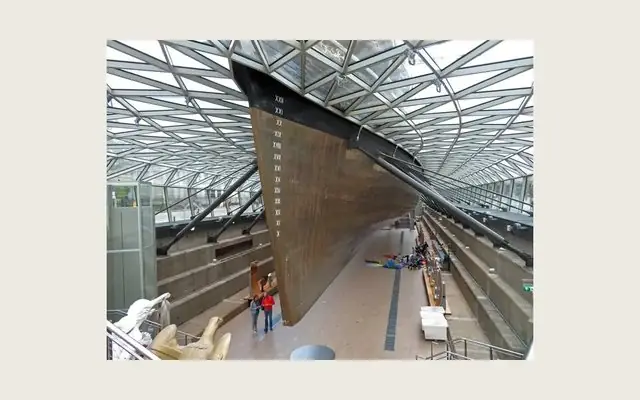
Cutty Sark entered its purpose-built Greenwich berth in 1954. Preservation then presented challenges that differed from keeping a ship afloat and sailing. Supports, corroding iron, timber condition, and the stresses within the hull all required attention. Later conservation introduced new structural arrangements and a sheltered visitor space beneath the vessel. The great fire of 2007 also became part of its modern history, followed by reopening in 2012. The surviving ship should consequently be understood through maintenance and intervention, with historic fabric and modern support systems identified rather than imagined as an untouched vessel from 1869.
Cutty Sark's career is a story of changing usefulness. A tea clipper became a wool carrier, a ship under another flag, a training resource, and a preserved historical structure. Those identities do not diminish the achievement of its original design. They explain how that design encountered a world that would not remain fixed around it. The ship's graceful form still makes its sailing ambition visible, but its longer lesson lies in adaptation: the same hull could acquire new purposes as technology, trade, ownership, and public ideas about preservation changed around it.