A vessel acquired a final purpose on land
The Oseberg ship was built to move through water, but its extraordinary survival depended on a final use on land. In 834, it became part of a burial for two women near what is now Tønsberg in Norway. The vessel and its contents were covered by a mound, preserving timber and objects that would otherwise have been vulnerable to decay or reuse. The result is exceptional evidence of Viking Age craftsmanship and ceremony. It is also a reminder that a ship's archaeological history can be shaped by a purpose very different from the one for which it first sailed.
Built in the early ninth century, the vessel could be sailed and rowed. Its surviving form displays the skilled joining of overlapping planks and the elaborate carving associated with the Oseberg find. The ship was not simply an ornamental object made to look maritime for a funeral. Evidence of its construction and earlier life belongs beside the burial arrangement. Those stages should remain distinguishable. A vessel's use at sea, its selection for a grave, and its position beneath a mound provide different kinds of information, even though they became parts of the same surviving archaeological object.
A rich burial did not preserve a complete biography
The burial contained a remarkable range of objects, including a decorated wagon, sledges, beds, textiles, household equipment, and animal remains. Such an assemblage helps researchers investigate craft, material resources, and funerary practice. It does not give direct access to every motive behind the ceremony. Objects selected for a burial were placed within a particular ritual and social setting; they cannot automatically be read as an inventory of everyday life exactly as it was lived. Their value increases when their locations and relationships are considered, rather than treating each impressive item as an isolated treasure.
The remains of two women are central to the find, but their identities remain unknown. Suggestions involving named royal figures or a simple division between a queen and her servant have not become secure identifications. Rich grave goods indicate importance without supplying names, precise offices, or an unambiguous relationship between the individuals. This distinction is especially valuable in a discovery that so readily invites storytelling. A responsible account can explain what the evidence suggests while leaving the unknowns visible. The women do not need invented biographies to make the burial historically significant.
Excavation began another long phase of work
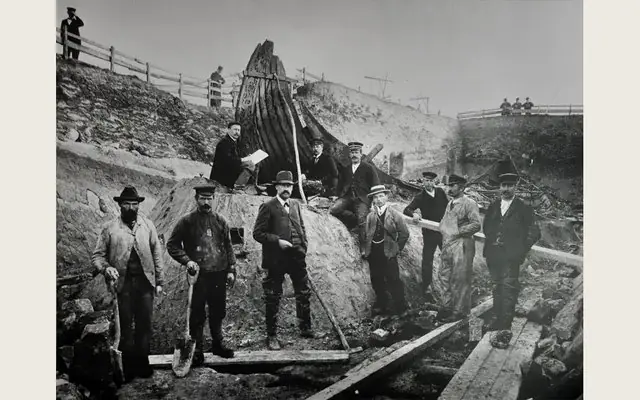
The ship was identified in 1903, and the major excavation began in 1904 under Gabriel Gustafson with Håkon Shetelig and other specialists. Drawings, photography, and notes helped record the find as it was uncovered. That work mattered because excavation changes a site irreversibly. Once objects are removed and the mound opened, the original relationships cannot simply be recreated by returning everything to the ground. Documentation preserves evidence of context that the conserved objects alone may no longer display. The history of the find consequently includes the methods of its investigators as well as the activities of the people who made the burial.
The grave had also been entered before modern excavation. It was not a sealed capsule that remained wholly undisturbed from 834 until the twentieth century. That earlier disturbance complicates the interpretation of missing objects and the arrangement encountered by archaeologists. After excavation, conservation and reconstruction took many years. Drying and supporting the surviving wood required care, while damaged or absent portions demanded decisions about the vessel's shape. A high proportion of original timber could survive without every relationship among the pieces remaining self-evident. Material authenticity and certainty of reconstruction are related questions, but they are not identical.
Reconstruction remained a question to investigate
Later work on reconstructed sailing versions prompted renewed investigation of the hull form. Roskilde's Viking Ship Museum describes how an unsuccessful sea trial in 1987 contributed to questions about the earlier reconstruction. New recording and analysis in the following decades examined the surviving pieces again. This does not mean a replica's behavior can be transferred directly to the ninth-century ship without qualification. It shows how experimental work can generate questions that send researchers back to the archaeological evidence. Reconstruction becomes a way of testing interpretations rather than a final picture exempt from further examination.
Oseberg's enduring importance lies in the richness of its evidence and the openness of the investigation around it. The vessel preserves shipbuilding, carving, burial practice, and objects associated with two women of substantial status, while still withholding their names and much of their story. Its modern life adds another layer of evidence about excavation, conservation, and interpretation. Keeping those layers separate makes the find more revealing. The ship was once a means of travel, then a setting for remembrance, and later a source through which successive generations have reconsidered what they can responsibly know about the Viking Age.