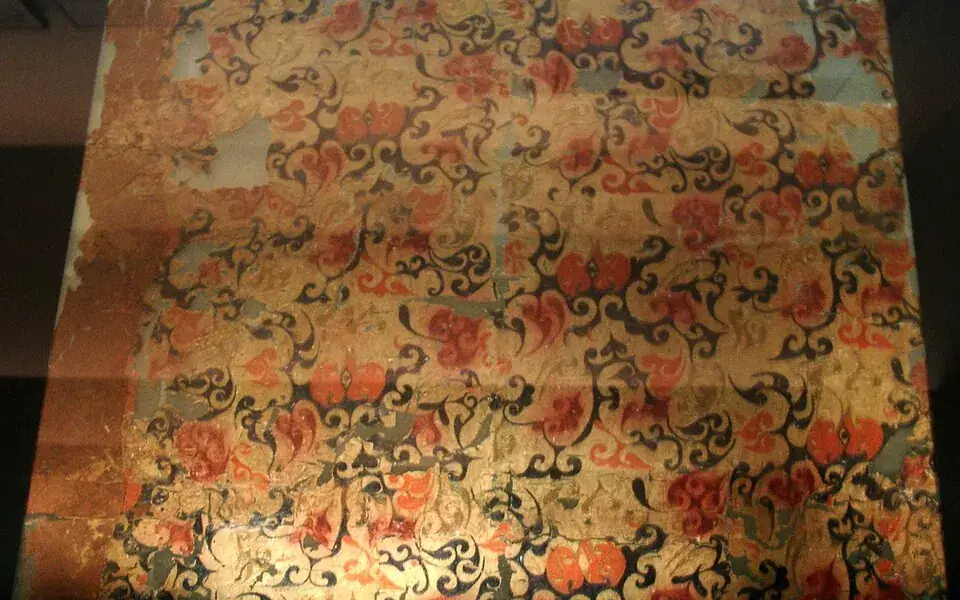
Silk production combines silkworm rearing, reeling, and weaving. Reeling turns the filaments from cocoons into usable threads, which can then be woven into fabrics.
Ancient Chinese silk weaving developed varied structures and patterns. As a commodity and a gift, silk had a lasting influence on exchange across Eurasia.
Production process
The process of silk production is known as sericulture. Extracting raw silk starts by cultivating the silkworms on mulberry leaves. Once the worms start pupating in their cocoons, the cocoons are immersed in boiling water to remove the sericin and free the end of the silk filament, which is then reeled off in one continuous length. Unlike most other natural fibres, silk is not spun.
To produce 1 kg of silk, 104 kg of mulberry leaves must be eaten by 3000 silkworms. It takes about 5000 silkworms to make a pure silk kimono. The most important silk producers are China (54%) and India (14%).
The environmental impact of silk production is potentially large when compared with other natural fibers. A life-cycle assessment of Indian silk production shows that the production process has a large carbon and water footprint, mainly due to the fact that it is an animal-derived fiber and more inputs such as fertilizer and water are needed per unit of fiber produced.
China
Silk use in fabric was first developed in ancient China. The earliest evidence for silk is the presence of the silk protein fibroin in soil samples from two tombs at the neolithic site Jiahu in Henan, which date back about 8,500 years. The earliest surviving example of silk fabric dates from about 3630 BC, and was used as the wrapping for the body of a child at a Yangshao culture site in Qingtaicun near Xingyang, Henan.
In July 2007, archaeologists discovered intricately woven and dyed silk textiles in a tomb in Jiangxi province, dated to the Eastern Zhou dynasty roughly 2,500 years ago. Although historians have suspected a long history of a formative textile industry in ancient China, this find of silk textiles employing "complicated techniques" of weaving and dyeing provides direct evidence for silks dating before the Mawangdui-discovery and other silks dating to the Han dynasty (202 BC – 220 AD).
Silk is described in a chapter of the Fan Shengzhi shu from the Western Han empire (202 BC – 9 AD). There is a surviving calendar for silk production in an Eastern Han empire (25–220 AD) document. The two other known works on silk from the Han empire are lost. The first evidence of the long distance silk trade is the finding of silk in the hair of an Egyptian mummy of the 21st dynasty, c.1070 BC. The silk trade reached as far as the Indian subcontinent, the Middle East, Europe, and North Africa. This trade was so extensive that the major set of trade routes between Europe and Asia came to be known as the Silk Road.
Ancient Mediterranean
In the Odyssey, 19.233, when Odysseus, while pretending to be someone else, is questioned by Penelope about her husband's clothing, he says that he wore a shirt "gleaming like the skin of a dried onion" (varies with translations, literal translation here) which could refer to the lustrous quality of silk fabric. Aristotle wrote of Coa vestis, a wild silk textile from Kos. Sea silk from certain large sea shells was also valued. The Roman Empire knew of and traded in silk, and Chinese silk was the most highly priced luxury good imported by them. During the reign of emperor Tiberius, sumptuary laws were passed that forbade men from wearing silk garments, but these proved ineffectual.
The Historia Augusta mentions that the third-century emperor Elagabalus was the first Roman to wear garments of pure silk, whereas it had been customary to wear fabrics of silk/cotton or silk/linen blends. Despite the popularity of silk, the secret of silk-making only reached Europe around AD 550, via the Byzantine Empire. Contemporary accounts state that monks working for the emperor Justinian I smuggled silkworm eggs to Constantinople from China inside hollow canes. All top-quality looms and weavers were located inside the Great Palace complex in Constantinople, and the cloth produced was used in imperial robes or in diplomacy, as gifts to foreign dignitaries. The remainder was sold at high prices.