A token that could identify a child
A scrap of ribbon, a marked coin, or a small ornament could carry an immense responsibility at London's Foundling Hospital. Between the 1740s and 1760s, people bringing babies into its care left such objects as identifying tokens. Children received new names on admission, so a parent hoping to return needed a way to demonstrate a connection that the institution's public identity no longer displayed. The objects were kept in the archive rather than handed to the children. What looks like a collection of modest possessions was once part of a system for keeping the possibility of reunion alive.
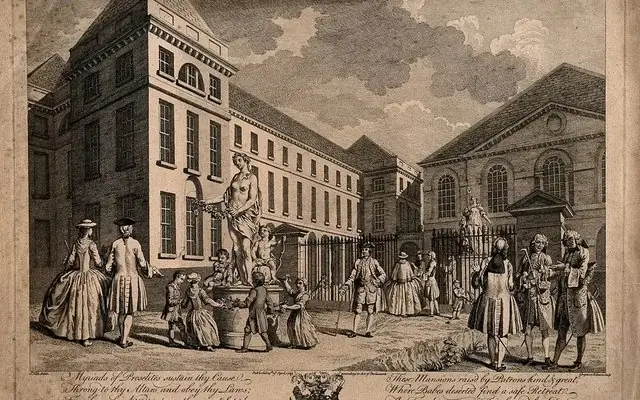
The institution itself grew from Thomas Coram's campaign to help babies whose mothers could not care for them. King George II signed its royal charter on 17 October 1739, and the first admissions began on 25 March 1741. Coram's supporters included prominent figures from the arts and public life. Care involved more than the imposing London building: young children were placed with foster families before returning for education, and older pupils later entered apprenticeships. Behind this administrative journey stood individual families facing poverty and social pressures, often with very limited choices about where to seek help.
Admission by chance and proof by record
A place was not always available simply because a baby needed one. In October 1742 the governors introduced a lottery to replace admission by order of arrival. A black ball meant refusal; a white one gave a child the chance of admission, subject to examination and the age rules. Red balls offered a further opportunity if places remained after those examinations. The arrangement was intended to avoid favoritism, but it made access depend on chance as well as eligibility. The colored balls reveal how sharply demand for care could exceed the institution's capacity to provide it.
For an admitted child, officials completed a document called a billet and sealed identifying material inside it. Anyone returning to claim the child could be asked to describe that material. Its usefulness therefore depended on keeping its details private. Parliamentary funding brought a broader admission system in June 1756, and the Hospital began issuing receipts in 1758. Receipts removed the official need for tokens, although objects that arrived were still stored. These changes matter because the surviving collection did not emerge from one unchanging procedure. Its contents reflect adjustments to registration, admission, and proof of identity over time.
What a scrap of fabric can tell us
Fabric survives in especially large quantities. Historian John Styles describes roughly five thousand textile scraps in the Hospital archives, a remarkable resource for understanding ordinary eighteenth-century clothing. Poor working women seldom left complete wardrobes for museums to collect, but small pieces of printed cotton, checked linen, and colored ribbon remained attached to institutional paperwork. These were often used fabrics rather than newly purchased gifts. Their patterns could be distinctive enough to remember, while their modest cost put them within reach of people who could not afford expensive objects. Tiny fragments preserve a material world that larger monuments rarely reveal.
It would be misleading, however, to imagine that every surviving swatch records a mother's deliberate personal selection. During periods of heavy admissions, nurses and clerks sometimes cut identifying pieces from the clothing a baby wore when no separate token had arrived. Other scraps do bear names, initials, dates, or words sewn or written onto them, offering stronger evidence of an intentional message. The difference asks us to look closely at both object and record. A beautiful ribbon can be moving without supplying a complete biography, and a plausible emotional interpretation is not the same as a documented fact.
Keeping objects connected to lives
The later history of collecting introduced another difficulty. In the nineteenth century some tokens were removed for display without a record of which child's billet had contained them. Objects survived, but their links to particular lives were lost. Researchers have since matched some tokens back to individuals through careful archival work, although many connections may never be recovered. The museum holds around four hundred object tokens, alongside the much larger paper and textile collections in the archives. Their value lies partly in this uncomfortable lesson: preserving a thing is not enough if the information connecting it to a person disappears.
Modern digitization allows those connections to be investigated more widely. Coram's online archive brings together images and transcriptions of registers, mothers' petitions, and other records, including material associated with tokens. These documents can place an object beside a request for assistance or a child's later movements through care and employment. They cannot return every missing name or explain every separation. They do let readers move beyond an anonymous display toward the evidence of particular lives. The Foundling tokens are compelling because they join ordinary materials to a serious question: how can a family remain identifiable inside a system that renames its children?