Two travelers above a familiar sea
On January 7, 1785, Jean-Pierre Blanchard and John Jeffries left Dover in a balloon and reached France. The English Channel had been crossed by countless ships, but never before by people traveling through the air. Their success depended on a fragile envelope of gas, the movement of the wind, and decisions about how much weight they could afford to carry. It also produced an unusually memorable detail: when the balloon descended dangerously toward the water, the men lightened their load with equipment and much of their clothing.
The crossing followed the spectacular beginnings of human balloon flight in France in 1783. Different methods of producing lift had quickly emerged. The Montgolfiers used heated air, while Jacques Charles and the Robert brothers demonstrated hydrogen. The latter gas is less dense than the surrounding atmosphere and can lift a balloon without a fire heating the air inside it. Blanchard used a hydrogen balloon for his Channel expedition. Distinguishing the systems matters because early prints and later descriptions sometimes loosely call almost any eighteenth-century balloon a hot-air balloon.
Lift was easier than steering
Blanchard brought practical experience and a talent for publicity. Jeffries, a Boston-born physician living in Britain, supplied financial backing and had scientific interests of his own. They had already flown together from London into Kent on November 30, 1784. Jeffries's published narrative described both that flight and the Channel crossing, together with meteorological observations. The expedition thus belonged to several overlapping enterprises: an experiment in atmospheric measurement, a dangerous journey, and an opportunity to claim public credit. Funding a flight did not automatically make its personalities easy to manage.
There was a basic difference between rising into the air and choosing a dependable route across a sea. Blanchard experimented with devices intended to control a balloon, including flapping arrangements, but the crossing depended on favorable wind. The men could alter their altitude by managing lift and weight; they could not steer like the pilot of a powered airplane. A departure from the English coast therefore involved trust in conditions over the water as well as confidence in the craft. Watching a balloon leave land was exciting partly because its return or destination could not be guaranteed.
A dangerous calculation of weight
As they traveled over the Channel, the balloon lost sufficient height to make the sea an immediate danger. The response was to discard weight. The familiar story of their undressing was not simply a later comic embellishment: the Library of Congress's account of Jeffries's narrative records that they threw over most of their clothing along with other contents. The incident exposes the narrow margin on which their flight depended. Objects taken aloft as equipment or personal necessities could become expendable when the alternative was touching down in cold water.
They reached the French coast and completed the journey on land. Accounts commonly describe the crossing as Dover to Calais, identifying the ports on opposite shores; the landing associated with the flight was inland near Guînes. Neither phrasing should suggest a scheduled service between two prepared airfields. The important result was that the water barrier had been passed by air. The outcome did not establish that balloons were safe or readily controllable transport. It demonstrated a possibility while leaving much of the practical problem of dependable flight unresolved.
The flight in print and on paper
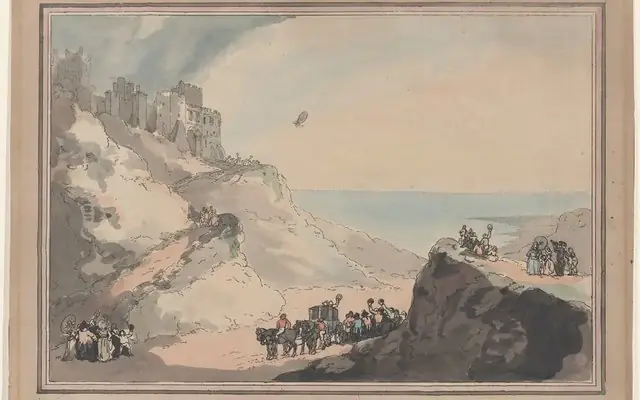
Artists quickly made such flights visible to people who had never watched an ascent. The accompanying hand-colored etching by Thomas Rowlandson shows the departure from Dover, with the cliffs, spectators, and tiny airborne craft sharing a wide landscape. The Metropolitan Museum dates the print to January 1794, nine years after the event named in its title. It is therefore a historical representation of the crossing, rather than a photograph or a visual record made at the exact moment of takeoff. Its distant balloon makes human ambition look small against the coast and sky.
Jeffries later presented an account to the Royal Society, preserving observations alongside the journey's drama. Reading that kind of record beside an exhibition print reveals different ways an early flight could survive. One organized measurements and recollections; the other made an attractive scene for viewers. Together they show why the crossing held attention. It joined a recognizable stretch of European geography to an entirely unfamiliar kind of travel. The celebrated breakthrough was achieved by two people who, for part of the journey, could improve their prospects only by throwing things away.