Freedom across an imperial border
For some people escaping slavery in the eighteenth-century Carolinas, the direction of freedom was south. Spanish Florida offered a refuge across the frontier between rival empires. In 1738, Governor Manuel de Montiano established Gracia Real de Santa Teresa de Mose near St. Augustine. Commonly called Fort Mose, it became the first legally sanctioned free Black settlement in what is now the United States. Its residents had not waited for a general emancipation: they had fled their enslavers and sought a place where an imperial boundary could become a boundary between bondage and freedom.
That opportunity grew from a calculation as well as a promise. A Spanish royal decree of 1693 offered sanctuary to people escaping English slavery, with religious and service obligations. Refugees were expected to embrace Catholicism and serve the Spanish Crown. The arrangement weakened English plantations while bringing workers and defenders into a vulnerable colony. It should not be mistaken for a Spanish commitment to universal emancipation. Slavery continued in Spain's American possessions, including Florida. Mose's residents secured a particular legal status within that unequal system, using the rivalry between colonial powers to open a path for themselves.
A village beyond the military record
The settlement stood roughly two miles north of St. Augustine, where waterways and overland routes made a defensive outpost useful. A small earthen fort was part of a living community. Families farmed, attended church, and maintained households while men performed military duties. Documents examined by historian Jane Landers describe a village of twenty-two palm-thatched huts in 1759, housing thirty-seven men, fifteen women, seven boys, and eight girls. Those figures make the social scale tangible: the place was sustained by children and domestic work as well as guards, weapons, and frontier patrols.
The women's history also shows how uncertain the journey into freedom could be. The National Park Service identifies Ana Maria de Escovar among Mose's residents. She and her husband, Francisco Menéndez, escaped Carolina but experienced further captivity in the borderlands. Their petitions for freedom were initially refused, even though Spain had advertised sanctuary. A later petition under Montiano succeeded in 1738. Her story complicates any smooth account of refugees arriving and immediately becoming free. Colonial promises still had to be pursued through officials and changing circumstances, while families faced dangers that a decree on paper could not remove.
A community exposed to war and diplomacy
Military protection carried its own exposure. During James Oglethorpe's campaign against St. Augustine in 1740, British forces took Fort Mose and its people withdrew into the town. Menéndez and other defenders participated in the counterattack that recovered the position, but the fighting left the fort badly damaged. Mose was not simply rebuilt the following week. Its inhabitants spent years in St. Augustine before a new fort was constructed nearby in 1752. The Florida Museum reports that former residents returned reluctantly, under official pressure: a community's preference for town life could conflict with the colony's demand for a frontier shield.
The next decisive change arrived through diplomacy. In 1763, Spain transferred Florida to Britain, and the people of Mose departed for Cuba with other inhabitants of Spanish St. Augustine. Their freedom had depended partly on a political geography that the peace settlement suddenly redrew. Leaving a home could therefore be part of preserving what flight and service had won. The episode gives the fort a history extending beyond a single founding date. Mose was an achievement maintained through war, rebuilding, and relocation, rather than a permanent guarantee secured once and then left untouched.
Recovering a lived landscape
Much of that everyday history later had to be recovered from small remains. Kathleen Deagan's Florida Museum team investigated Mose between 1986 and 1988, combining excavation with archival research. A moat and traces of structures helped reveal the fort; gunflints and bullets recorded its defensive purpose. Thimbles, ceramics, glass, and food remains pointed toward other tasks. These objects cannot supply every resident's thoughts, but they widen a story that military correspondence might reduce to manpower and strategy. A sewing implement or a fragment of a meal asks us to consider how people actually sustained the community they defended.
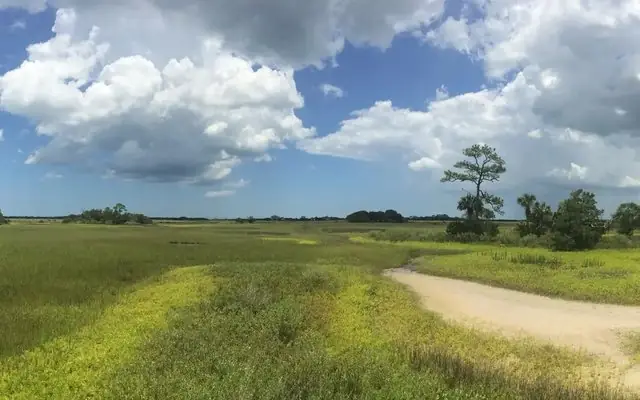
The marshland shown in the accompanying photograph is the modern landscape at Fort Mose, photographed in 2015, rather than a surviving eighteenth-century fort. Understanding the difference is part of caring for the evidence. Research has continued: a National Park Service preservation grant awarded in 2021 supported further archaeological assessment by the University of Florida. Excavation and interpretation can keep refining what is known without pretending that every detail has been recovered. The site's importance rests in that combination of knowledge and remaining questions, and in the families who made freedom a lived, demanding project on an imperial frontier.