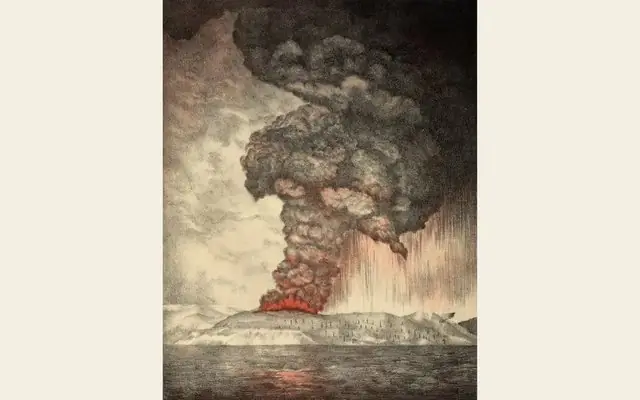
A catastrophe with distant witnesses
The eruption of Krakatoa reached people who would never see the volcano. During the destructive climax of August 26 and 27, 1883, communities around the Sunda Strait faced darkness, falling volcanic material, and devastating tsunamis. Farther away, observers encountered different signals: unexplained reports like distant artillery, disturbances on weather instruments, and unusually colored skies. The catastrophe occurred between Java and Sumatra, in present-day Indonesia, but its physical effects did not stop at the surrounding coast. Understanding those effects required connecting events that initially seemed local to the people who heard, measured, or watched them.
The August disaster had a prehistory visible to travelers and investigators. NOAA's National Centers for Environmental Information describes a warship captain observing an ash cloud in May, followed by reports from commercial vessels and scientific expeditions. These accounts preserved the changing behavior of a volcano before its most destructive phase. They also show the limits of recognizing a warning in retrospect. A conspicuous plume could become an object of curiosity without revealing the scale of what was coming. The same maritime routes that brought witnesses within sight of Krakatoa later helped carry information about its aftermath.
Hearing and measuring were different kinds of evidence
Sound provided one of the eruption's most striking distant effects. The Smithsonian's atmospheric exhibition reports that the explosion was heard about 4,800 kilometers away. Such reports concerned a disturbance traveling through the air, not people hearing an eruption everywhere on Earth. Distance also changed interpretation. Someone who heard detonations without seeing a volcano had to compare them with familiar sounds, including guns. A dramatic report could therefore be valuable without being self-explanatory. Its usefulness increased when investigators could identify where the listener had been and compare that account with evidence from other places.
Instruments supplied a second kind of record. Acoustician Thomas Gabrielson describes more than fifty weather stations recording the pressure wave, with some registering as many as seven passages as it traveled around the globe. A barograph turned changing atmospheric pressure into a trace that could be inspected after the event. The pulse appeared at different times in distant cities and then returned by another route. Comparing those traces made a moving disturbance visible on a planetary scale. An account of a loud noise and a pressure recording were related evidence, but they were not interchangeable measurements.
An altered sky became an archive
The sky carried a slower aftermath. Volcanic sulfur dioxide and water vapor helped produce sulfuric-acid aerosols high in the atmosphere. The Smithsonian explains that light scattering from these circulating particles generated extraordinary sunsets. This mechanism is more informative than imagining a permanent blanket of heavy ash hanging over every country. Material could alter the passage of sunlight far from the eruption, making evening colors part of a shared atmospheric event. The striking beauty of those effects did not lessen the destruction near Krakatoa; it demonstrated how differently one disturbance could appear at different distances.
Artists and letter writers became observers of that altered sky. The Royal Society preserves sunset studies made by William Ascroft at Chelsea on November 26, 1883, along with descriptions sent from other locations. Color drawings recorded changing appearances that ordinary written labels could only partly convey. Letters supplied dates, positions, and comparisons with familiar sights. Their authors were not all professional investigators, yet their observations could enter a scientific collection. A useful record depended less on whether its maker stood beside the volcano than on what had been noticed and how carefully it was documented.
From scattered reports to a shared investigation
The Royal Society's Krakatoa Committee requested information about falling dust and pumice, pressure disturbances, sea levels, sulfurous vapors, sounds, and unusual light. Responses included letters and physical specimens from around the world. Bringing them together changed the unit of investigation: a collection could reveal connections that no single witness could establish alone. It also demanded judgment. A vivid description was not automatically a precise measurement, and reports needed their locations and circumstances preserved. The resulting archive joined personal experience with instruments and material samples, retaining differences rather than reducing everything to one spectacular account.
Geological investigation proceeded alongside that international correspondence. Linda Hall Library's account describes Rogier Verbeek gathering observations, testimony, and official information for a report published in 1885. The Royal Society's larger synthesis followed in 1888, incorporating geological and atmospheric evidence. These publications were products of sustained work after the explosions had ended. Krakatoa's historical importance therefore includes the way its effects were assembled into knowledge. A devastated island, a barograph trace, and a painted sunset could belong to the same investigation, provided researchers kept track of what each record could actually tell them.