One name for many separate encounters
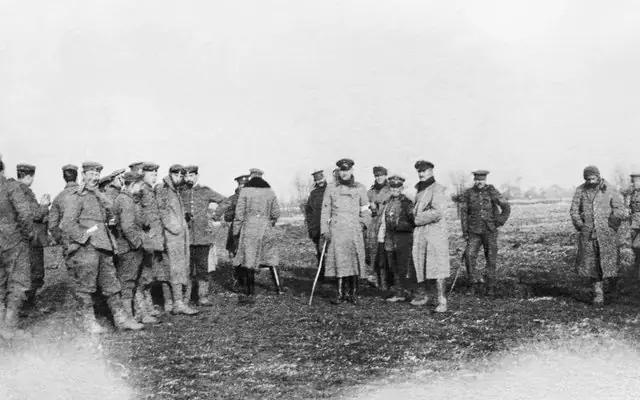
A group of soldiers standing together in a field can look unremarkable until their uniforms reveal that they belonged to opposing armies. At Christmas 1914, meetings like these briefly became possible in parts of the Western Front. The name Christmas Truce makes the episode sound like one agreed event. It was instead a collection of local, unofficial ceasefires. Some men left their trenches and shook hands; others merely stopped shooting. Elsewhere, fighting continued. That unevenness is essential to understanding what the participants could actually choose, witness, and remember.
Christmas offered recognizable signals across a dangerous divide. Accounts collected by museums describe songs, lights, greetings, and decorated trees. The National WWI Museum preserves the recollection of British gunner Herbert Smith that a lull on Christmas Eve accompanied a German tree in the trenches. Another letter describes illuminated greetings opposite the British line. Such gestures did not provide a guarantee of safety. They did make it possible to test whether voices that normally arrived with threats could carry something else. The first exchanges depended on what happened within hearing distance.
The diaries record different Christmases
The National Army Museum's diaries preserve several different versions. Rifleman William Eve recorded men standing on the parapet, exchanging greetings and souvenirs, and meeting the Germans on December 25. Lieutenant-Colonel Schoolbred described bugles and candle illuminations on Christmas Eve. Other encounters allowed soldiers to recover and bury comrades whose bodies lay between the lines. That work belongs at the center of the story alongside its more cheerful details. A temporary pause could offer a necessary act of mourning without changing either army's orders or the purpose of the war.
One regimental account gives the exchanges a very specific flavor. The Royal Welch Fusiliers Museum describes the 2nd Battalion near Frelinghien, where a Christmas greeting was raised above the parapet. German soldiers offered two barrels of beer and received Christmas pudding. The same account says that the next morning Captain Stockwell fired shots into the air, raised another greeting, and exchanged salutes with Captain von Sinner. This was a local arrangement with a local ending. Its details cannot be transferred automatically to a trench several miles away, where different officers and soldiers faced different circumstances.
Looking carefully at the football story
Football is the best-known part of the modern legend and the part requiring particular care. The National Football Museum distinguishes eyewitness references to informal play from reports of matches heard about farther along the line. Lieutenant Charles Brockbank's diary describes a game after a small rubber ball was found. Another letter reported that an intended game could not happen because there was no ball. Stories about a precise score therefore deserve more scrutiny than their familiarity suggests. Evidence for some improvised kicking does not establish one organized international fixture with agreed teams and rules.
The more common exchanges were modest and portable. Men shared tobacco, food, photographs, or small souvenirs, sometimes communicating with limited language. The National Army Museum notes that parcels from home had brought sweets, puddings, reading matter, and other comforts into wartime life. Meeting an opponent could briefly place such familiar things in unfamiliar hands. A surviving photograph of British and German troops in the Bridoux–Rouge Banc sector records one encounter involving men of the Northumberland Hussars. It shows a gathering, not a football game, and proves only what that particular scene can show.
A pause whose limits still matter
Commanders had reasons to discourage these contacts: their armies were expected to resume fighting. Some junior officers tolerated events, while senior orders opposed friendly relations with the enemy. Different ceasefires ended at different times. The Royal Welch Fusiliers Museum also records a more limited Christmas truce involving the regiment in 1915, so saying that nobody ever repeated such behavior would go too far. The wider 1914 pattern did not become an annual agreement. Personal goodwill and brief practical cooperation were not enough to replace the military and political machinery of the conflict.
Remembering the truce responsibly preserves both its warmth and its boundaries. A letter may report what its author saw, what another unit was said to have done, or what the writer hoped a family at home would understand. Those are different kinds of evidence. Putting them beside regimental accounts and photographs produces a richer picture than either accepting every later embellishment or dismissing the whole episode as a myth. The meetings mattered precisely because they were temporary and uncertain. For a short time, some soldiers recognized neighbors in the people they would soon be ordered to fight again.