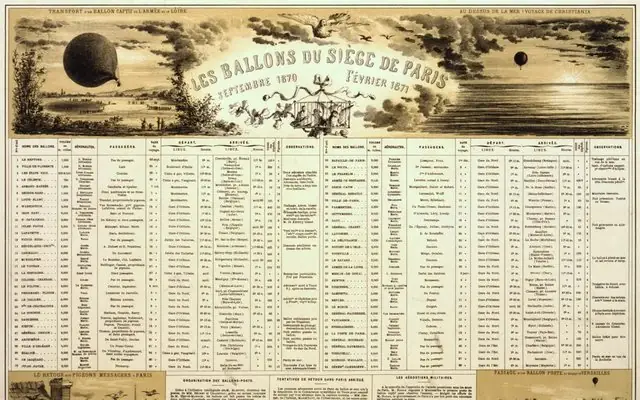
A postal route above the siege
When Paris was surrounded during the Franco-Prussian War, a letter could leave the city by taking to the sky. Railway journeys and ordinary postal routes could no longer connect the capital with the rest of France, but a balloon might cross the lines above the soldiers. On September 23, 1870, the Neptune rose with mail aboard. What followed was an improvised postal network with an unusual distinction: sending a message out and bringing an answer back required different carriers.
The first machines were available balloons pressed into emergency service. France's Air and Space Museum describes the rapid change from borrowing existing equipment to making new balloons specifically for the siege. The Godard brothers established a workshop at the Gare d'Orléans, while Nadar and his balloon company occupied the Gare du Nord. Railway stations offered a useful resource even when normal railway communication had broken down: their enormous covered spaces. Under those roofs, workers could assemble the vast fabric envelopes and leave their protective varnish to dry.
The workers behind the ascent
The work depended on skills that a dramatic painting of an ascent can easily hide. Women stitched the separate sections of fabric, sailors made the enclosing nets, and other workers wove the basketry. A surviving gondola in the Air and Space Museum is built from wicker, wood, and rope. Its suspension cords run around the sides and floor, connecting the basket to the load-bearing ring above. The museum records demanding specifications for the equipment, and the supplier had to provide the accompanying gear and even the aeronaut. Getting a balloon ready meant coordinating materials, labor, and a pilot, rather than simply filling a bag.
The most famous passenger was Léon Gambetta. On October 7, 1870, he left Paris aboard the Armand Barbès, a balloon supplied by Nadar, to join the government's representatives at Tours. The Bibliothèque nationale de France connects this flight with Nadar's effort to provide a postal service to the besieged city. Gambetta's escape made a powerful political image: a member of the new government could rise above the encirclement and continue his work elsewhere. Yet that celebrated departure should not obscure the less visible cargo. Bags of written messages mattered to people who had no prospect of leaving Paris themselves.
A newspaper with room for a letter
One surviving publication makes the everyday purpose especially clear. Le Ballon Poste was a newspaper designed to travel out of Paris during the siege; the Air and Space Museum preserves its complete run of twenty-two issues. Its news included official measures as well as accounts of the population's hardships and hopes. The paper was therefore both a source of information about the capital and an object shaped by the difficulty of moving information. A reader outside Paris could learn what was happening inside, while a sender inside could use the same printed sheet to maintain a private connection.
The design accommodated both functions. Printed on thin paper with a prescribed weight of three grams, the newspaper left margins where its purchaser could add a personal message. It could then be folded like a letter, stamped for twenty centimes, and handed to the post office. The object joined public events and personal concerns on one lightweight sheet. It also shows why the history of balloon mail cannot be told solely through famous passengers: the postal cargo carried the voices and anxieties of people remaining behind.
Finding a way to bring answers home
A balloon's outward journey did not automatically create a return service. Pigeons taken out in cages provided the other half of the arrangement, carrying messages back toward their Paris lofts. Microphotography reduced the writing so that many dispatches could fit into a small container attached to a bird. Inside Paris, the images were enlarged and copied back onto paper for delivery. The airborne postal network consequently depended on photography, lenses, handwriting, and the pigeon's capacity to return home. The cleverness lay in combining those different abilities.
Albert Tissandier's nineteenth-century lithographic broadside brings several parts of this system into a single image. Its central tables record balloon journeys, while surrounding scenes show balloons, returning pigeons, and a flight over Versailles. The Library of Congress preserves the print, reproduced here in a cropped view. Its combination of lists and illustrations is instructive: the ascents were spectacular, but each journey also had a name, a departure, a destination, and a record of what happened. Balloon post did not end the siege. It helped people work around one of its consequences by turning an aerial adventure into a difficult, practical service.