A visible ship with an uncertain outline
A ship covered in enormous stripes and jagged blocks looks like a strange answer to the problem of being seen. During the First World War, however, conspicuous paint became part of an Allied attempt to protect vessels from submarine attack. Known as dazzle camouflage, the scheme divided hulls into conflicting shapes that could make a familiar ship difficult to interpret. Its purpose was not to erase a vessel from the sea. Marine artist and naval officer Norman Wilkinson wanted an attacker to misread what was plainly visible, turning an observation into a less reliable guide to action.
Wilkinson's explanation began with the circumstances of a submarine observer. A vessel might appear against the sky rather than a convenient background of water, and smoke could announce its presence while the hull was still beyond the horizon. An even coat of paint could do little about those signals. Once the ship came closer, its outline supplied clues about its orientation. The Royal Navy's later account explains the practical stakes: submariners needed to identify a target and estimate its movement before launching a torpedo. Confusing those judgments might matter even when concealment was impossible.
The artist’s instructions for a working illusion
On July 16, 1917, Wilkinson sent Rear Admiral Clement Greatorex a description of the scheme with three representative plans for the information of the United States Navy Board. The surviving letter, reproduced by the Naval History and Heritage Command, is unusually direct about its limitations and intentions. Wilkinson proposed strong contrasts in shapes and colors to disrupt a ship's apparent symmetry and bulk. He also insisted that the pattern had to suit the particular vessel. Small patches would lose their effect at distance; excessively large ones could leave recognizable proportions exposed.
The same document shows that dazzle was a working design process rather than a single decorative pattern. Wilkinson described painting each vessel differently and varying the design between its two sides, so an opponent could not simply learn one standard arrangement. Designs used obtainable colors and flat shapes that could be marked out and painted relatively easily. This combination of visual experiment and practical instruction is part of the scheme's fascination. The desired illusion had to survive the transfer from a drawing to an enormous, three-dimensional hull maintained by people working under wartime conditions.
A large experiment and its uncertain results
The Admiralty approved the idea after experiments with miniature vessels. It spread through British naval and merchant shipping and then among allies. A photograph cataloged by the National Army Museum records the scheme on a dockside vessel, while the museum's description reports that more than 2,300 British merchant ships and warships had received it by mid-June 1918. That scale matters more than the popular image of one eccentric painted liner. Dazzle required a repeated commitment of planning, paint, labor, and maintenance across a large collection of ships with different dimensions and duties.
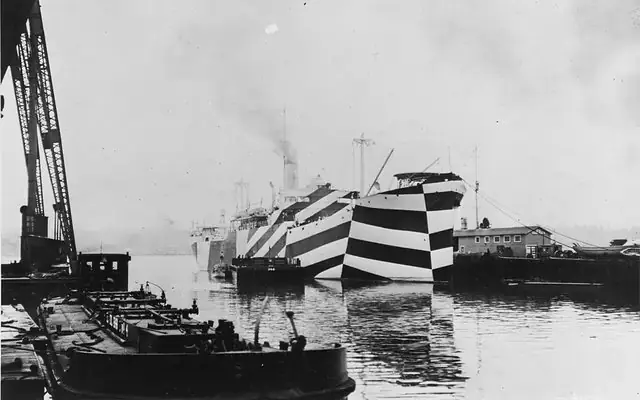
The photograph accompanying this story offers a particularly striking example. Taken around November 1918, it shows the American cargo ship USS West Mahomet in port. The naval archive specifically draws attention to the way the paint alters the apparent shape of the bow. A still photograph lets us inspect that effect carefully, but it cannot reproduce an actual attack through a periscope. Nor does the widespread adoption of a design establish its success. The Navy's commentary on Wilkinson's letter questions the effectiveness of dazzle, a useful warning against treating every patterned hull as proof of a torpedo avoided.
The pattern that returned as an identity
Its visual language nevertheless outlasted the emergency that produced it. Dazzle schemes returned in the Second World War, before improved sensing and optical equipment reduced their role. In April 2021, the Royal Navy announced that patrol ship HMS Tamar had received a new interpretation using grays and black. The Navy described its modern significance chiefly in terms of identity and historical association, while acknowledging much less military value in contemporary conditions. The revived pattern therefore tells a different story from its predecessor: it deliberately recalls a celebrated visual experiment as well as furnishing a distinctive appearance.
Dazzle is memorable because it exposes a gap between seeing an object and understanding it. Wilkinson's proposal treated the observer's interpretation as part of the battlefield. Its drawings and surviving photographs also remind us to separate intention, implementation, and demonstrated result. We can establish what designers hoped to confuse, examine how painters tried to do it, and trace the scheme's extensive adoption. Establishing precisely how much protection it delivered is a harder question. Keeping that uncertainty in view makes the history more interesting than a simple claim that stripes saved ships.