An animal inside a communications system
A small pigeon has acquired an enormous place in the memory of the First World War. Cher Ami is often described as the bird that saved the American Lost Battalion in France's Argonne Forest in October 1918. The familiar version has a wounded messenger returning with a desperate warning that American artillery is striking American troops. There is real courage behind the story, but its neatest details are less secure than they sound. Surviving messages, army records, and a preserved bird reveal both the importance of animal communication and the way a complicated battlefield emergency became a memorable public legend.
Pigeons were useful because industrial warfare could destroy the technologies that seemed to have replaced them. Telephone wires could be broken by shelling, and a human runner might not cross dangerous ground alive. A homing bird offered a different route back to a trained loft. The message still needed to be written, attached, received, and passed onward by people. This was a communication system with feeding, training, transport, and handlers behind each flight. American forces used pigeons for reports and urgent information on the Western Front. Cher Ami belonged to that larger service rather than operating as a solitary miracle.
A surrounded force and a surviving message
The men called the Lost Battalion were actually drawn from several companies of the 77th Division. On October 2, 1918, their advance in the Argonne carried them beyond forces on either flank. German troops then surrounded them. Under Major Charles Whittlesey, they held their position while food, water, and medical resources became desperately scarce. Artillery intended to assist them could also become a threat when their location was misunderstood. The National Archives' account describes five days and nights of resistance before relief on October 7. Getting one message through was crucial, but the siege ended through a larger sequence of military actions.
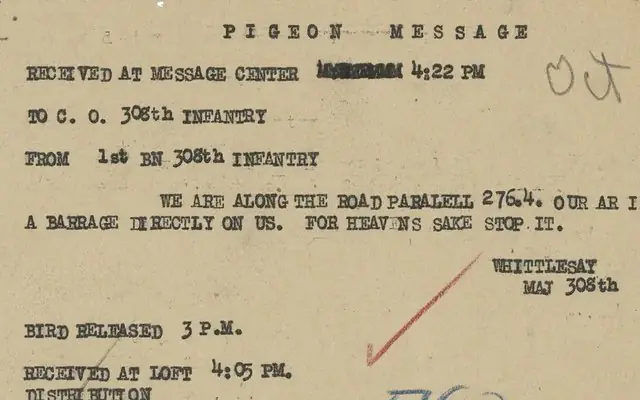
One surviving document puts the communication problem into unusually direct form. Preserved by the National Archives as a pigeon message dated October 4, it identifies Whittlesey's troops' position beside a road and urgently asks for American shelling to stop. Its administrative markings record the bird's release and receipt at a loft. Unlike a later adventure story, the paper does not require a reader to imagine what the commander felt. The problem is visible in the information itself: soldiers who were surrounded needed their own side to know precisely where they were. The document is firm evidence of that urgent exchange.
Where the famous story becomes uncertain
Identifying the particular bird carrying that famous message is more difficult. The Smithsonian's review finds that military records cannot establish which pigeon delivered it. Cher Ami certainly returned from a mission with severe injuries: an army record describes a damaged right leg, a breast wound, and a message tube still attached by a tendon. That record places the flight from Grandpré, complicating the usual identification with the Lost Battalion's warning. Recognizing this distinction does not make the wounds imaginary. It separates evidence for a remarkable wounded bird from a stronger claim about one specific journey and its consequences.
After the war, Cher Ami crossed the Atlantic with other selected military pigeons and reached the United States in April 1919. Public attention helped transform a communications animal into a recognizable veteran. When the bird died that year, the Signal Corps chose preservation rather than burial. Smithsonian taxidermist Nelson Wood prepared the body, and it went on display in 1921. The physical specimen could now carry a story to people who had never seen a military pigeon loft. Films, poems, and repeated newspaper accounts added to its fame, sometimes allowing certainty to grow faster than the surviving documentation justified.
What a preserved pigeon can prove
Even the bird's sex remained unsettled for a century. Wartime paperwork described Cher Ami as a hen, while the Smithsonian used male pronouns. In 2021, Smithsonian researchers tested tiny tissue samples taken from the preserved specimen. Comparisons with other pigeons of known sex helped check that the procedure worked on old material. The results detected the chromosome pattern associated with a male bird, resolving this particular disagreement. DNA could answer a biological question because the animal itself survived as a museum specimen. It could not identify the message carried on a particular afternoon; that remained a question for historical records.
The contrast is what makes Cher Ami's history especially revealing. A preserved animal, a brief message, and a stack of military paperwork do not all answer the same questions. The Army's own command historian has acknowledged scholarship questioning how the traditional account developed and how it helped publicize the pigeon service. It is therefore safer to describe Cher Ami as a badly wounded military messenger associated with the Lost Battalion legend than to assign an exact number of lives saved to one unverified flight. The wider achievement remains substantial: vulnerable living creatures helped soldiers communicate when other connections failed.