An intervention amid uncertainty
On September 8, 1854, the handle of a public water pump in London's Soho district was removed after physician John Snow presented evidence connecting its water with a devastating cholera outbreak. The action has become a famous image of public health: stop an everyday activity, and interrupt a dangerous route of infection. Its significance becomes clearer when we look beyond the handle itself. Snow had assembled records, questioned families, and considered how people actually obtained drinking water. He was arguing for a practical intervention while the cause of cholera remained fiercely disputed.
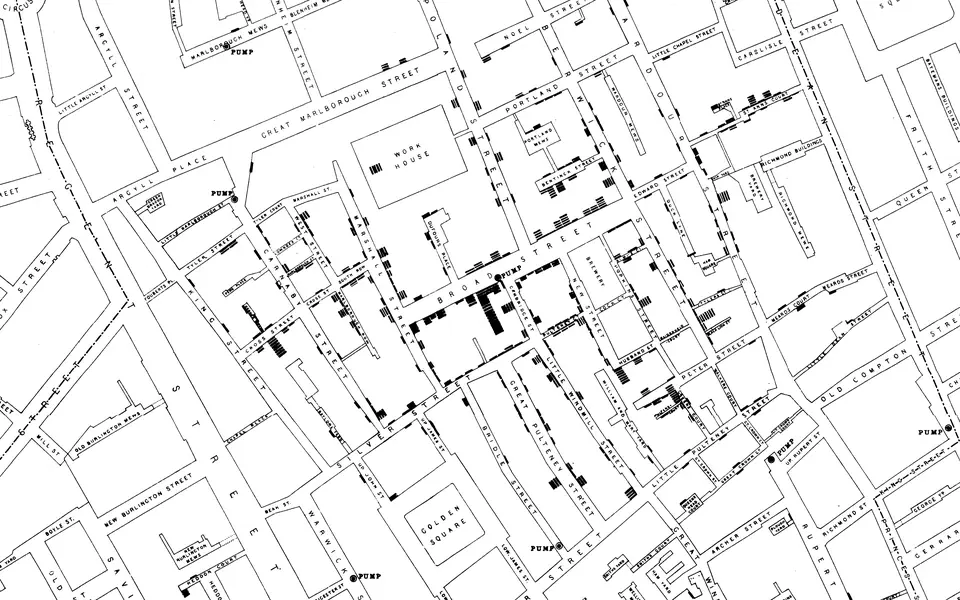
Broad Street's crisis unfolded in a city where many people associated disease with foul air. Snow instead believed that cholera could travel through contaminated water. The distinction mattered because an offensive smell and an infectious water supply did not necessarily point to the same place. More than six hundred people died in the Soho outbreak, making the neighborhood's ordinary routines a matter of urgent investigation. A popular pump could draw customers from beyond the nearest houses. To understand exposure, Snow needed more than the address at which a death had been recorded.
Household habits and useful exceptions
His own account, published in the enlarged 1855 edition of On the Mode of Communication of Cholera, describes obtaining mortality records and making detailed inquiries. Some victims lived nearer other pumps, apparently weakening his argument. Interviews revealed that several families preferred Broad Street's water and fetched it despite the extra distance. Children also passed the pump on their way to school. Such exceptions were useful evidence rather than inconvenient details to discard. They showed why residence and water consumption could differ, and why a boundary drawn around nearby houses would never tell the entire story.
Places that escaped the worst mortality supplied another test. The Poland Street workhouse stood among heavily affected streets, yet its residents used water available on the premises rather than sending to Broad Street. Snow also visited a local brewery whose workers had largely escaped severe illness. Its proprietor reported that the men did not obtain water from the street pump; the brewery had other water supplies and provided malt liquor. These observations did not establish that a particular drink cured cholera. They helped distinguish sharing a neighborhood from sharing the suspected source of contamination.
A map and a more complicated chronology
The celebrated map made the distribution legible. Small black bars recorded deaths beside the buildings associated with them, while the street network placed the pumps in their local setting. But the map was not a magical picture that first revealed an unsuspected cause. UCLA's historical account notes that Snow displayed a Broad Street map in December 1854, months after the handle's removal, and published it in his book the following year. His prior theory and inquiries had already guided the intervention. The map organized an argument built through investigation, rather than replacing that investigation.
Nor did removing the handle suddenly halt an epidemic at its peak. New attacks had already been declining, and many inhabitants had fled. The local clergyman Henry Whitehead, who undertook his own inquiries, later emphasized this chronology. He initially doubted Snow's explanation but came to support the connection with the pump. His research and the parish investigation also examined contamination near the well. The more careful account leaves room for uncertainty about the precise effect of the intervention, while recognizing the value of stopping access to a suspected source before further exposure could occur.
Beyond the famous handle
Snow's reasoning also extended beyond this one street. In south London he compared cholera mortality among households supplied by different water companies. One company continued drawing polluted Thames water, while another had moved its intake upstream. The resulting comparison linked a household's water supply with its risk of death on a much larger scale. That investigation helps explain why the pump story should not stand alone. A memorable object can symbolize a discovery, but the broader case depended on comparisons across populations as well as conversations around a single neighborhood well.
Broad Street is now Broadwick Street, where a replica pump commemorates the investigation. The memorial invites visitors to remember a decision, while the surviving accounts reveal the labor behind it. Records had gaps, witnesses had preferences and imperfect knowledge, and even a persuasive map required interpretation. Snow's achievement was to bring these fragments into an explanation that could guide action. The story remains valuable because it connects observation with a public decision: identifying an everyday route of exposure, testing it against competing evidence, and changing conditions before every scientific dispute had been settled.