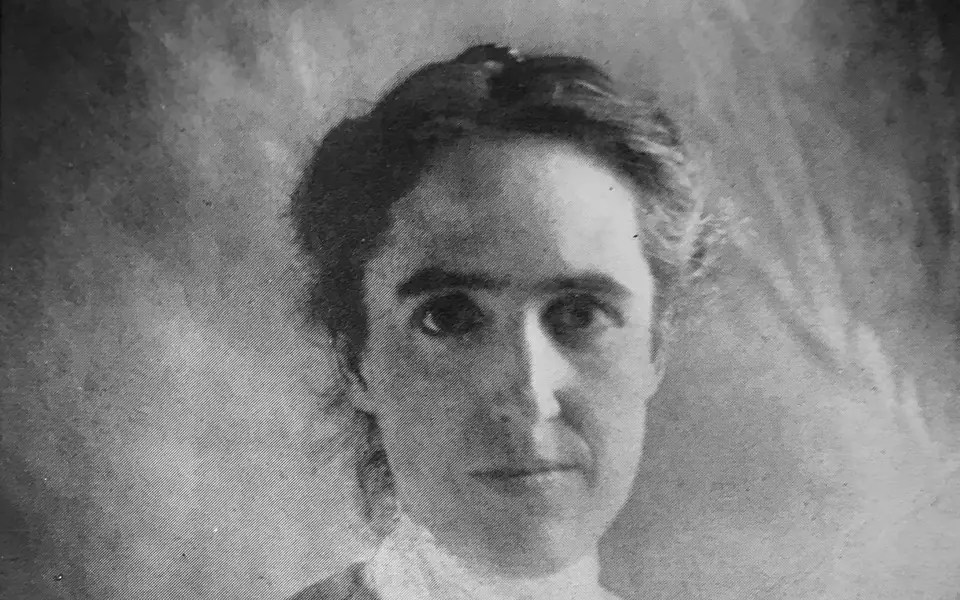
A discovery on three printed pages
A short Harvard College Observatory circular dated March 3, 1912, contained a relationship that would help astronomers measure an unexpectedly large universe. Its table listed twenty-five variable stars in the Small Magellanic Cloud, arranging them by the lengths of their cycles of changing brightness. The statement was prepared by Henrietta Swan Leavitt, as the opening sentence explicitly acknowledged, although observatory director Edward C. Pickering signed the circular. Behind those few printed pages lay years of comparing photographic records. Leavitt had recognized that a star's rhythm could reveal something about its actual light output.
Leavitt came to astronomy through education and painstaking analytical work. Born in Massachusetts in 1868, she studied at Oberlin and then at the institution that became Radcliffe College. An astronomy course led her toward the Harvard observatory. There, women employed as human computers measured and organized the growing collection of photographs of the sky. Some plates came from Harvard's observing station at Arequipa, Peru, giving researchers in Cambridge access to southern stars. The glass negatives were both distant observations and physical objects: evidence that could be revisited long after the telescope exposure had ended.
Comparing photographs and finding a pattern
Finding a variable star demanded careful comparison. Leavitt examined images of the same field taken on different nights, looking for a star whose recorded brightness changed while surrounding stars remained steady. The Harvard Plate Stacks account describes overlaying negatives with a positive image to make differences easier to detect. Once a candidate was identified, photographs from other dates helped establish its cycle. Changes in exposure and image quality also required attention. A promising pattern could disappear into inconsistent measurements unless the observer distinguished changes in a star from changes in the photographic record.
The Small Magellanic Cloud offered a crucial advantage. Its member stars could be treated as approximately equally distant from Earth, allowing their apparent brightnesses to be compared without the enormous distance differences that complicate an arbitrary selection of stars. In her 1908 work, Leavitt had already noticed that brighter variables tended to have longer periods. The point was still provisional, drawn from a limited sample, so further measurements mattered. This was a relationship being established through repeated observations, rather than an astronomical distance scale appearing fully formed in a single flash of insight.
From a relationship to a distance scale
The 1912 circular sharpened the result. Its two graphs showed brightness at maximum and minimum, first against period and then against the logarithm of period. On the logarithmic graph, the measurements lay near straight lines. The paper also acknowledged the faintness and crowding of the stars, and the difficulties of the available photographic material. Such qualifications were part of the discovery's strength. Readers could see both the pattern and the conditions under which it had been measured. Leavitt had extracted an orderly relationship from images that were demanding to measure, rather than assuming the data were perfect.
For this relation to become a distance tool, another step was necessary. The original work established a relative scale; astronomers still needed an independently known distance to calibrate it. Once calibrated, the period of an appropriate variable star could indicate its intrinsic brightness. Comparing that expected brightness with how faint it appeared from Earth then offered a way to estimate distance. This separation between finding a relationship and fixing its scale is essential to understanding Leavitt's contribution. She supplied a foundation on which subsequent researchers could build, without personally completing every later application.
The astronomer behind the measurements
Her opportunities did not match the importance of that foundation. The Center for Astrophysics describes a working environment in which women computers made major contributions while having limited control over their research assignments. Leavitt also experienced recurring illness and progressive hearing loss, which interrupted her work and sometimes required arrangements for working away from Cambridge. Pickering valued her precision, but other projects competed with the variable-star investigation. Her career therefore challenges the familiar image of scientific progress as a sequence of unconstrained individuals choosing whichever question seems most exciting. Skill operated within an institution's priorities and restrictions.
Leavitt died in December 1921, before the later uses of Cepheid variables transformed debates about distant galaxies. The Library of Congress highlights a quieter surviving record: the 1920 census identified her occupation as astronomer. Her notebooks and glass plates also preserve the material work behind a law now associated with her name. They invite a broader understanding of discovery, in which measuring, comparing, and organizing observations count as intellectual achievement. An astronomer did not have to stand at a telescope to change what could be learned from the sky; careful work with its recorded light could open a new scale of inquiry.