A caterpillar becomes a research question
A butterfly pinned in a cabinet reveals its wings, but very little about the caterpillar it once was or the plant that fed it. Maria Sibylla Merian wanted to connect those separate parts of a life. She raised insects, watched their changes, and recorded them in paintings that placed different stages beside their food plants. In 1699, aged fifty-two, she took that demanding practice across the Atlantic to Suriname with her younger daughter, Dorothea Maria. The journey helped produce one of natural history's most memorable illustrated books.
Merian was born in Frankfurt in 1647 into a family connected with engraving and publishing. After her father's death, her mother married the flower painter Jacob Marrel, whose studio gave the young artist access to practical training. Preparing pigments and understanding how an image could become a printed plate were useful scientific skills as well as artistic ones. Merian's interest in silkworms began while she was young. Instead of treating a caterpillar as a decorative addition to flowers, she asked what it ate, how it changed, and what emerged afterward.
An artist crosses the Atlantic
Her first book devoted to European insect metamorphosis appeared in 1679. Observing a living creature required patience that a cabinet specimen did not demand. A caterpillar needed an appropriate food supply and might die before completing its development. Sometimes a pupa produced flies or wasps rather than the expected moth or butterfly. Such surprises exposed relationships that a still-life painting could miss. Merian recorded these unexpected outcomes without possessing the modern framework for insect parasitism. The observations remain valuable precisely because she attended to events that did not fit a simple sequence.
By the late 1690s, she was living in Amsterdam, a city connected to overseas collecting through commerce and colonial rule. Specimens arriving in Europe could excite curiosity while concealing how they had lived. Traveling to Suriname allowed Merian and her daughter to look for living insects and associated plants themselves. They stayed from 1699 until 1701, returning earlier than planned after Merian became ill. This was sustained fieldwork, involving collecting, rearing, drawing, and obtaining information, rather than a brief visit to select attractive tropical specimens for a European cabinet.
A beautiful book with complicated origins
The setting of that research demands attention. Suriname was a Dutch plantation colony sustained by enslaved labor. Merian learned from Indigenous people and people of African descent who knew the local plants and animals. Her writing records information obtained from them, yet generally fails to preserve their names. It also makes clear that she used enslaved labor herself. Recognizing her unusual scientific ambition therefore cannot mean imagining an independent observer untouched by colonial power. Access to the forest, specimens, and knowledge depended on people whose own circumstances were profoundly unequal.
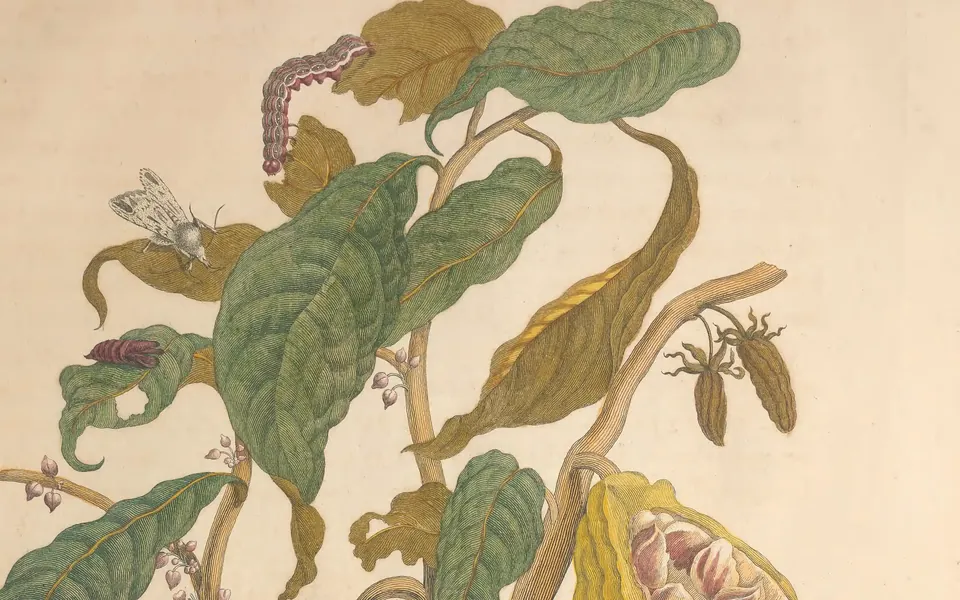
In 1705, she published Metamorphosis insectorum Surinamensium, presenting sixty plates with explanatory text. The pages bring insects and vegetation together in compositions that are visually dramatic but also organized around questions of development and feeding. A reader could compare a larva, pupa, and adult rather than assume they were unrelated creatures. The accompanying image is a detail of her cacao plate, reproduced from a public-domain library scan. Its fruit, leaves, and insects show how a botanical subject could become a setting for investigating an animal's changing life.
Looking closely, then looking again
These pictures should not be treated as infallible photographs of a tropical ecosystem. Natural-history illustrations select and arrange evidence, and Merian sometimes combined observations with information supplied by others. Later researchers have identified mistakes and debated particular relationships shown in her work. Those limitations do not erase the importance of studying living organisms together. They also remind viewers that a convincing composition can contain claims requiring independent checking. A beautiful plate is an invitation to investigate its subjects, rather than a guarantee that every interaction happened exactly as depicted.
Merian died in 1717, leaving work that circulated through later editions and contributed to subsequent natural history. Her achievement joined workshop expertise with the daily care of small creatures: the same person could prepare a drawing, recognize a host plant, and wait for a chrysalis to open. Her books make transformation visible without reducing an insect to its most colorful adult form. Read alongside the colonial circumstances of their production, they also reveal a second network of relationships, connecting European publications to largely unnamed people who helped make the observations possible.