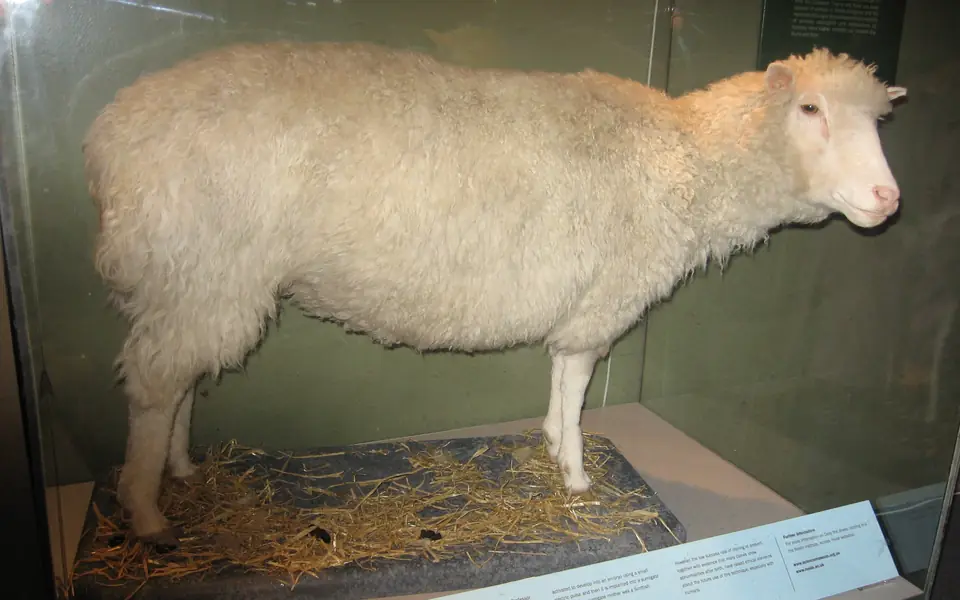
An ordinary-looking lamb with unusual origins
On July 5, 1996, a white-faced lamb was born at the Roslin Institute in Scotland. She looked like a sheep, and that apparent ordinariness would become part of her extraordinary appeal. Dolly was the first mammal cloned from an adult cell, a qualification that matters as much as the word first. Researchers had already cloned mammals using cells from embryos. Dolly's significance lay in the much later stage of the donor cell's life. A cell that had belonged to an adult animal helped produce a new lamb, challenging assumptions about how firmly a cell's specialized role limited its future.
The research belonged to a longer investigation of livestock genetics, rather than a project conceived simply to produce a famous animal. Scientists at Roslin and PPL Therapeutics were exploring ways to improve the production of genetically modified farm animals and to understand development. Ian Wilmut led a team whose skills extended beyond laboratory research to embryology, veterinary work, surgery, and everyday animal care. Earlier Roslin sheep, Megan and Morag, had been cloned from cultured embryonic cells. Those successes formed an essential background. Dolly emerged from accumulated experiments and the cooperation of people performing very different kinds of work.
An adult cell and the limits of copying
The donor cell came from the mammary gland of a six-year-old Finn Dorset ewe. Its nucleus supplied the genetic material central to Dolly's development, while an egg cell and a Scottish Blackface surrogate mother provided other indispensable contributions. Dolly's white face distinguished her visibly from that surrogate. The explanation was striking because specialized adult cells normally perform particular jobs within an existing body. The researchers' 1997 paper reported a lamb derived from an adult cell as evidence that specialization had not irreversibly removed the genetic capacity required for development. The result changed an experimental possibility into an observed living animal.
A clone is nevertheless not a photocopy of a complete life. Most of Dolly's genetic information came from the nucleus of the adult donor cell, but mitochondria contain additional DNA inherited through the egg. Development and environment also affect characteristics, so matching nuclear genetic information does not guarantee identical behavior or appearance. Nor does cloning itself mean that new genes have been introduced: cloning and genetic modification describe different things, even when researchers use them within related projects. These distinctions helped explain why Dolly was scientifically important without supporting the broader fantasy that an animal's experiences or personality could be reproduced along with its genes.
A birthday before the headlines
Dolly's birth and her arrival in the headlines were separated by months. The institute announced her existence on February 22, 1997, close to publication of the research in Nature on February 27. Keeping those dates apart avoids turning a news announcement into a birthday. The paper, by Wilmut and colleagues, described offspring from adult, fetal, and embryonic cell populations, placing Dolly within a wider experiment. Public attention focused on the single recognizable sheep. The scientific report asked a more specific question about the developmental possibilities of cells, while readers and broadcasters quickly began debating cloning's wider implications.
The announcement brought enormous interest and controversy, but Dolly continued to live among other sheep at Roslin. National Museums Scotland records that she had six lambs with a Welsh Mountain ram named David: one in 1998, twins in 1999, and triplets in 2000. Her ability to reproduce through ordinary breeding became another part of the history. She was both a research milestone and an animal requiring food, company, observation, and care. Following that daily life restores a timescale absent from the initial headlines, which could make the experiment seem complete the moment the world first saw her photograph.
Health, evidence, and a lasting exhibit
Her later health attracted close scrutiny. Arthritis diagnosed in 2001 raised questions about whether cloning had accelerated aging, but its cause was never established. Researchers also found shorter than expected telomeres, the protective structures at chromosome ends, without establishing a simple explanation for her whole lifespan. Dolly developed lung tumors associated with a virus that had infected other sheep in the flock. Following examination in February 2003, she was euthanized on February 14 to prevent suffering. Her death should not be presented as proof that every cloned animal ages prematurely; the observations, possible explanations, and demonstrated causes are different kinds of evidence.
After her death, the Roslin Institute donated Dolly to National Museums Scotland, where her preserved body became an exhibit. Visitors could encounter the actual animal behind a familiar scientific name and picture. Her legacy also continued through questions about cellular reprogramming, the relationship between genes and development, and responsibility toward research animals. The breakthrough did not answer every question about cloning, nor did it make every imagined application practical. It showed that a boundary thought to constrain adult cells could be crossed. That precise finding remains powerful enough without turning a sheep into a promise that biology can reproduce any life on demand.