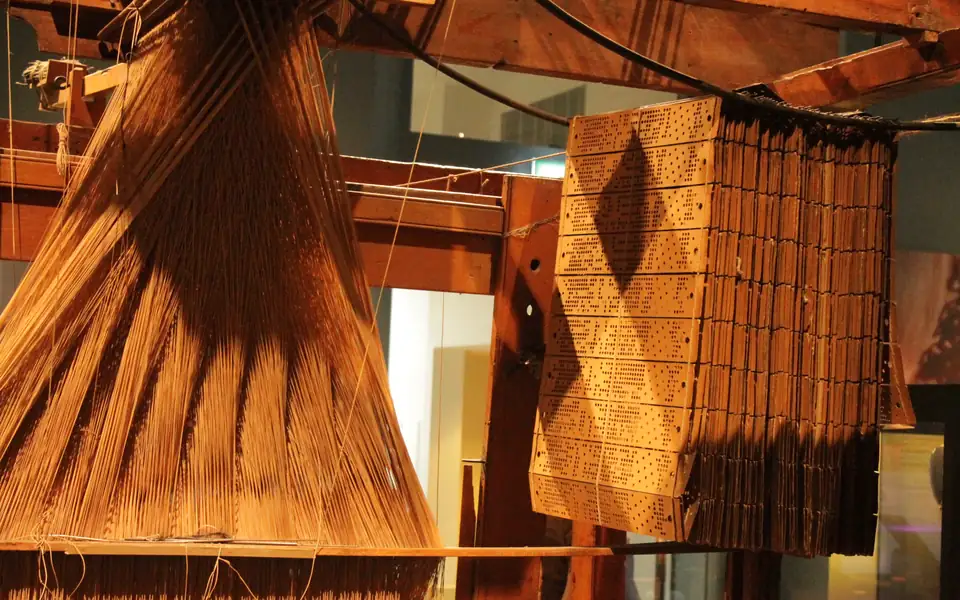
A design written in holes
A strip of card with holes in it seems a modest object to place in the history of computing. On a Jacquard loom, however, such cards could direct the production of an elaborate woven design. Joined into a chain, they carried decisions that otherwise required repeated human attention. Their immediate purpose was textile manufacture, not arithmetic. The surprising connection lies in the separation of instructions from machinery: a loom could remain in place while its sequence of cards changed. Information about a pattern had acquired a physical form that a mechanism could read.
Weaving brings two sets of threads together. The lengthwise warp must be separated so the crosswise weft can pass through, and different selections of warp threads create different designs. In complex patterned weaving, choosing those threads was skilled, repetitive work. The Science Museum Group's collection of Jacquard cards explains that the punched instructions controlled which warp threads rose, taking over a task previously performed by an assistant. Keeping the same card sequence allowed the selections to recur in the same order. An arrangement of holes could therefore preserve a pattern beyond the memory of the people operating the loom.
How a loom reads a card
A surviving hand loom made by W. Archer around 1910 shows the system clearly. Its linked cards form a loop above the frame. As weaving proceeds, a card meets pins; some pins pass through holes while others are stopped by the solid card. The mechanism translates that difference into a choice of threads to lift. A foot lever allows the weaver to operate the apparatus. This example also helps avoid a misleading picture of complete automation. The cards handled pattern selection, but a person still worked at the loom, and preparing the design remained an essential part of making the cloth.
Joseph Marie Jacquard developed his mechanism in France in the opening years of the nineteenth century. The Computer History Museum identifies an 1801 demonstration in Lyon, while the Science Museum Group dates the developed machine to 1804–1805. These dates describe stages in a technology's emergence rather than requiring one magical moment of invention. Later machines could display extraordinary complexity. The Henry Ford preserves an 1839 woven portrait of Jacquard, executed by Michel-Marie Carquillat for Didier Petit et Cie after a portrait by Claude Bonnefond. At first glance, such silk work can look like a printed image, until its construction from threads becomes apparent.
From woven patterns to stored instructions
The computer connection developed through other people and other machines. Charles Babbage planned to employ punched cards for instructions and data in his Analytical Engine. Later in the century, Herman Hollerith used punched cards in an electromechanical system to process census information. Neither machine was simply a loom with its shuttle removed. Different tasks required different mechanisms and conventions. What traveled was the usefulness of recording choices in a durable, readable medium. A sequence of holes could organize repeated operations or represent information, provided that a machine had been designed to interpret it.
The cards preserved in museum collections make that relationship tangible. Some remain bundled with sample ribbons showing the patterns they produced, linking an encoded sequence directly to its visible result. A damaged card or a misplaced sequence could alter the work, just as an incorrect instruction can change a later program's output. The comparison is useful so long as the loom retains its own history. It was a practical tool in a textile industry, operated and maintained by people. Its contribution to computing grew from the success of a concrete solution to weaving: make the instructions portable, repeatable, and readable by the mechanism itself.