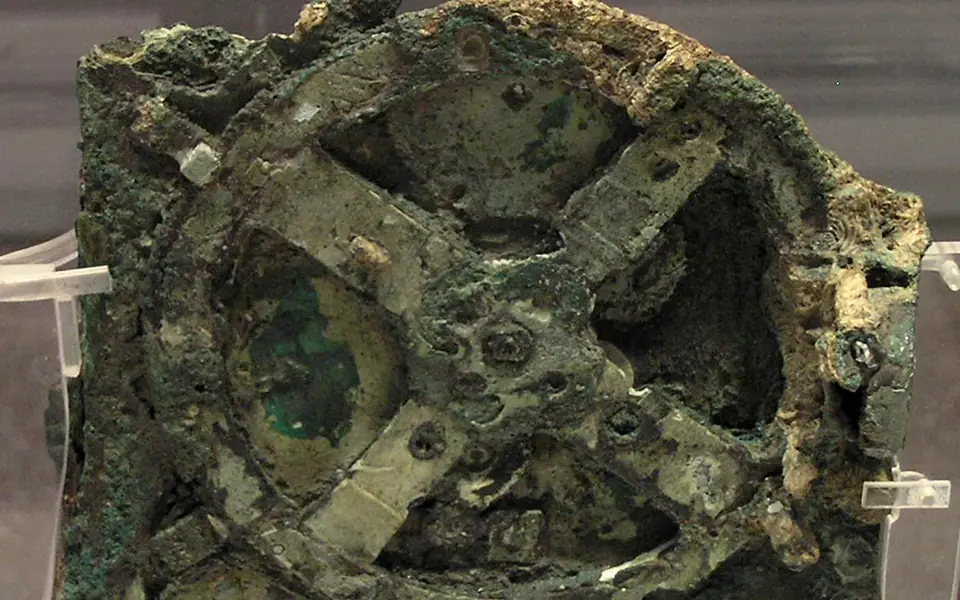
An astronomical instrument from a shipwreck
Among the objects recovered from a shipwreck near the Greek island of Antikythera in 1901 was a corroded bronze instrument. Its broken remains eventually revealed gears and inscriptions that belonged to an ancient astronomical calculator. The device is often called an analogue computer, a description that can make it sound more familiar than it really is. It had no electronic screen or stored software. Instead, mechanical relationships represented cycles in the heavens. Turning its mechanism could translate an input into a display of astronomical information, making mathematical knowledge something a person could manipulate with a hand.
The surviving object is incomplete. Researchers study eighty-two fragments, with about thirty surviving bronze gears distributed among the remains. The largest pieces contain the most recognizable mechanical evidence, but inscriptions on smaller fragments can also be crucial. Modern investigators must distinguish what physically survives from what a reconstruction proposes. A complete working model is an argument about the missing machinery, supported to different degrees by gears, bearings, text, and astronomical relationships. Its polished appearance should not obscure the fragmentary condition of the original object in the National Archaeological Museum in Athens.
Calendars and eclipses in turning gears
Calendar calculation was one of the problems embodied in the device. Lunar months and solar years do not fit together as whole numbers, so a calendar that tracks both requires adjustments. Ancient astronomers identified longer cycles that brought the two into approximate alignment. The Metonic cycle relates nineteen years to 235 lunar months. Such relationships could be represented mechanically, with gear ratios translating one period into another. This is the sense in which bronze could calculate: linked rotations performed a repeated mathematical relationship without requiring the operator to carry out each step on paper.
Eclipses required another set of cycles. The Saros consists of 223 lunar months, a little more than eighteen years, after which similar eclipse conditions recur. That interval does not contain a whole number of days, so a recurring eclipse does not return to the same place on Earth. Three Saros cycles form the Exeligmos, helping account for the shift in time. The museum's explanation emphasizes the observational and mathematical knowledge behind these periods. The machine did not discover the cycles for its user; it incorporated accumulated astronomy into a compact arrangement that made selected relationships easier to follow.
Reading the missing machine
Reading that arrangement required modern technology. Three-dimensional X-ray studies and detailed surface imaging revealed internal structures and inscriptions that ordinary inspection could not resolve. Research published in 2006 helped establish the eclipse-prediction system and the sophistication of the lunar gearing. A 2021 study proposed a reconstruction of the front display, drawing on surviving features and inscriptions about planetary cycles. The authors presented a model that sought to satisfy the evidence within the available space. They also identified the need to demonstrate that the proposed arrangement could actually be manufactured using ancient techniques.
The difference between surviving function and proposed reconstruction is part of the fascination. The mechanism establishes that ancient craftspeople could combine fine metalworking with sophisticated astronomical schemes. It does not identify its maker with certainty or provide a complete history of every similar instrument. Written references suggest that related mechanical traditions existed, even though this particular survival is exceptional. The wreck brought one damaged example into the archaeological record. Its remaining teeth, scales, and letters have since forced historians to give ancient engineering a more complicated place in the story of calculation: a small machine could organize a very large sky.