The historical setting
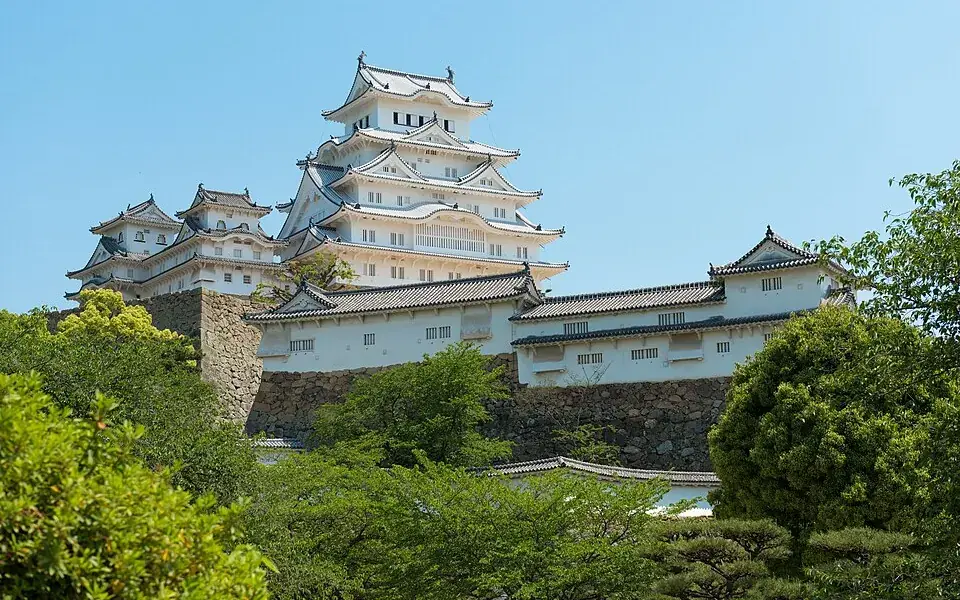
Himeji Castle is a hilltop Japanese castle complex situated in Himeji, a city in Hyōgo Prefecture, Japan. The castle is regarded as the finest surviving example of prototypical Japanese castle architecture, comprising a network of 83 structures with advanced defensive systems from the feudal period. The castle is frequently known as Hakuro-jō or Shirasagi-jō ("White Egret Castle" or "White Heron Castle") because of its brilliant white exterior and supposed resemblance to a bird taking flight.
As with almost all Japanese castles from the Azuchi-Momoyama period onward, the tenshu, the most prominent structure, was used as a storehouse in times of peace and as a fortified tower in times of war, and the daimyo 's government offices and residences were located in a group of single-story buildings near the tenshu and the surrounding yagura. Himeji Castle dates to 1333 when Akamatsu Norimura built a fort on top of Himeyama hill.
History
Himeyama hill, the location of present-day Himeji Castle, was first fortified in 1333 by Akamatsu Norimura, the shugo of Harima Province, during the Genkō War. In 1346, his son Sadanori demolished this fort and built Himeyama Castle in its place. In 1545, the Kuroda clan was stationed here by order of the Kodera clan, and feudal ruler Kuroda Shigetaka remodeled the castle into Himeji Castle, completing the work in 1561. In 1580, Kuroda Yoshitaka presented the castle to Toyotomi Hideyoshi, and in 1581 Hideyoshi significantly expanded the castle, building a three-story keep with an area of about 55 m (590 ft). In the Meiji Period (1868–1912), many Japanese castles were destroyed.
Himeji Castle was abandoned in 1871 and some of the castle corridors and gates were destroyed to make room for Japanese army barracks. The entirety of the castle complex was slated to be demolished by government policy, but it was spared by the efforts of Nakamura Shigeto, an army colonel. A stone monument honoring Nakamura was placed in the castle complex within the first gate, the Hishi Gate. Although Himeji Castle was spared, Japanese castles had become obsolete and their preservation was costly.
Design details
Himeji Castle is the largest castle in Japan. It serves as an excellent example of prototypical Japanese castle architecture, containing many of the defensive and architectural features associated with Japanese castles. The curved walls of Himeji Castle are sometimes said to resemble giant fans, but the principal materials used in the structures are stone and wood. Feudal family crests are installed throughout the architecture of the building, signifying the various lords that inhabited the castle throughout its history. The specific style of the castle is a hirayama. Two castles that were built during the same time and shared many of the architectural features are Matsuyama Castle (Iyo) and Tsuyama Castle.
The Himeji Castle complex is located in the centre of Himeji, Hyōgo on top of a hill called Himeyama, which is 45.6 m (150 ft) above sea level. The castle complex comprises a network of 83 buildings such as storehouses, gates, corridors, and turrets. Of these 83 buildings, 74 are designated as Important Cultural Assets: 11 corridors, 16 turrets, 15 gates, and 32 earthen walls. The highest walls in the castle complex have a height of 26 m (85 ft).
Defences
The castle complex included three moats, one of which—the outer moat—is now buried. Parts of the central moat and all of the inner moats survive. The moats have an average width of 20 m (66 ft), a maximum width of 34.5 m (113 ft), and a depth of about 2.7 m (8.9 ft). The Three Country Moat is a 2,500 m (27,000 ft) pond which exists inside the castle; one of the purposes of this moat was to store water for use in fire prevention. The castle complex, particularly the Waist Quarter, contains numerous warehouses that were used to store rice, salt, and water in case of a siege.
A building known as the Salt Turret was used specifically to store salt, and it is estimated that it contained as many as 3,000 bags of salt when the castle complex was in use. The castle complex also contained 33 wells within the inner moat, 13 of which remain; the deepest of these has a depth of 30 m (98 ft). One of the castle's most important defensive elements is the confusing maze of paths leading to the castle's keep. The gates, baileys, and outer walls of the complex are organized so as to confuse an approaching force, causing it to travel in a spiral pattern around the complex on its way to the keep.