The historical setting
One of the oldest forerunners of Noh and kyōgen is sangaku, which was introduced to Japan from China in the 8th century. At the time, the term sangaku referred to various types of performance featuring acrobats, song and dance as well as comic sketches. Its subsequent adaptation to Japanese society led to its assimilation of other traditional art forms. Various performing art elements in sangaku as well as elements of dengaku (rural celebrations performed in connection with rice planting), sarugaku (popular entertainment including acrobatics, juggling, and pantomime), shirabyōshi (traditional dances performed by female dancers in the Imperial Court in the 12th century), gagaku (music and dance performed in the Imperial Court beginning in the 7th century), and kagura (ancient Shinto dances in folk tales) evolved into Noh and kyōgen. Studies on the genealogy of the Noh actors in 14th century indicate they were members of families specializing in the performing arts.
The establishment of Noh by Kan'ami and Zeami Motokiyo
In the 14th century, during the Muromachi period (1336 to 1573), Kan'ami Kiyotsugu and his son Zeami Motokiyo reinterpreted various traditional performing arts and completed Noh in a significantly different form from the traditional one, essentially bringing Noh to the present form. Kan'ami was a renowned actor with great versatility playing roles from graceful women and 12-year-old boys to strong men. When Kan'ami first presented his work to the 17-year-old Ashikaga Yoshimitsu, Zeami was a child actor in his play, around age 12. Yoshimitsu fell in love with Zeami and his position of favor at court caused Noh to be performed frequently for Yoshimitsu thereafter.
Konparu Zenchiku, who was the great-grandson of Bishaō Gon no Kami, the founder of the Konparu school, and the husband of Zeami's daughter, incorporated elements of waka (poetry) into Zeami's Noh and further developed it. By this period, among the five major schools of Noh, four were established: the Kanze school, established by Kan'ami and Zeami; the Hōshō school established by Kan'ami's eldest brother; the Konparu school; and the Kongō school. All of these schools were descendants of the sarugaku troupe from Yamato Province. The Ashikaga Shogunate supported only the Kanze school among the four schools.
Masks
Noh masks are carved from blocks of Japanese cypress, and painted with natural pigments on a neutral base of glue and crushed seashell. There are approximately 450 different masks mostly based on sixty types, all of which have distinctive names. Some masks are representative and frequently used in many different plays, while some are very specific and may only be used in one or two plays. Noh masks signify the characters' gender, age, and social ranking, and by wearing masks the actors may portray youngsters, old men, female, or nonhuman (divine or demonic) characters. Only the shite, the main actor, wears a mask in most plays, although the tsure may also wear a mask in some plays.
Even though the mask covers an actor's facial expressions, the use of the mask in Noh is not an abandonment of facial expressions altogether. Rather, its intent is to stylize and codify the facial expressions through the use of the mask and to stimulate the imagination of the audience. By using masks, actors are able to convey emotions in a more controlled manner through movements and body language. Some masks use lighting effect to convey different emotions through slight tilting of the head.
Stage
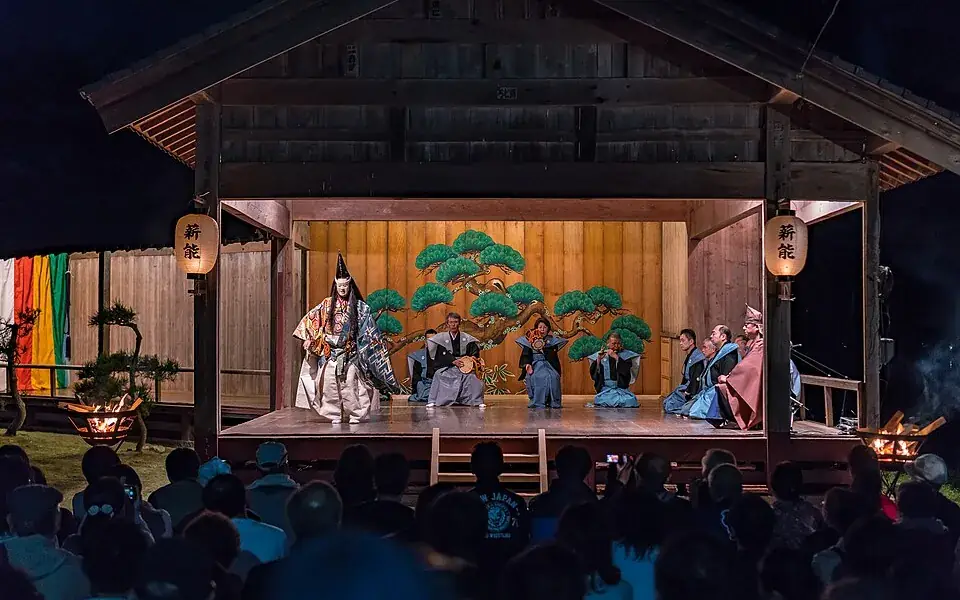
The traditional Noh stage (butai) has complete openness that provides a shared experience between the performers and the audience throughout the performance. Without any proscenium or curtains to obstruct the view, the audience sees each actor even during the moments before they enter (and after they exit) the central "stage" (honbutai, "main stage"). The theatre itself is considered symbolic and treated with reverence both by the performers and the audience. One of the most recognizable characteristics of the Noh stage is its independent roof that hangs over the stage even in indoor theatres. Supported by four columns, the roof symbolizes the sanctity of the stage, with its architectural design derived from the worship pavilion (haiden) or sacred dance pavilion (kagura-den) of Shinto shrines.
The roof also unifies the theatre space and defines the stage as an architectural entity. The pillars supporting the roof are named shitebashira (principal character's pillar), metsukebashira (gazing pillar), wakibashira (secondary character's pillar), and fuebashira (flute pillar), clockwise from upstage right respectively. Each pillar is associated with the performers and their actions. Another unique feature of the stage is the hashigakari, a narrow bridge at upstage right used by actors to enter the stage.