The historical setting
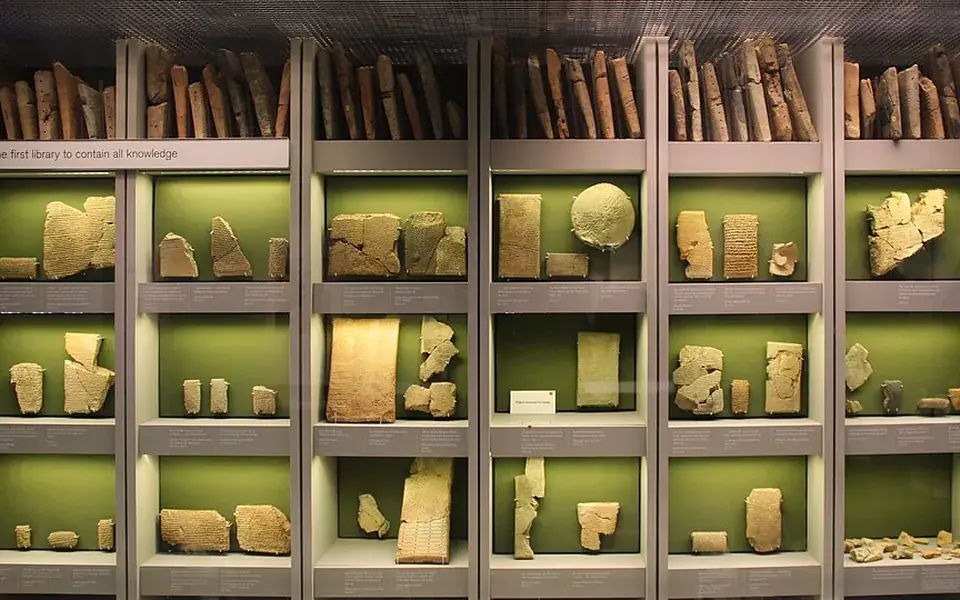
The Royal Library of Ashurbanipal, named after Ashurbanipal, the last great king of the Assyrian Empire, is a collection of more than 30,000 clay tablets and fragments containing texts of all kinds and in various languages from the 7th century BCE. Among its holdings was the famous Epic of Gilgamesh. Ashurbanipal's Library gives modern historians information regarding people of the ancient Near East. In his Outline of History, H. G. Wells calls the library "the most precious source of historical material in the world." The materials were found in the archaeological site of Kouyunjik (ancient Nineveh, capital of Assyria) in northern Mesopotamia. The site is in modern-day northern Iraq, within the city of Mosul.
Discovery
The library is an archaeological discovery credited to Austen Henry Layard; most tablets were taken to England and can now be found in the British Museum, but the first discovery was made in late 1849 in the so-called South-West Palace, which was the Royal Palace of king Sennacherib (705–681 BCE).
Contents
Ashurbanipal was known as a tenacious martial commander; however, he was also a recognized intellectual who was literate, and a passionate collector of texts and tablets. In collecting texts for his library, he wrote to cities and centers of learning across Mesopotamia, instructing them to send him copies of all work written in the region. As an apprentice scribe he mastered both the Akkadian and the Sumerian languages. He sent scribes into every region of the Neo-Assyrian Empire to collect ancient texts. He hired scholars and scribes to copy texts, mainly from Babylonian sources. Ashurbanipal used war loot as a means of stocking his library.
Because he was known for being cruel to his enemies, Ashurbanipal was able to use threats to gain materials from Babylonia and surrounding areas. Ashurbanipal's intense interest in collecting divination texts was one of his driving motivations in collecting works for his library. His original motive may have been to "gain possession of rituals and incantations that were vital to maintain his royal power." More than 30,000 clay tablets and fragments from the Nineveh collections have been recovered. This is a count of surviving physical objects, including broken pieces, rather than 30,000 complete books: several fragments can belong to one text. Many tablets bear inscriptions identifying them as the property of Ashurbanipal's palace.
The surviving texts include letters, contracts and administrative records, along with divination, omens, incantations and hymns. Other works concern medicine, astronomy and literature. Nineveh was sacked in 612 BCE by forces including the Babylonians and Medes. Its palaces burned, and the collection was buried among their ruins. Clay made a crucial difference to survival: inscribed tablets could remain readable after burial, even when broken, while organic writing boards were lost. Fire appears to have partially baked some tablets, helping harden their material, although heat also damaged objects. The remains were not an untouched library frozen at the moment of conquest. British Museum research has found that tablets were sifted, deliberately smashed and dispersed around the palaces. The surviving fragments therefore preserve ancient writing while presenting a difficult reconstruction problem. Their modern catalogue entries must not be mistaken for a simple inventory of complete volumes on the king's shelves.
Ashurbanipal library project
Created in collaboration with the University of Mosul and funded by the Townley group, the British Museum has been compiling a catalogue record of artifacts from Ashurbanipal's library since 2002. The goal is to document the library in as much detail as possible in texts and images including sign-transliterations, hand-drawn copies, translations, and high-quality digital images. The project was undertaken in three stages with published results coming out in 2003, 2004, and 2014. Dr. Jeanette C. Fincke studied ancient oriental studies, Hittitology, and Egyptology at the University of Hamburg and was involved heavily during the first two stages. During the first stage, Fincke compiled an authoritative list of the 3500 library tablets in Babylonian scripts.
During the second stage, Fincke also compiled several astrological texts from Nineveh. The third stage was completed with the help of professor Riekel Borger, who died mid-catalogue in December 2010, and completed with the help of Andrew Mellon Foundation from 2009 to 2013 under the direction of Jon Taylor. During this last stage, the library produced high resolution digital images of all the library tables. Each image is created using 14 images which allows a virtual two-dimensional representation of the three-dimensional tablets. The images have been released on the Cuneiform Digital Library Initiative website and British Museum Collections online site. The Hermitage of St.
Petersburg, The Louvre of Paris, The Vatican Museums of Vatican City, the Penn Museum of Philadelphia, The Kunsthistorisches Museum of Vienna, and the de Liagre Böhl collection of Leiden have all made their collections available for the project.