The historical setting
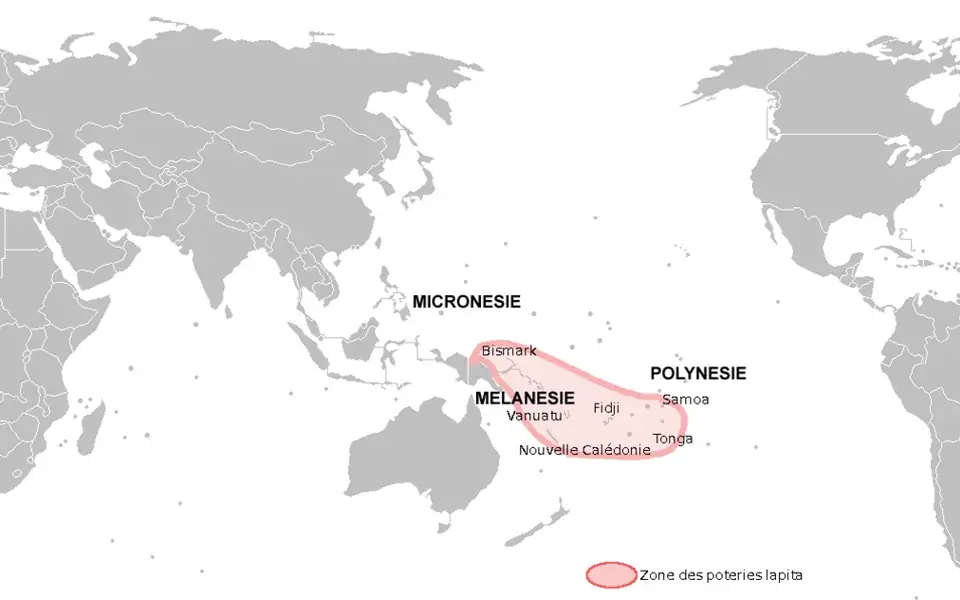
The Lapita culture is a Neolithic Austronesian people and their distinct material culture, who settled Island Melanesia via a seaborne migration at around 1600 to 500 BCE. The Lapita people are believed to have originated from the northern Philippines, either directly, via the Mariana Islands, or both. They produced dentate-stamped pottery with distinctive geometric designs, which closely resemble the pottery recovered from the Nagsabaran archaeological site in northern Luzon. The Lapita intermarried with the Papuan populations to various degrees, and are the direct ancestors of the Austronesian peoples of Polynesia, eastern Micronesia, and Island Melanesia.
The term "Lapita" was coined by archaeologists during a 1952 excavation in New Caledonia after mishearing a word in the local Haveke language, xapeta'a, which means "to dig a hole" or "the place where one digs". The Lapita archaeological culture is named after the type site where it was first uncovered in the Foué peninsula on Grande Terre, the main island of New Caledonia.
Burial customs
In 2003, at the Teouma archeological excavation site on Efate Island in Vanuatu, a large cemetery was discovered, including 25 graves containing burial jars and a total of 36 human skeletons. All the skeletons were headless: At some point after the bodies had originally been buried, the skulls had been removed and replaced with rings made from cone shells, and the heads had been reburied. One grave contained the skeleton of an elderly man with three skulls sitting on his chest. Another grave contained a burial jar depicting four birds looking into the jar. Carbon dating of the shells placed this cemetery as having been in use around 1000 BCE. In 2002, a complete human skeleton was discovered on Moturiki in Fiji.
The Mana skeleton, as it was later named, was of a Lapita woman that lived in the year 800 BCE or earlier. She was buried more than 1.5 metres below the ground surface and she was covered by undisturbed layers of sand and silt sediment in which Lapita pottery was found. A large shell had been placed beneath her neck and another one between her knees, with more smaller shells also present inside the grave.
Origin
The Lapita complex is part of the eastern migration branch of the Austronesian expansion, which started from Taiwan between about 5,000 and 6,000 years ago. Some of the emigrants reached Melanesia and were distant descendants of much earlier migrations into the super-continent of Sahul. There are different theories about the route they took to get there. They may have gone through the Marianas Islands, or through the Philippines, or both. The strongest support for the theory that the original people of the Lapita culture were Austronesian is linguistic evidence showing very considerable lexical continuity between Proto-Malayo-Polynesian (presumably spoken in the Philippines) and Proto-Oceanic (presumably spoken by the Lapita people). In addition, the patterns of linguistic continuity correspond to patterns of similarity in material culture.
In 2011, Peter Bellwood proposed that the initial movement of Malayo-Polynesian speakers into Oceania was from the northern Philippines eastward into the Mariana Islands, then southward into the Bismarcks. An older proposal was that Lapita settlers first arrived in Melanesia via eastern Indonesia. Bellwood's proposal included the possibility that both migration patterns happened, with different migrants taking different routes. Bellwood's proposal is supported by the pottery evidence: Lapita pottery is more similar to pottery recovered from the Philippines (at the Nagsabaran archaeological site on Luzon Island) than it is to pottery discovered anywhere else.
Discovery
The first recorded discovery of Lapita materials was by Otto Meyer, a Sacred Heart missionary working on Watom Island in 1909. Meyer discovered potsherds after a tropical storm hit the island and exposed the artifacts. The decorated sherds were sent by Meyer to the Musée de l'Homme in Paris. In 1920, anthropologist William C. McKern unearthed over 1500 potsherds in the island of Tongatapu as part of a widespread expedition, most with stamped motifs. McKern wasn't aware of Meyer's discoveries and assumed the sherds were prehistoric Fijian ceramics. The connection between Meyer's sherds and those excavated by McKern was made in 1940 with the discovery of pottery on the Ile des Pins.
As the archaeological record improved in the 1980s and 1990s, the Lapita people were found to be the original settlers in parts of Melanesia and Western Polynesia. Many scientists believe Lapita pottery in Melanesia to be proof that Polynesian ancestors passed through this area on their way into the central Pacific. The earliest archaeological site in Polynesia is in Tonga. Other early Lapita discovery sites dating back to 900 BCE are also found in Tonga and contain the typical pottery and other archaeological "kit" of Lapita sites in Fiji and eastern Melanesia of about that time and immediately before.