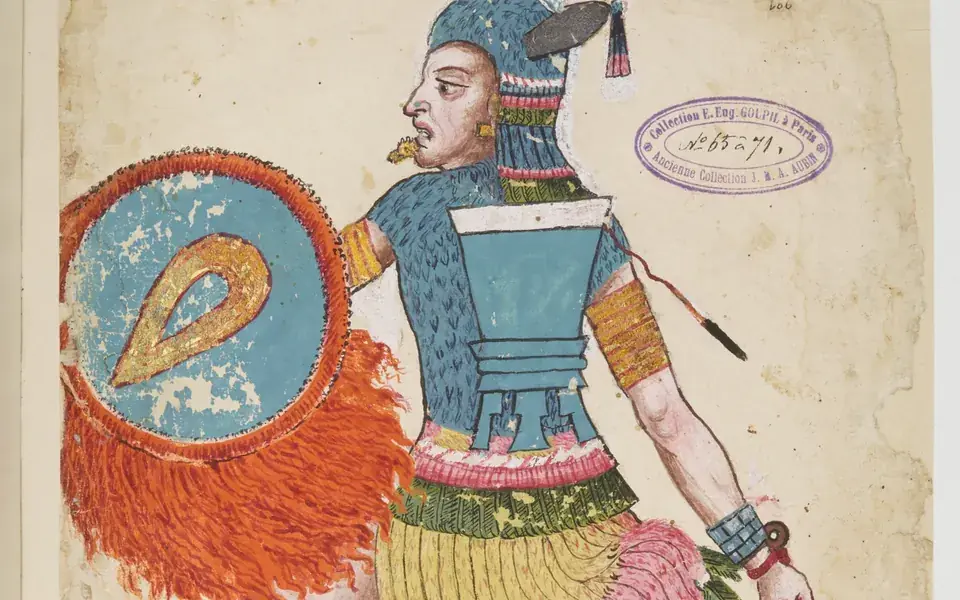
Nezahualcoyotl Acolmiztli, "Fasting Coyote" (April 28, 1402 – 1472) was tlatoani (king) of the Acolhua altepetl (city-state) of Texcoco from 1431 to his death in 1472, in pre-Columbian Mexico. He is noted for his achievements as a philosopher (tlamatini), warrior, architect, legislator and poet, earning him the nickname of "the Poet-King" (Rey Poeta, in Spanish). In his lifetime, he was also known by his poetic nickname Yoyontzin. His difficult younger years following his father's assassination, and his efforts to reconquer his realm after being taken over by the powerful Tepanec Empire turned him into a hero in pre-Columbian society.
Exile and the recovery of Texcoco
Following his father's assassination, Nezahualcoyotl and his brother spent the following days fleeing, under the care of the three men, while seeking refuge throughout the local crags and gorges to avoid any potential assassins. According to the Annals of Cuauhtitlan, while hiding at Acalhuacan during one night, a companion named Coyohua encountered a boat with men sent by the future tlatoani of Tenochtitlan, Itzcoatl. He had sent a scouting party, composed of his own sons, to find and rescue the orphaned princes, as, through their mother, they were also members of the Mexica royal family, in spite of the war between the Mexica and Ixtlilxochitl. Coyohua informed the party that the princes were still alive, though their father was dead.
As the tlatoani Itzcoatl of Tenochtitlan requested help from the Huexotzincans against the Tepanecs, Nezahualcoyotl envisioned a single military force in order to fight the mighty kingdom of Azcapotzalco. After being offered support from insurgents inside Acolhuacan and rebel Tepanecs from Coyohuacan, Nezahualcoyotl joined the war. He called for a coalition consisting of many of the most important pre-Hispanic cities of the time: Tenochtitlan, Tlacopan, Tlatelolco, Huexotzinco, Tlaxcala and Chalco. The war was declared a shared and single effort, and the coalition army of more than 100,000 men under the command of Nezahualcoyotl and other important tlatoque headed towards Azcapotzalco from the city of Calpulalpan. This began the military offensive that would reconquer Acolhuacan in 1428.
Law and hydraulic engineering
According to Motolinia, Nezahualcoyotl practiced his strict laws judiciously and imposed them on all his subjects. He purportedly killed four of his sons for their sexual relationships with his concubines. Cities conquered by the Aztec Empire paid tribute that was distributed among three kings. Fourteen cities in the region of Acolhuacan were under Nezahualcoyotl, including Otompan, Huexotla, Coatlinchan, Chimalhuacan, Tepetlaoztoc, Chiauhtla, Tezoyucan, Teotihuacan, Acolman, Tepechpan, Chiconauhtlan, Xicotepec, Cuauhchinanco, and Tollantzinco. Nezahualcoyotl, himself half Mexica, adopted the Mexica religious and legal systems in Acolhuacan to help in the reconstruction of his city.
The historical records claim that Nezahualcoyotl proposed and was even personally in charge of several impressive works of hydraulic engineering during his reign, having executed some of the most important works of this time during the 15th century. There is no direct evidence that these works were actually designed by him or that he personally supervised their construction, but he demonstrated great interest for large-scale civic engineering problems throughout the course of his reign.
Poetry and the limits of the evidence
Although many poems have historically been attributed to Nezahualcoyotl, it is difficult to tell for certain which of the surviving ones were actually composed by him, if any. As early as the 1880s, some Mexican writers, such as Alfredo Chavero, had openly questioned the authorship of these poems, claiming that that surviving examples were recorded after the conquest, creating uncertainty about their earlier form and authorship. Daniel Garrison Brinton, in response, wrote in 1890 that he did believe the poems to be of pre-conquest origin, "written down shortly after the Nahuatl language had been reduced to the Spanish alphabet." In the collections of the Cantares Mexicanos and the Romances de los señores de Nueva España, several poems are referred to as "Song of Nezahualcoyotl" (Ycuic neçahualcoyotzin in the Cantares, de Neçahualcoyotzin in the Romances), implying that he's the author or main subject.
Additionally, several poems, within their own content, mention Nezahualcoyotl explicitly as their singer (e.g. However, this does not necessarily mean that these songs were composed by Nezahualcoyotl. In fact, a poem entitled "Song of Nezahualpilli" (Ycuic neçahualpilli) is explicitly stated to have been composed by a singer named Tececepouhqui, not by Nezahualpilli. Moreover, Tececepouhqui never mentions himself in the content of the poem. This makes arguments such as Garibay's stand on shaky ground, and demonstrates, according to Bierhorst (1985), that it is not possible to confirm that the tlatoque (kings) of the Aztec Empire actually composed the songs historically attributed to them.