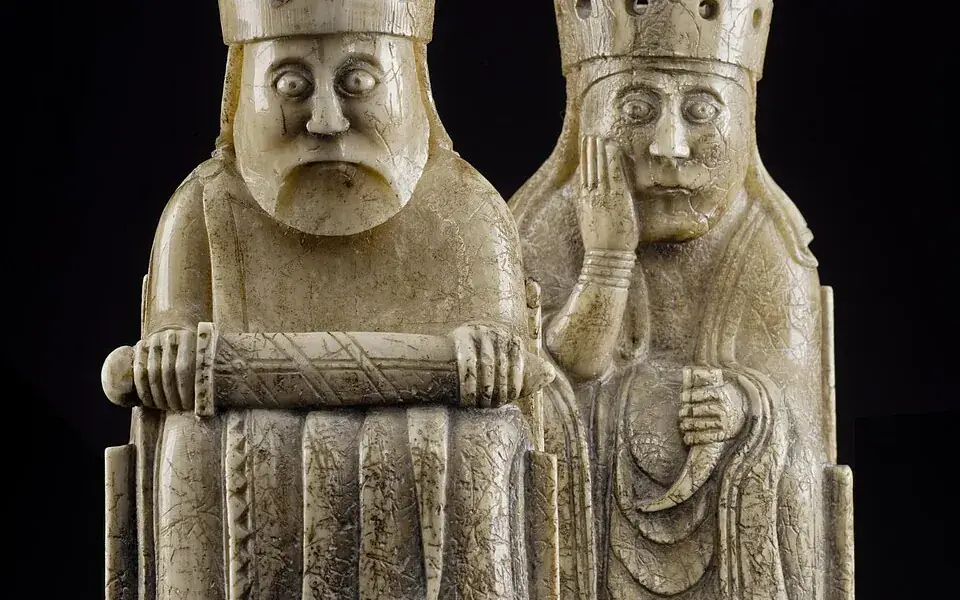
A newly identified piece, a "warder", the equivalent of a rook, was sold for £735,000 in July 2019. Four other major pieces, and many pawns, remain missing from the chess sets.
Origin and discovery
The Lewis chessmen were probably made between 1150 and 1200 AD. They are commonly believed to have been made in Trondheim, Norway, though some scholars have alternatively suggested Icelandic or local Hebridean manufacture. They are usually thought to have been brought to Lewis as part of a merchant's wares. The chessmen were discovered in 1831. Most accounts have said they were found at Uig Bay on the west coast of Lewis, but Caldwell et al. of National Museums Scotland consider that Mealista, which is also in the parish of Uig and some 6 miles (10 km) further south down the coast, is a more likely place for the hoard to have been discovered. Their discovery was initially credited to an unnamed local peasant; the name of the discoverer is first recorded in 1863 as Malcolm MacLeod from the nearby township of Pennydonald.
Description
Almost all of the pieces in the collection are carved from walrus ivory, with a few made instead from whale teeth. The 79 chess pieces consist of 8 kings, 8 queens, 16 bishops, 15 knights, 13 warders (rooks) and 19 pawns. The heights of the pawns range from 3.5 to 5.8 cm (1 3 / 8 to 2 9 / 32 in), while the other pieces are between 7 and 10.2 cm (2 3 / 4 and 4 in).
Although there are 19 pawns (a complete set requires 16), they have the greatest range of sizes of all the pieces, which has suggested that the 79 chess pieces might belong to at least five sets; however, Caldwell et al. note that the creators of the Lewis chess sets may never have intended the sets to be as uniform as modern audiences with access to sets mass produced in factories expect.
Based on the pieces' facial features, Caldwell, Hall, and Wilkinson place them in five groups, which they propose were the work of five different craftsmen. Nine of the pieces are not able to be assigned to any of these groups. They suggest that two of these, a king and a warder, may have been made at a different workshop entirely, perhaps to replace missing or broken pieces.
Exhibition and ownership
The chessmen were first exhibited at a meeting of the Society of Antiquaries of Scotland on 11 April 1831 by Roderick Ririe, from Stornoway. Ririe sold ten of the pieces to Charles Kirkpatrick Sharpe, a Scottish collector; Sharpe later acquired another bishop, probably also from Ririe. Ririe sold the remainder of the pieces to a Mr. T. A. Forrest, from whom they were bought by the British Museum.
After Sharpe's death, his pieces were sold to Baron Londesborough. In 1888, they were sold through Christie's to the Society of Antiquaries of Scotland, for the National Museum of Scotland. When the chessmen were uncovered in 1831, 1 knight and 4 warders were missing from the four sets. In June 2019 it was announced that a warder piece, which had previously gone unrecognised for at least 55 years, had emerged in Edinburgh half a year earlier. This so-called "Antique Walrus Tusk Warrior Chessman" was purchased at a Sotheby's auction for £735,000 the following month, by an undisclosed buyer.
Of the pieces given to the British Museum, most can be found in Room 40, with the registration numbers M&ME 1831, 11–1.78–159. Others have been lent to Scottish museums and temporary exhibitions. A range of wooden or plastic replicas are popular items in the Museum shops. The chessmen were number 5 in the list of British archaeological finds selected by experts at the British Museum for a 2003 BBC documentary. They were one of the items featured in the 2010 Radio 4 historical series A History of the World in 100 Objects.