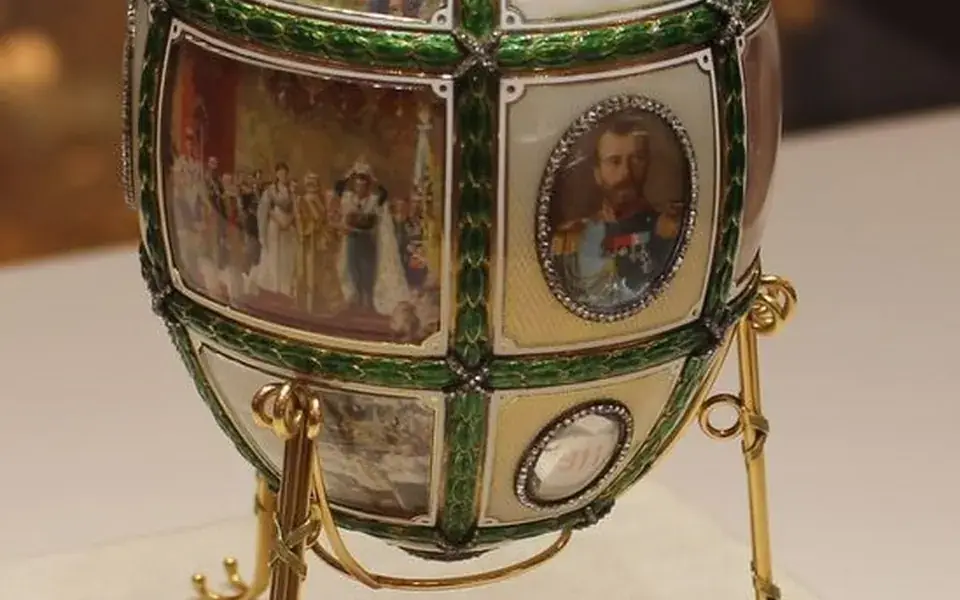
A Fabergé egg is a jewelled egg first created by the jewellery firm House of Fabergé, in Saint Petersburg, Russia. As many as 69 eggs were created during the Tsarist era, of which 61 are known to have survived. The most famous of the house creations are the 50 Imperial Easter eggs manufactured under the supervision of Peter Carl Fabergé, between 1885 and 1917, of which 44 are known to be in complete or partial physical existence, leaving the fate of those remaining unknown. The eggs are very highly sought-after collectors' items.
History
The House of Fabergé was founded by the goldsmith Gustav Fabergé in 1842 in Saint Petersburg, Russia, and the eggs were commissioned by the Russian tsar after Peter Carl Fabergé took the helm, in 1882. For Easter in 1883, before his coronation, Alexander III and Maria Feodorovna were given eggs, one of which contained a silver dagger and two skulls. The egg came with messages, including "Christ is risen" and "You may crush us—but we Nihilists shall rise again!"
Prior to Easter 1885, Alexander III's brother Grand Duke Vladimir Alexandrovich suggested that Peter Carl Fabergé create a jewelled egg. This type of egg is believed to have been inspired by an ivory hen egg made for the Danish Royal Collection in the 18th century. Known as the Hen Egg, it had a 65 mm (2.5 in) outer enamel shell and a golden band around the middle. The egg opens to reveal a golden "yolk" within, which in turn opens to expose a golden hen sitting on golden straw. Inside the hen lies a miniature diamond replica of the imperial crown and a ruby pendant, though these two elements have been lost. The egg cost 4,151 rubles. Six weeks later, the emperor made Fabergé the supplier to the imperial court, following which, the egg designs became more elaborate.
Once Fabergé had approved an initial design, the work was carried out by a team of craftsmen, among them Michael Perkhin, Henrik Wigström, and Erik August Kollin. After Alexander III's death on 1 November 1894, his son, Nicholas II, presented a Fabergé egg to both his wife, Alexandra Feodorovna, and his mother, the Dowager Empress Maria Feodorovna. Records have shown that of the 50 Imperial Easter eggs, 20 were given to the former and 30 to the latter. Eggs were made each year except 1904 and 1905, during the Russo-Japanese War.
The imperial eggs enjoyed great fame. Fabergé was commissioned to make similar eggs for a few private clients, including the Duchess of Marlborough, the Rothschild family, and the Yusupovs. He was also commissioned to make twelve eggs for the industrialist Alexander Kelch, though only seven appear to have been completed. Following the revolution and the nationalisation of the Fabergé workshop in Saint Petersburg by the Bolsheviks in 1918, the Fabergé family left Russia. Their trademark was sold several times, and different companies retailed merchandise using the Fabergé name. From 1998 to 2009, the Victor Mayer jewellery company produced Fabergé eggs under Unilever's license.
Art of surprise
Every Fabergé egg embodied a story and a surprise. The Hen Egg (1885) opened to reveal a golden egg and hen. The Rosebud Egg (1895) was the first egg made for Alexandra Fedorovna, wife of Tsar Nicholas II, and featured a yellow rose, believed to be the most noble colour, a miniature jewelled crown, and a ruby pendant (both missing).
The Danish Palace Egg (1890) contained a folding ten-panel screen depicting the Danish Imperial yacht Polar Star, Amaliensborg Palace, the estate of Hvidøre, Fredensborg Palace, Bernsdorff Castle, Kronberg Castle, two views of Cottage Palace in Copenhagen, and Catching Palace, St Petersburg. Techniques such as guilloché enamelling were introduced by Fabergé, and quality was overseen and approved by Peter Carl himself, or in his absence, by his eldest son Eugène, before it was placed into stock. The smallest of faults would result in rejection.
List of Kelch eggs
Fabergé was also commissioned to make eggs for Alexander Ferdinandovich Kelch, a Siberian gold mine industrialist, as gifts for his wife Barbara (Varvara) Kelch-Bazanova. Though still "Fabergé eggs" by virtue of having been produced by his workshop, these seven eggs were not as elaborate as the imperial eggs and were not unique in design. Most are copies of other eggs.