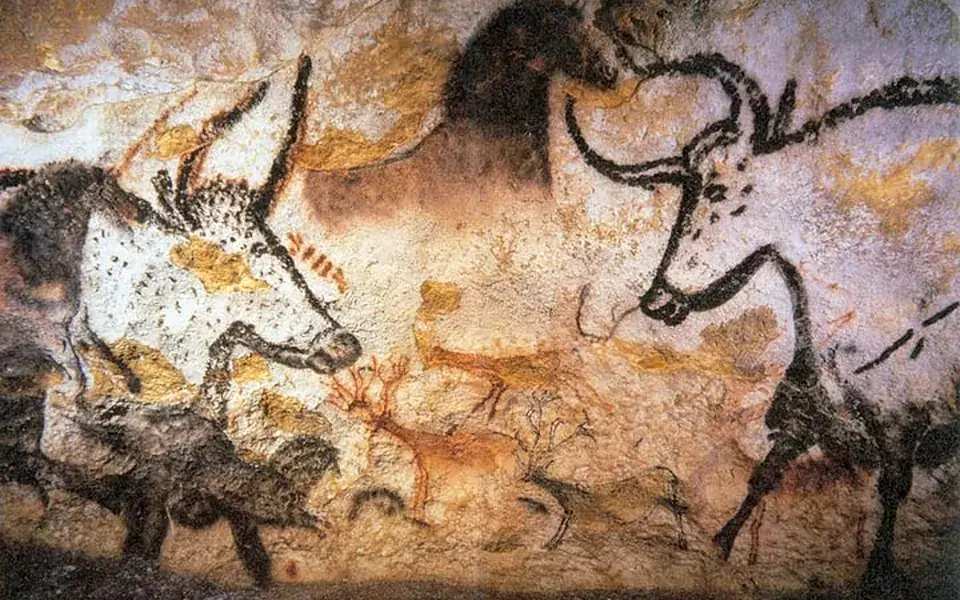
Lascaux is a network of caves near the village of Montignac, in the department of Dordogne in southwestern France. Over 600 parietal wall paintings cover the interior walls and ceilings of the cave. The paintings represent primarily large animals, typical local contemporary fauna that correspond with the fossil record of the Upper Paleolithic in the area. They are the combined effort of many generations.
History since rediscovery
On 12 September 1940, the entrance to the Lascaux Cave was discovered on the La Rochefoucauld-Montbel lands by 18-year-old Marcel Ravidat when his dog investigated a hole left by an uprooted tree (Ravidat would embellish the story in later retellings, saying the dog had fallen into the cave). Ravidat returned to the scene with three friends, Jacques Marsal, Georges Agnel, and Simon Coencas. They entered the cave through a 15-metre-deep (50-foot) shaft that they believed might be a legendary secret passage to the nearby Lascaux Manor.
The cave complex was opened to the public on 14 July 1948, and initial archaeological investigations began a year later, focusing on the Shaft. By 1955, carbon dioxide, heat, humidity, and other contaminants produced by 1,200 visitors per day had visibly damaged the paintings. As air condition deteriorated, fungi and lichen increasingly infested the walls. Consequently, the cave was closed to the public in 1963, the paintings were restored to their original state, and a monitoring system on a daily basis was introduced.
Parietal representation
The Hall of the Bulls presents the most spectacular composition of Lascaux. Its calcite walls are not suitable for engraving, so it is only decorated with paintings, often of impressive dimensions: some are up to five metres (16 ft) long. Two rows of aurochs face each other, two on one side and three on the other. The two aurochs on the north side are accompanied by about ten horses and a large enigmatic animal, with two straight lines on its forehead that earned it the nickname "unicorn". On the south side, three large aurochs are next to three smaller ones, painted red, as well as six small deer and the only bear in the cave, superimposed on the belly of an aurochs and difficult to read.
The Axial Diverticulum is also decorated with aurochs and horses accompanied by deer and ibex. A drawing of a fleeing horse was brushed with manganese pencil 2.50 m (8.2 feet) above the ground. Some animals are painted on the ceiling and seem to roll from one wall to the other. These representations, which required the use of scaffolding, are intertwined with many signs (sticks, dots, and rectangular signs).
Interpretation
The interpretation of Palaeolithic Art is problematic, as it can be influenced by our own prejudices and beliefs. Some anthropologists and art historians theorize the paintings could be an account of past hunting success, or could represent a mystical ritual in order to improve future hunting endeavors. The latter theory is supported by the overlapping images of one group of animals in the same cave location as another group of animals, suggesting that one area of the cave was more successful for predicting a plentiful hunting excursion.
Applying the iconographic method of analysis to the Lascaux paintings (studying position, direction and size of the figures; organization of the composition; painting technique; distribution of the color planes; research of the image center), Thérèse Guiot-Houdart attempted to comprehend the symbolic function of the animals, to identify the theme of each image and finally to reconstitute the canvas of the myth illustrated on the rock walls.
Julien d'Huy and Jean-Loïc Le Quellec showed that certain angular or barbed signs of Lascaux may be analysed as "weapon" or "wounds". These signs affect dangerous animals – big cats, aurochs, and bison – more than others and may be explained by a fear of the animation of the image. Another finding supports the hypothesis of half-alive images. At Lascaux, bison, aurochs, and ibex are not represented side by side. Conversely, one can note a bison-horses-lions system and an aurochs-horses-deer-bears system, these animals being frequently associated. Such a distribution may show the relationship between the species pictured and their environmental conditions. Aurochs and bison fight one against the other, and horses and deer are very social with other animals.