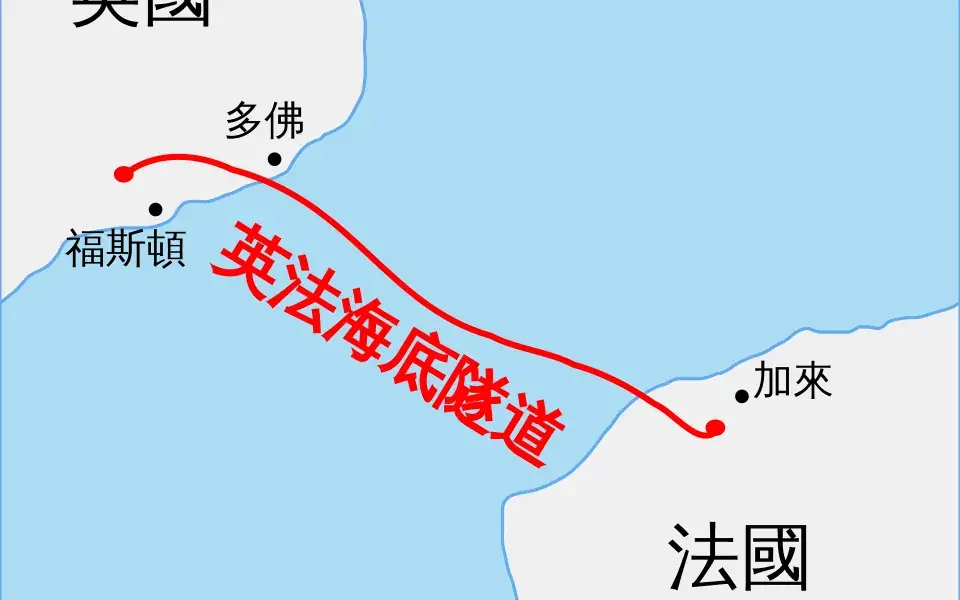
Opened in 1994, the Channel Tunnel connects Britain and France by rail. Trains can carry road vehicles; motorists do not drive directly through the long tunnel. The system includes running tunnels and a service tunnel. Its construction required solutions to geological conditions, ventilation, and safety, and changed the timing and means of travel across the Channel.
Historical background
The Channel Tunnel, sometimes referred to as the Chunnel, is a 50.46-kilometre (31.35-mile) railway tunnel beneath the English Channel which connects Folkestone in the United Kingdom with Coquelles in northern France. Opened in 1994, it remains the only fixed link between Great Britain and the European mainland.
The tunnel has the longest underwater section of any tunnel in the world, at 37.9 km (23.5 miles), reaching a depth of 75 m (246 ft) below sea level and runs, on average, 45 m (148 ft) below the seabed. It is the third-longest railway tunnel in the world. Although the tunnel was designed for speeds up to 200 km/h (120 mph), trains are limited to a maximum speed of 160 km/h (99 mph) for safety reasons. It connects to high-speed railway lines on either end: the LGV Nord in France and High Speed 1 in the United Kingdom.
The tunnel is operated by Getlink (formerly Eurotunnel) and is used by Eurostar high-speed passenger trains, LeShuttle services for road vehicles, and freight trains. In 2017, Eurostar trains carried 10.3 million passengers, freight trains transported 1.2 million tonnes (2.6 billion pounds) of freight, and LeShuttle trains moved 10.4 million passengers in 2.6 million cars and 51,000 coaches, and 1.6 million heavy goods vehicles carrying 21.3 million tonnes (47 billion pounds) of freight. That compares with 11.7 million passengers, 2.2 million cars, and 2.6 million heavy goods vehicles transported by sea through the Port of Dover.
Construction
Working from both the English and French sides of the Channel, eleven tunnel boring machines (TBMs) cut through chalk marl to construct two rail tunnels and a service tunnel. The vehicle shuttle terminals are at Cheriton (part of Folkestone) and Coquelles, and are connected to the English M20 and French A16 motorways, respectively.
Tunnelling commenced in 1988, and the tunnel began operating in 1994. At the peak of construction, 15,000 people were employed with daily expenditure over £3 million. Ten workers, eight of them British, were killed during construction between 1987 and 1993, most in the first few months of boring.
Tunnelling
Tunnelling was a major engineering challenge; the only precedent was the undersea Seikan Tunnel in Japan, which opened in 1988. A serious health and safety risk with building tunnels under water is major water inflow due to the high hydrostatic pressure from the sea above, under weak ground conditions. The tunnel also had the challenge of timescale: being privately funded, an early financial return was paramount.
The objective was to construct two 7.6 m-diameter (25 ft) rail tunnels, 30 m (98 ft) apart, 50 kilometres (31 mi) in length; a 4.8-metre-diameter (16 ft) service tunnel between the two main ones; pairs of 3.3 m (10 ft 10 in)-diameter cross-passages linking the rail tunnels to the service tunnel at 375 m (1,230 ft) spacing; piston relief ducts 2 m (6 ft 7 in) in diameter connecting the rail tunnels 250 m (820 ft) apart; two undersea crossover caverns to connect the rail tunnels, with the service tunnel always preceding the main ones by at least 1 km (0.6 mi) to ascertain the ground conditions. There was plenty of experience with excavating through chalk in the mining industry, while the undersea crossover caverns were a complex engineering problem.
The French one was based on the Mount Baker Ridge freeway tunnel in Seattle; the UK cavern was dug from the service tunnel ahead of the main ones, to avoid delay.
Engineering
Site investigation undertaken in the 20 years before construction confirmed earlier speculations that a tunnel could be bored through a chalk marl stratum. The chalk marl is conducive to tunnelling, with impermeability, ease of excavation and strength. The chalk marl runs along the entire length of the English side of the tunnel, but on the French side a length of 5 kilometres (3.1 mi) has variable and difficult geology. The tunnel consists of three bores: two 7.6 m (24 ft 11 in) diameter rail tunnels, 30 m (98 ft) apart, 50 kilometres (31 mi) in length with a 4.8 m (15 ft 9 in) diameter service tunnel in between. The three bores are connected by 270 cross-passages and 194 piston relief ducts.