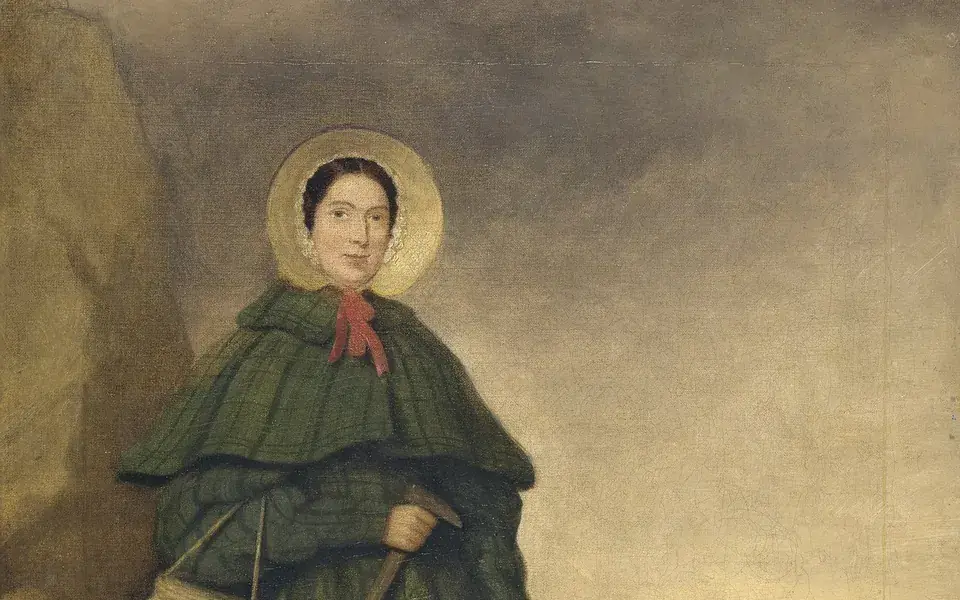
Mary Anning (21 May 1799 – 9 March 1847) was an English fossil collector, dealer, and palaeontologist. She became known internationally for her discoveries in Jurassic marine fossil beds in the cliffs along the English Channel at Lyme Regis in the county of Dorset, South West England. Anning's findings contributed to changes in scientific thinking about prehistoric life and the history of the Earth.
Fossils as a family business
By the late 18th century, Lyme Regis had become a popular seaside resort, especially after 1792 when the outbreak of the French Revolutionary Wars made travel to the European mainland dangerous for the English gentry, and increasing numbers of wealthy and middle-class tourists were arriving there. Even before Anning's time, locals supplemented their income by selling what were called "curios" to visitors. These were fossils with colourful local names such as "snake-stones" (ammonites), "devil's fingers" (belemnites), and "verteberries" (vertebrae), to which were sometimes attributed medicinal and mystical properties. Fossil collecting was in vogue in the late 18th and early 19th century, at first as a pastime, but gradually transforming into a science as the importance of fossils to geology and biology was understood.
The source of most of these fossils was the coastal cliffs around Lyme Regis, part of a geological formation known as the Blue Lias. This consists of alternating layers of limestone and shale, laid down as sediment on a shallow seabed early in the Jurassic period (about 210–195 million years ago). It is one of the richest fossil locations in Britain. The cliffs could be dangerously unstable, however, especially in winter when rain weakened them, causing landslides. It was precisely during the winter months that collectors were drawn to the cliffs because the landslides often exposed new fossils.
Ichthyosaurs
Anning's first famous discovery was made shortly after her father's death when she was still a child of about 12. In 1811 (some sources say 1810 or 1809) her brother Joseph found a 4 ft (1.2 m) skull, but failed to locate the rest of the animal. After Joseph told Anning to look between the cliffs at Lyme Regis and Charmouth, she found the skeleton—17 ft (5.2 m) long in all—a few months later. The family hired workmen to dig it out in November that year, an event covered by the local press on 9 November, who identified the fossil as a crocodile.
Anning found several other ichthyosaur fossils between 1815 and 1819, including almost complete skeletons of varying sizes. In 1821, William Conybeare and Henry De la Beche, both members of the Geological Society of London, collaborated on a paper that analysed in detail the specimens found by Anning and others. They concluded that ichthyosaurs were a previously unknown type of marine reptile, and based on differences in tooth structure, they concluded that there had been at least three species. Also in 1821, Anning found the 20 ft (6.1 m) skeleton from which the species Ichthyosaurus platydon (now Temnodontosaurus platyodon) would be named. In the 1980s it was determined that the first ichthyosaur specimen found by Joseph and Mary Anning was also a member of Temnodontosaurus platyodon.
Plesiosaurus
In the same 1821 paper he co-authored with Henry De la Beche on ichthyosaur anatomy, William Conybeare named and described the genus Plesiosaurus (near lizard), called so because he thought it more like modern reptiles than the ichthyosaur had been. The description was based on a number of fossils, the most complete of them specimen OUMNH J.50146, a paddle and vertebral column that had been obtained by Lieutenant-Colonel Thomas James Birch. Christopher McGowan has hypothesised that this specimen had originally been much more complete and had been collected by Anning, during the winter of 1820/1821. If so, it would have been Anning's next major discovery, providing essential information about the newly recognised type of marine reptile. No records by Anning of the find are known. The paper thanked Birch for giving Conybeare access to it, but does not mention who discovered and prepared it.
In 1823, Anning discovered a second, much more complete plesiosaur skeleton, specimen NHMUK OR 22656 (formerly BMNH 22656). When Conybeare presented his analysis of plesiosaur anatomy to a meeting of the Geological Society in 1824, he again failed to mention Anning by name, even though she had possibly collected both skeletons and had made the sketch of the second skeleton he used in his presentation. Conybeare's presentation was made at the same meeting at which William Buckland described the dinosaur Megalosaurus and the combination created a sensation in scientific circles.