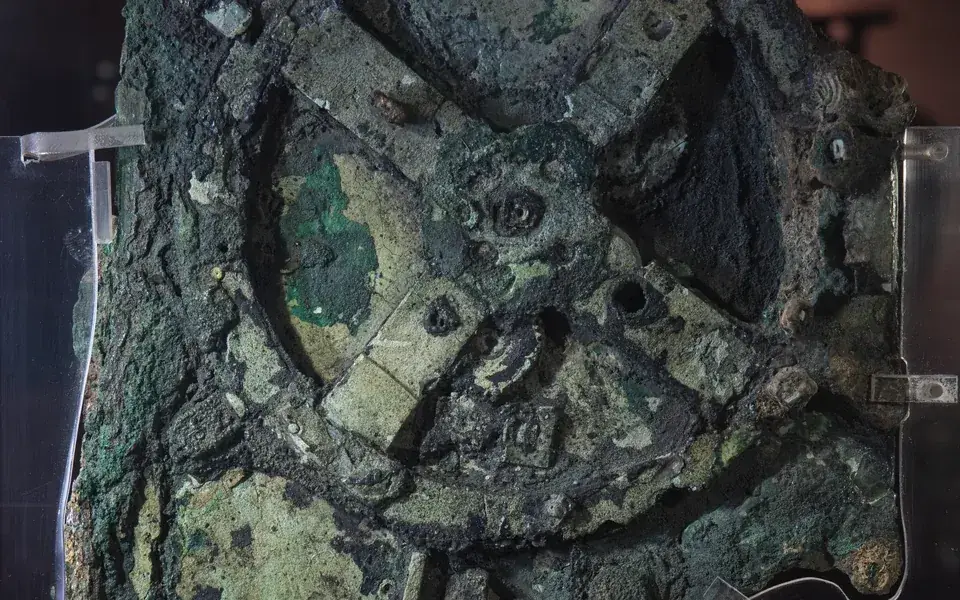
The Antikythera mechanism is an ancient Greek hand-powered orrery (model of the Solar System) built in the 2nd century BC and discovered in 1901. It is the oldest known example of an analogue computer. It could be used to predict astronomical positions and eclipses decades in advance. It could also be used to track the four-year cycle of athletic games similar to an olympiad, the cycle of the ancient Olympic Games.
Discovery
Captain Dimitrios Kontos and a crew of sponge divers from Symi island discovered the Antikythera wreck in early 1900, and recovered artefacts during the first expedition with the Hellenic Royal Navy, in 1900–1901. This wreck of a Roman cargo ship was found at a depth of 45 metres (148 ft) off Point Glyphadia on the Greek island of Antikythera. The team retrieved numerous large objects, including bronze and marble statues, pottery, unique glassware, jewellery, coins, and the mechanism. The mechanism was retrieved from the wreckage in 1901, probably July. It is unknown how the mechanism came to be on the cargo ship.
All of the items retrieved from the wreckage were transferred to the National Museum of Archaeology in Athens for storage and analysis. The mechanism appeared to be a lump of corroded bronze and wood. The bronze had turned into atacamite which cracked and shrank when it was brought up from the shipwreck, changing the dimensions of the pieces. It went unnoticed for two years, while museum staff worked on piecing together more obvious treasures, such as the statues. Upon removal from seawater, the mechanism was not treated, resulting in deformational changes.
Origin
The Antikythera mechanism is generally referred to as the first known analogue computer. The quality and complexity of the mechanism's manufacture suggests it must have had undiscovered predecessors during the Hellenistic period. Its construction relied on theories of astronomy and mathematics developed by Greek astronomers during the second century BC, and it is estimated to have been built in the late second century BC or the early first century BC.
In 2008, research by the Antikythera Mechanism Research Project suggested the concept for the mechanism may have originated in the colonies of Corinth, since they identified the calendar on the Metonic Spiral as coming from Corinth, or one of its colonies in northwest Greece or Sicily. Syracuse was a colony of Corinth and the home of Archimedes, and the Antikythera Mechanism Research Project argued in 2008 that it might imply a connection with the school of Archimedes. It was demonstrated in 2017 that the calendar on the Metonic Spiral is of the Corinthian type, but cannot be that of Syracuse.
Operation
On the front face of the mechanism, there is a fixed ring dial representing the ecliptic, the twelve zodiacal signs marked off with equal 30-degree sectors. This matched with the Babylonian custom of assigning one twelfth of the ecliptic to each zodiac sign equally, even though the constellation boundaries were variable. Outside that dial is another ring which is rotatable, marked off with the months and days of the Sothic Egyptian calendar, twelve months of 30 days plus five intercalary days. The months are marked with the Egyptian names for the months transcribed into the Greek alphabet. The first task is to rotate the Egyptian calendar ring to match the current zodiac points. The Egyptian calendar ignored leap days, so it advanced through a full zodiac sign in about 120 years.
The operator also had to be aware of the position of the spiral dial pointers on the two large dials on the back. The pointer had a "follower" that tracked the spiral incisions in the metal as the dials incorporated four and five full rotations of the pointers. When a pointer reached the terminal month location at either end of the spiral, the pointer's follower had to be manually moved to the other end of the spiral before proceeding further.