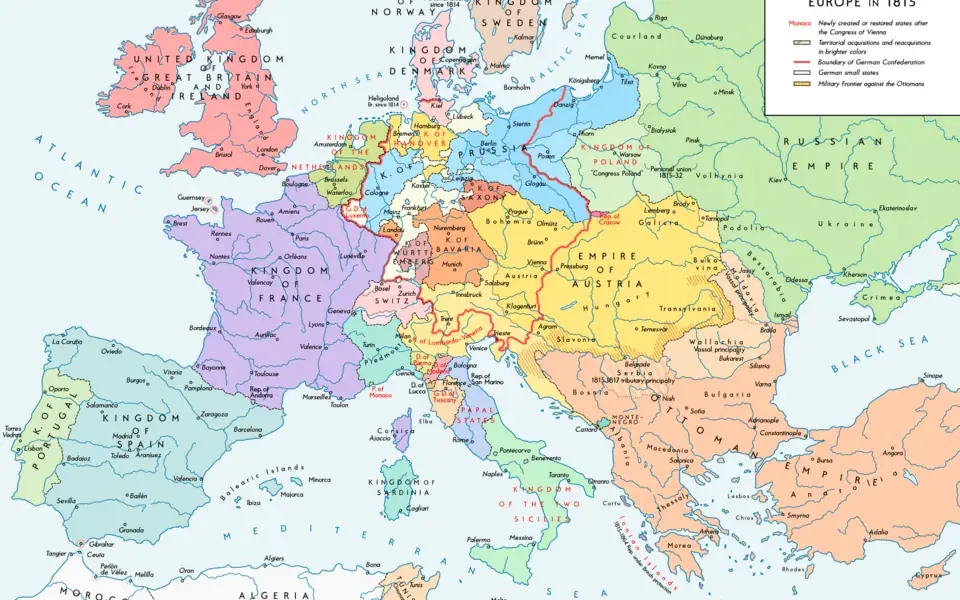
The Congress of Vienna considered postwar territorial and political arrangements. Major powers negotiated changes to borders and dynastic rule in hopes of establishing a more stable balance of power. Napoleon's return to France during the congress renewed tensions. The settlement shaped nineteenth-century Europe but could not remove nationalist and revolutionary questions.
Historical background
The Congress of Vienna of 1814–1815 was a series of international diplomatic meetings to discuss and agree upon a possible new layout of the European political and constitutional order after the downfall of the French emperor Napoleon Bonaparte. Participants were representatives of all European powers (other than the Ottoman Empire) and other stakeholders. The Congress was chaired by Austrian statesman Klemens von Metternich (Duke Metternich) and was held in Vienna from September 1814 to June 1815.
The objective of the Congress was to provide a long-term peace plan for Europe by settling critical issues arising from the French Revolutionary Wars and the Napoleonic Wars through negotiation. The goal was not simply to restore old boundaries, but to resize the main powers so they could balance each other and remain at peace, being at the same time shepherds for the smaller powers. More generally, conservative leaders like Metternich also sought to restrain or eliminate Bonapartist, republican, liberal, and revolutionary movements which, from their point of view, had upended the constitutional order of the European ancien régime.
The Congress format
The name "Congress of Vienna" was not meant to suggest a formal plenary session, but rather the creation of a diplomatic organizational framework bringing together stakeholders of all flocks to enable the expression of opinions, interests and sentiments and facilitate discussion of general issues among them. The Congress format had been developed by Austrian Foreign Minister Klemens von Metternich, assisted by Friedrich von Gentz, and was the first occasion in history where, on a continental scale, national representatives and other stakeholders came together in one city at the same time to discuss and formulate the conditions and provisions of treaties.
Before the Congress of Vienna the common method of diplomacy involved the exchange of notes sent back and forth among the several capitals and separate talks in different places, a cumbersome process that required much in the way of time and transportation. The format set at the Congress of Vienna would serve as inspiration for the 1856 peace conference brokered by France (the Congress of Paris) that settled the Crimean War.
Polish-Saxon questions
The most complex topic at the Congress was the Polish-Saxon Crisis. Russia wanted most of Poland, and Prussia wanted all of Saxony, whose king had allied with Napoleon. The tsar had wanted to become king of Poland. Austria concluded that this would make Russia too powerful – a view which was supported by Britain. The result was a deadlock, for which Talleyrand proposed a solution: admit France to the inner circle, and France would support Austria and Britain. The three nations signed a treaty on 3 January 1815, among only the three of them, agreeing to go to war against Russia and Prussia, if necessary, to prevent the Russo-Prussian plan from coming to fruition.
When the Tsar heard of the treaty he agreed to a compromise that satisfied all parties on 24 October 1815. Russia received most of the Napoleonic Duchy of Warsaw as a "Kingdom of Poland" – called Congress Poland, with the tsar as a king ruling it independently of Russia.
Other changes
The Congress's principal results, apart from its confirmation of France's loss of the territories annexed between 1795 and 1810, which had already been settled by the Treaty of Paris, were the enlargement of Russia (which gained most of the Duchy of Warsaw) and Prussia, which acquired the district of Poznań, Swedish Pomerania, Westphalia, and the northern Rhineland. The consolidation of Germany from the nearly 300 states of the Holy Roman Empire (dissolved in 1806) into a much less complex system of thirty-nine states (four of which were free cities) was confirmed. These states formed a loose German Confederation under the leadership of Austria.