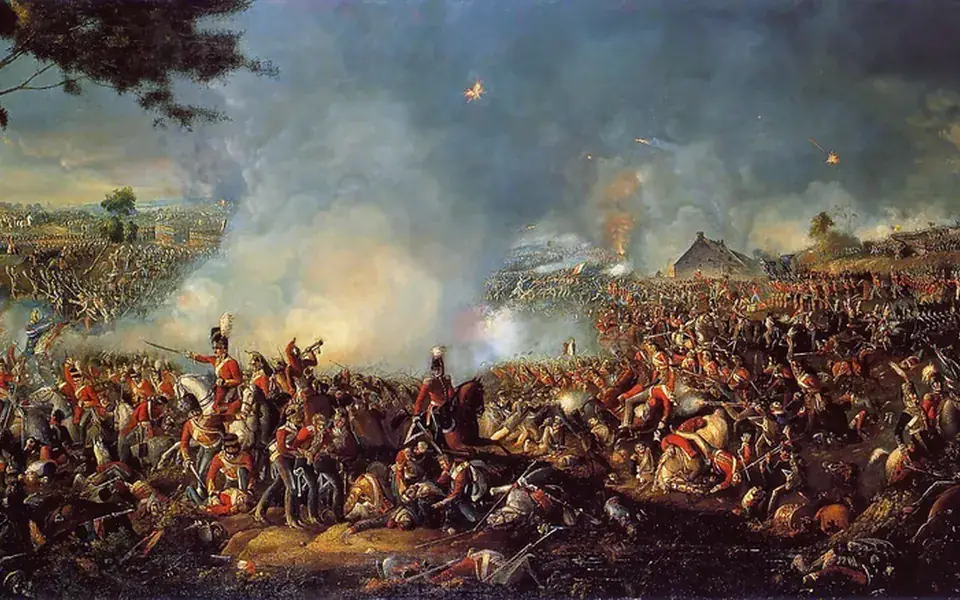
At the Battle of Waterloo in 1815, Napoleon's army was defeated by allied forces commanded by Wellington, Blucher, and others. His Hundred Days rule ended soon afterward. The battle involved marching, terrain, timing, and coordination among several forces. Later commemorations often compress its complexity into a single hero or one mistake.
Historical background
The Battle of Waterloo was fought on Sunday 18 June 1815, near Waterloo (then in the United Kingdom of the Netherlands, now in Belgium), being the last engagement with Napoleon I. The French Imperial Army under the command of Napoleon I was defeated by two armies of the Seventh Coalition. One was a British-led force with units from the United Kingdom, the Netherlands, Hanover, Brunswick, and Nassau, under the command of field marshal Arthur Wellesley, Duke of Wellington. The other comprised three corps of the Prussian army under Field Marshal Gebhard Leberecht von Blücher.
The battle was known contemporaneously as the Battle of Mont Saint-Jean in France (after the hamlet of Mont-Saint-Jean) and La Belle Alliance in Prussia ("the Beautiful Alliance"; after the inn of La Belle Alliance).
Upon Napoleon's return to power in March 1815, the beginning of the Hundred Days, many states that had previously opposed him formed the Seventh Coalition to oppose him again and hurriedly mobilised their armies. Wellington's and Blücher's armies were cantoned close to the northeastern border of France. Napoleon planned to attack them separately, before they could link up and invade France with other members of the coalition.
Prelude
On 13 March 1815, six days before Napoleon I reached Paris, the powers at the Congress of Vienna declared him an outlaw. Four days later, the United Kingdom, Russia, Austria, and Prussia mobilised armies to defeat Napoleon. Critically outnumbered, Napoleon knew that once his attempts at dissuading one or more members of the Seventh Coalition from invading France had failed, his only chance of remaining in power was to attack before the coalition mobilised.
Had Napoleon succeeded in destroying the existing coalition forces south of Brussels before they were reinforced, he might have been able to drive the British back to the sea and knock Prussia out of the war. Crucially, this would have bought him time to recruit and train more men before turning his armies against the Austrians and Russians.
Attack of the Imperial Guard
Meanwhile, with Wellington's centre exposed by the fall of La Haye Sainte and the Plancenoit front temporarily stabilised, Napoleon committed his last reserve, the hitherto-undefeated Imperial Guard infantry. This attack, mounted at around 19:30, was intended to break through Wellington's centre and roll up his line away from the Prussians. Although it is one of the most celebrated passages of arms in military history, it had been unclear which units actually participated. It appears that it was mounted by five battalions of the Middle Guard, and not by the grenadiers or chasseurs of the Old Guard.
... I saw four regiments of the middle guard, conducted by the Emperor, arriving. With these troops, he wished to renew the attack, and penetrate the centre of the enemy. He ordered me to lead them on; generals, officers and soldiers all displayed the greatest intrepidity; but this body of troops was too weak to resist, for a long time, the forces opposed to it by the enemy, and it was soon necessary to renounce the hope which this attack had, for a few moments, inspired.
Aftermath
Waterloo cost Wellington around 17,000 dead or wounded, and Blücher some 7,000 (810 of which were suffered by just one unit: the 18th Regiment, which served in Bülow's 15th Brigade, had fought at both Frichermont and Plancenoit, and won 33 Iron Crosses). Napoleon's losses were 24,000 to 26,000 killed or wounded, including 6,000 to 7,000 captured, with an additional 15,000 deserting subsequent to the battle and over the following days.
22 June. This morning I went to visit the field of battle, which is a little beyond the village of Waterloo, on the plateau of Mont-Saint-Jean; but on arrival there the sight was too horrible to behold. I felt sick in the stomach and was obliged to return. The multitude of carcasses, the heaps of wounded men with mangled limbs unable to move, and perishing from not having their wounds dressed or from hunger, as the Allies were, of course, obliged to take their surgeons and waggons with them, formed a spectacle I shall never forget. The wounded, both of the Allies and the French, remain in an equally deplorable state.