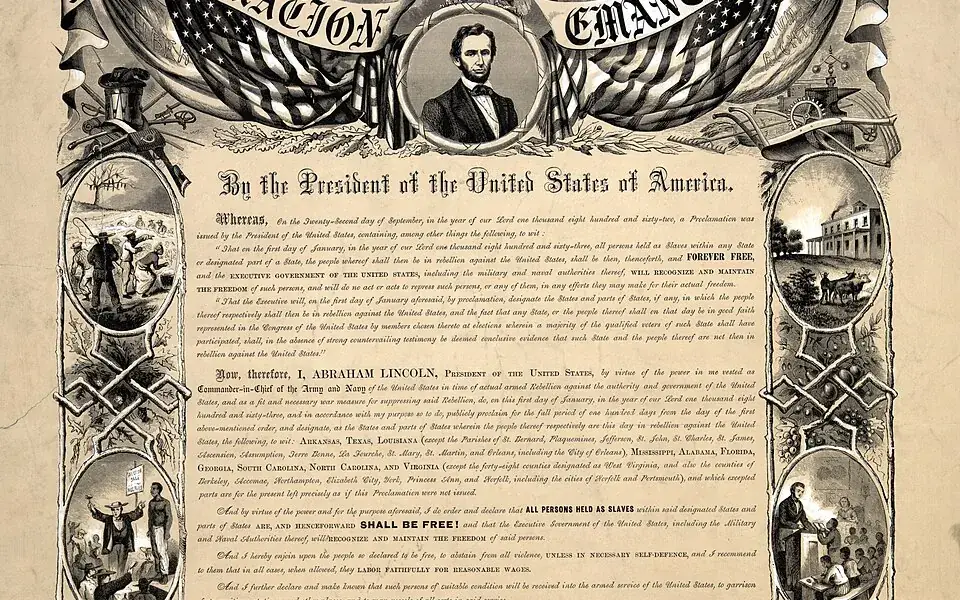
Lincoln's Emancipation Proclamation took effect in 1863, chiefly applying to territories in rebellion and expressly exempting some areas under Union control. It changed the war's political meaning, but abolishing slavery nationwide required a later constitutional amendment. Those two developments should not be confused.
Historical background
The Emancipation Proclamation, officially Proclamation 95, was a presidential proclamation and executive order issued by United States president Abraham Lincoln on January 1, 1863, during the American Civil War. The Proclamation changed the legal status of more than 3.5 million enslaved African Americans in the secessionist Confederate states from enslaved to free. As soon as slaves escaped the control of their enslavers, either by fleeing to Union lines or through the advance of federal troops, they were permanently free. In addition, the Proclamation allowed for former slaves to "be received into the armed service of the United States". The Emancipation Proclamation played a significant part in the end of slavery in the United States.
That on the first day of January in the year of our Lord, one thousand eight hundred and sixty-three, all persons held as slaves within any State, or designated part of a State, the people whereof shall then be in rebellion against the United States shall be then, thenceforward, and forever free;...
Authority
The United States Constitution of 1787 did not use the word "slavery" but included several provisions about unfree persons. The Three-Fifths Compromise (in Article I, Section 2) allocated congressional representation, and therefore the number of each states' votes in the Electoral College, based "on the whole Number of free Persons" and "three-fifths of all other Persons". Under the Fugitive Slave Clause (Article IV, Section 2), "No person held to Service or Labour in one State" would become legally free by escaping to another. Article I, Section 9 allowed Congress to pass legislation to outlaw the "Importation of Persons", but not until 1808.
In addition, for purposes of the Fifth Amendment—which states, "No person shall... be deprived of life, liberty, or property, without due process of law"—slaves were understood to be property. Although abolitionists used the Fifth Amendment to argue against slavery, it was made part of the legal basis for treating slaves as property by Dred Scott v. Sandford (1857). Slavery was also supported in law and in practice by a pervasive culture of white supremacy. Nonetheless, between 1777 and 1804, every Northern state provided for the immediate or gradual abolition of slavery.
Coverage
The Emancipation Proclamation applied only in the ten states that were still in rebellion on January 1, 1863, namely South Carolina, Mississippi, Florida, Alabama, Georgia, Louisiana, Texas, Virginia, Arkansas, North Carolina. The Proclamation did not cover the nearly 500,000 slaves in the slaveholding border states of Maryland, Delaware, Missouri and Kentucky. Also not named was the state of Tennessee, in which a Union-controlled military government had already been set up, based in the capital, Nashville. Specific exemptions were stated for other areas under Union control on January 1, 1863, namely 48 counties that would soon become West Virginia, seven other named counties of Virginia including Berkeley county, which was soon added to West Virginia, New Orleans and 13 named parishes nearby.
Exemptions were also made for certain areas that were deemed no longer in rebellion and areas Lincoln considered loyal to the Union. Enslaved people in those areas would be freed by later state and federal actions. The areas covered were, as the Proclamation stated, "Arkansas, Texas, Louisiana (except the Parishes of St. Bernard, Plaquemines, Jefferson, St. John, St. Charles, St. James, Ascension, Assumption, Terrebonne, Lafourche, St. Mary, St. Martin, and Orleans, including the city of New Orleans), Mississippi, Alabama, Florida, Georgia, South Carolina, North Carolina, and Virginia (except the forty-eight counties designated as West Virginia, and also the counties of Berkley, Accomac, Northampton, Elizabeth City, York, Princess Ann, and Norfolk, including the cities of Norfolk and Portsmouth)."
Immediate impact
On New Year's Eve in 1862, African Americans – enslaved and free – gathered across the United States to hold Watch Night ceremonies for "Freedom's Eve", looking toward the stroke of midnight and the promised fulfillment of the Proclamation. It has been inaccurately claimed that the Emancipation Proclamation did not free a single slave; historian Lerone Bennett Jr. alleged that the Proclamation was a hoax deliberately designed not to free any slaves. However, as a result of the Proclamation, most slaves became free during the war, beginning on the day it took effect; eyewitness accounts at places such as Hilton Head Island, South Carolina, and Port Royal, South Carolina record celebrations on January 1 as thousands of blacks were informed of their new legal status of freedom.