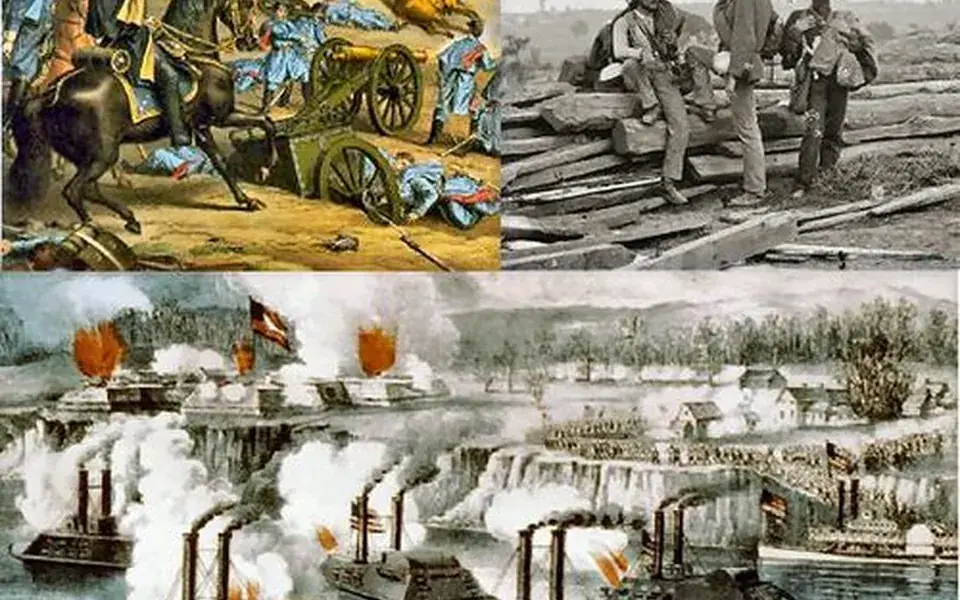
During the American Civil War, railways transported troops and supplies over long distances, while telegraphs accelerated orders and news. These technologies became part of modern military organization. The war was also rooted in slavery, the relationship between states and the federal government, and political and economic conflicts. Military technology is one aspect of understanding it.
Historical background
The U.S. Military Railroad (USMRR) was established by the United States War Department as a separate agency to operate any rail lines seized by the government during the American Civil War. An Act of Congress of 31 January 1862 authorized President Abraham Lincoln to seize control of the railroads and telegraph for military use in January 1862. In practice, however, the USMRR restricted its authority to Southern rail lines captured in the course of the war. As a separate organization for rail transportation, the USMRR is one of the predecessors of the modern United States Army Transportation Corps.
As the Confederate states organized, the US Army numbered 16,000, while Northern governors began mobilizing their militias. The Confederate Congress authorized up to 100,000 troops in February. By May, Jefferson Davis was pushing for another 100,000 soldiers for one year or the duration, and the US Congress responded in kind.
In the first year of the war, both sides had more volunteers than they could effectively train and equip. After the initial enthusiasm faded, relying on young men who came of age each year was not enough. Both sides enacted draft laws (conscription) to encourage or force volunteering, though relatively few were drafted. The Confederacy passed a draft law in April 1862 for men aged 18 to 35, with exemptions for overseers, government officials, and clergymen. The US Congress followed in July, authorizing a militia draft within states that could not meet their quota with volunteers. European immigrants joined the Union Army in large numbers, including 177,000 born in Germany and 144,000 in Ireland. About 50,000 Canadians served, around 2,500 of whom were black.
Economic impact
The Southern economy nearly collapsed during the war due to multiple factors, the most notable being severe food shortages, failing railroads, loss of control over key rivers, foraging by Northern armies, and the seizure of animals and crops by Confederate forces. Historians agree the blockade was a major factor in ruining the Confederate economy; however, Wise argues blockade runners provided enough of a lifeline to allow General Robert E. Lee to continue fighting for additional months, as a result of supplies that included 400,000 rifles, lead, blankets, and boots that the Confederate economy could no longer supply.
The Confederate cotton crop became nearly useless, which cut off the Confederacy's primary source of income. Critical imports were scarce, and coastal trade also largely ended. The blockade's success was not measured by the few ships, which slipped through, but by the thousands that never tried. European merchant ships could not obtain insurance for their ships and transport, and were too slow to evade the blockade, leading them to cease docking in Confederate ports.
Technological significance
Technological innovations during the war had a great impact on 19th-century science. The war was an early example of an "industrial war", in which technological might is used to achieve military supremacy. New inventions, such as the train and telegraph, delivered soldiers, supplies and messages at a time when horses had been the fastest way to travel. It was also in this war that aerial warfare, in the form of reconnaissance balloons, was first used. It saw the first action involving steam-powered ironclad warships in naval warfare history.
Repeating firearms such as the Henry rifle, Spencer repeating rifle, Colt revolving rifle, Triplett & Scott carbine and others, first appeared during the Civil War; they were a revolutionary invention that would soon replace muzzle-loading and single-shot firearms. The war saw the first appearances of rapid-firing weapons and machine guns such as the Agar gun and Gatling gun.