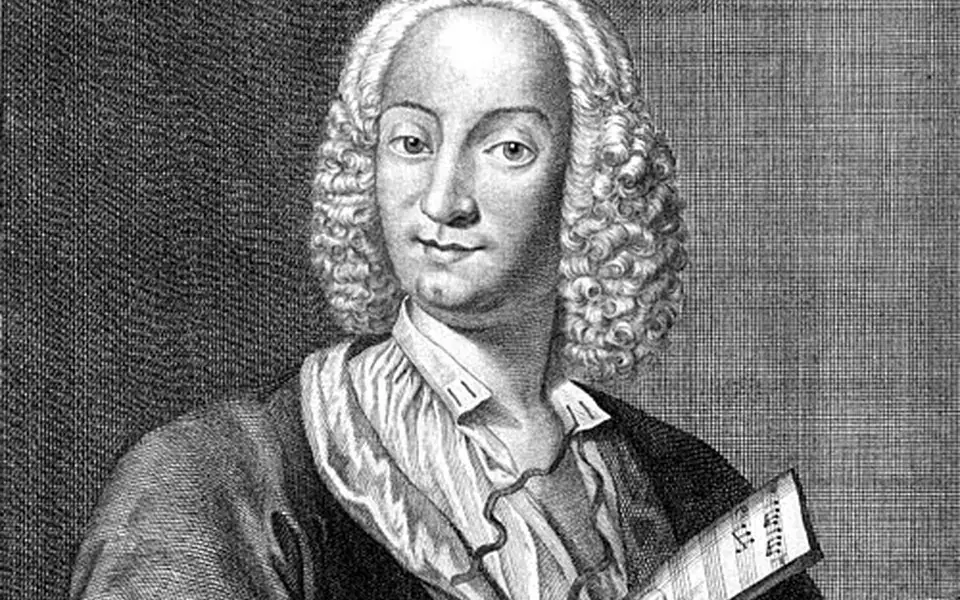
Vivaldi's The Four Seasons consists of four violin concertos. The music is connected to texts describing seasonal scenes, evoking birdsong, wind, rain, and other images. The pieces exemplify the relationship between soloist and ensemble in a Baroque concerto. They are four concertos with several movements each, rather than four short movements.
Historical background
The Four Seasons is a group of four violin concerti by Italian composer Antonio Vivaldi, each of which gives musical expression to a season of the year. These were composed around 1718–1723, when Vivaldi was the court chapel master in Mantua. They were published in 1725 in Amsterdam in what was at the time the Dutch Republic, together with eight additional concerti, as Il cimento dell'armonia e dell'inventione (The Contest Between Harmony and Invention).
The Four Seasons is the best known of Vivaldi's works. The inspiration for the concertos is not the countryside around Mantua, as initially supposed, where Vivaldi was living at the time, since according to Karl Heller they could have been written as early as 1716–1717, while Vivaldi was engaged with the court of Mantua only in 1718.
They were a revolution in musical conception: Vivaldi represented flowing creeks, singing birds (of different species, each specifically characterized), a shepherd and his barking dog, buzzing flies, storms, drunken dancers, hunting parties from both the hunters' and the prey's point of view, frozen landscapes, and warm winter fires.
Unusual for the period, Vivaldi published the concerti with accompanying sonnets (possibly written by the composer himself) that elucidated what it was in the spirit of each season that his music was intended to evoke. The concerti therefore stand as one of the earliest and most detailed examples of what would come to be called program music—in other words, music with a narrative element. Vivaldi took great pains to relate his music to the texts of the poems, translating the poetic lines themselves directly into the music on the page. For example, in the second movement of "Spring", when the goatherd sleeps, his barking dog can be heard in the viola section. The music is elsewhere similarly evocative of other natural sounds. Vivaldi divided each concerto into three movements (fast–slow–fast), and, likewise, each linked sonnet into three sections.
Sonnets and allusions
There is some debate as to whether the four concerti were written to accompany four sonnets or vice versa. Though it is not known who wrote the accompanying sonnets, the theory that Vivaldi wrote them is supported by the fact that each sonnet is broken into three sections, each neatly corresponding to a movement in the concerto. Regardless of the sonnets' authorship, The Four Seasons can be classified as program music, instrumental music intended to evoke something extra-musical, and an art form which Vivaldi was determined to prove sophisticated enough to be taken seriously.
In addition to these sonnets, Vivaldi provided instructions such as "The barking dog" (in the second movement of "Spring"), "Languor caused by the heat" (in the first movement of "Summer"), and "the drunkards have fallen asleep" (in the second movement of "Autumn").
Mantua and the Four Seasons
In 1717 or 1718, Vivaldi was offered a prestigious new position as Maestro di Cappella of the court of Prince Philip of Hesse-Darmstadt, governor of Mantua, in the northwest of Italy He moved there for three years and produced several operas, among them Tito Manlio (RV 738). In 1721, he was in Milan, where he presented the pastoral drama La Silvia (RV 734); nine arias from it survive. He visited Milan again the following year with the oratorio L'adorazione delli tre re magi al bambino Gesù (RV 645, now lost). In 1722 he moved to Rome, where he introduced his operas' new style. The new Pope Benedict XIII invited Vivaldi to play for him. In 1725, Vivaldi returned to Venice, where he produced four operas in the same year.
During this period, Vivaldi wrote the Four Seasons, four violin concertos that give musical expression to the seasons of the year. The composition is probably one of his most famous. Although three of the concerti are wholly original, the first, "Spring", borrows motifs from a Sinfonia in the first act of Vivaldi's contemporaneous opera Il Giustino. The inspiration for the concertos was probably the countryside around Mantua. They were a revolution in musical conception: in them, Vivaldi represented flowing streams, singing birds (of different species, each specifically characterized), barking dogs, buzzing mosquitoes, crying shepherds, storms, drunken dancers, silent nights, hunting parties from both the hunters' and the prey's point of view, frozen landscapes, ice-skating children, and warming winter fires.