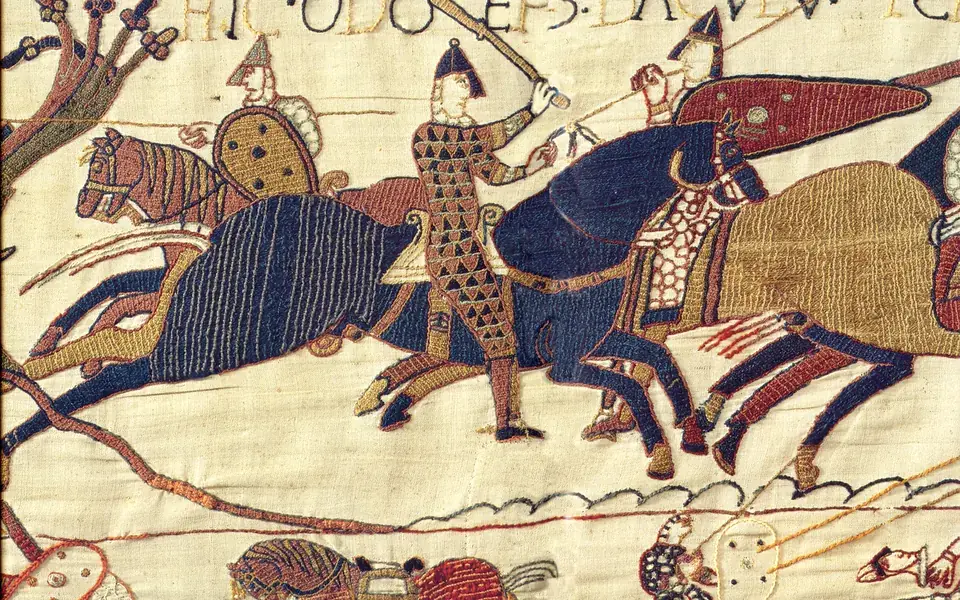
The Bayeux Tapestry depicts events connected with the Norman Conquest in a continuous sequence. Despite its familiar name, its principal technique is embroidery on linen. Written captions accompany the scenes, and the people, ships, and everyday details offer historical evidence. The work also reflects its patronage and narrative perspective.
Historical background
The Bayeux Tapestry is an embroidered cloth nearly 70 metres (230 feet) long and 50 centimetres (20 inches) tall that depicts the events leading up to the Norman conquest of England, led by William, Duke of Normandy, and the Battle of Hastings in 1066. It is normally thought to have been made in England in the decades after the events it shows, although the earliest known written reference to it was in 1476. Since 2007 it has been inscribed on UNESCO's Memory of the World Register. It is normally displayed in the Bayeux Tapestry Museum in Bayeux, Normandy, France, but this is closed for renovation until 2027, and the work is currently on display in London.
Despite its name, the work is technically an embroidery rather than a true tapestry, since the images are stitched rather than woven into the fabric. It was worked in wool thread on a coarse linen ground using four different stitches and ten natural dye colours. The cloth now consists of 58 scenes, all with Medieval Latin tituli. The surviving piece depicts 623 human figures, 994 animals, 438 plants, 37 buildings and fortifications, 41 ships and boats, and a vast array of other objects.
Origins
The earliest known written reference to the tapestry is a 1476 inventory of Bayeux Cathedral, but its origins have been the subject of much speculation and controversy.
French legend maintained the tapestry was commissioned and created by Queen Matilda, the powerful wife of William the Conqueror, and her ladies-in-waiting. Indeed, in France, it is occasionally known as La Tapisserie de la Reine Mathilde ("The Tapestry of Queen Matilda"). However, scholarly analysis in the 20th century concluded it was probably commissioned by William's half-brother, Bishop Odo of Bayeux, who, after the Conquest, also became Earl of Kent and, when William was absent in Normandy, regent of England.
If the tapestry was indeed commissioned by Odo, it was probably designed and constructed in England by Anglo-Saxon artists, with most contemporary scholars arguing that it was probably made in or around Canterbury: it is similar to illuminated manuscripts made in monastic libraries there or owned by them; Odo's English power base was by then in Kent; the Latin text contains hints of Anglo-Saxon; other embroideries originate from England at this time; and the vegetable dyes can be found in cloth traditionally woven there.
Construction, design and technique
In common with other embroidered hangings of the early medieval period, this piece is conventionally referred to as a "tapestry", although it is not a true tapestry in which the design is woven into the cloth in tapestry weave; it is technically an embroidery, although it meets the traditional broader definition of "tapestry" as: "A textile fabric decorated with designs of ornament or pictorial subjects, painted, embroidered, or woven in colours, used for wall hangings, curtains, covers for seats,..."
The Bayeux tapestry is embroidered in crewel (wool yarn) on a tabby-woven linen ground 68.38 m long and 70 cm tall (224.3 ft × 2.3 ft) of which about 50 centimetres (20 in) are devoted to the embroidery itself. It uses two methods of stitching: outline or stem stitch for lettering and the outlines of figures, and couching or laid work for filling in figures. Nine linen panels, between fourteen and three metres in length, were sewn together after each was embroidered and the joins were disguised with subsequent embroidery. At the first join (end of scene 13) the borders do not line up properly but the technique was improved so that the later joins are practically invisible.
The design involved a broad central zone with narrow decorative borders top and bottom. By inspecting the woollen threads behind the linen it is apparent all these aspects were embroidered together at a session and the awkward placing of the tituli is not due to them being added later. Later generations have patched the hanging in numerous places and some of the embroidery (especially in the final scene) has been reworked. The tapestry may well have maintained much of its original appearance—it now compares closely with a careful drawing made in 1730.