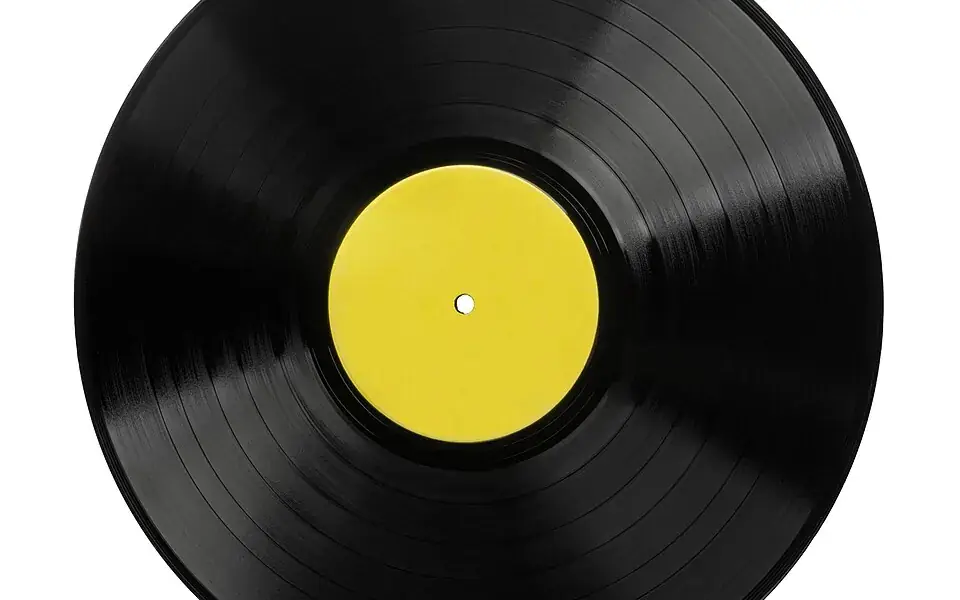
A record's stylus follows a groove, converting its tiny variations back into sound. Materials, playback speeds, and recording methods underwent repeated changes over time. Early discs and cylinders competed in the market. The recording industry transformed musical circulation, allowing listeners to replay and collect particular performances.
Historical background
A phonograph record (also known as a gramophone record, especially in British English) or a vinyl record (for later varieties only) is a disc-shaped analog sound storage medium with an inscribed, modulated spiral groove. The groove usually starts near the outside edge and ends near the center of the disc. The stored sound information is made audible by playing the record on a phonograph (or "gramophone", "turntable", or "record player").
Records have been produced in different formats with playing times ranging from a few minutes to around 30 minutes per side. For about half a century, the discs were commonly made from shellac and these records typically ran at a rotational speed of 78 rpm, giving it the nickname "78s" ("seventy-eights").
Predecessors
The phonautograph was invented by 1857 by Frenchman Édouard-Léon Scott de Martinville. It could not, however, play back recorded sound, as he intended for people to read back the tracings, which he called phonautograms. Prior to this, tuning forks had been used in this way to create direct tracings of the vibrations of sound-producing objects, as by English physicist Thomas Young in 1807.
In 1877, Thomas Edison invented the first phonograph, which etched sound recordings onto phonograph cylinders. Unlike the phonautograph, Edison's phonograph could both record and reproduce sound, via two separate needles, one for each function.
The first disc records
The first commercially sold disc records were created by Emile Berliner in the 1880s. Emile Berliner improved the quality of recordings while his manufacturing associate Eldridge R. Johnson, who owned a machine shop in Camden, New Jersey, eventually improved the mechanism of the gramophone with a spring motor and a speed regulating governor, resulting in a sound quality equal to Edison's cylinders. Abandoning Berliner's "Gramophone" trademark for legal reasons in the United States, Johnson's and Berliner's separate companies reorganized in 1901 to form the Victor Talking Machine Company in Camden, New Jersey, whose products would come to dominate the market for several decades.
Berliner's Montreal factory, which became the Canadian branch of RCA Victor, still exists. There is a dedicated museum in Montreal for Berliner (Musée des ondes Emile Berliner).
Acoustic recording
Early recordings were made entirely acoustically: sound was collected by a horn and piped to a diaphragm, which vibrated the cutting stylus. Sensitivity and frequency range were poor, and frequency response was irregular, giving acoustic recordings an instantly recognizable tonal quality. A singer almost had to put their face in the recording horn. A way of reducing resonance was to wrap the recording horn with tape.
Even drums, if placed properly, could be effectively recorded and heard on even the earliest jazz and military band recordings. The loudest instruments, like drums and trumpets, were positioned further away from the collecting horn. Lillian Hardin Armstrong, a member of King Oliver's Creole Jazz Band, which recorded at Gennett Records in 1923, remembered that at first Oliver and his young second trumpet, Louis Armstrong, stood next to each other and Oliver's horn could not be heard. "They put Louis about 15 ft (5 m) over in the corner, looking all sad."
Structure
Increasingly from the early 20th century, and almost exclusively since the 1920s, both sides of the record have been used to carry the grooves. Occasional records have been issued since then with a recording on only one side.
Since its inception in 1948, vinyl record standards for the United States follow the guidelines of the Recording Industry Association of America (RIAA).
Microgroove and vinyl era
The commercial rivalry between RCA Victor and Columbia Records led to RCA Victor's introduction of what it had intended to be a competing vinyl format, the 7-inch (180 mm) 45 rpm disc, with a much larger center hole. For a two-year period from 1948 to 1950, record companies and consumers faced uncertainty over which of these formats would ultimately prevail in what was known as the "War of the Speeds". In 1949 Capitol and Decca adopted the new LP format and RCA Victor gave in and issued its first LP in January 1950. The 45 rpm size was gaining in popularity, too, and Columbia issued its first 45s in February 1951. By 1954, 200 million 45s had been sold.