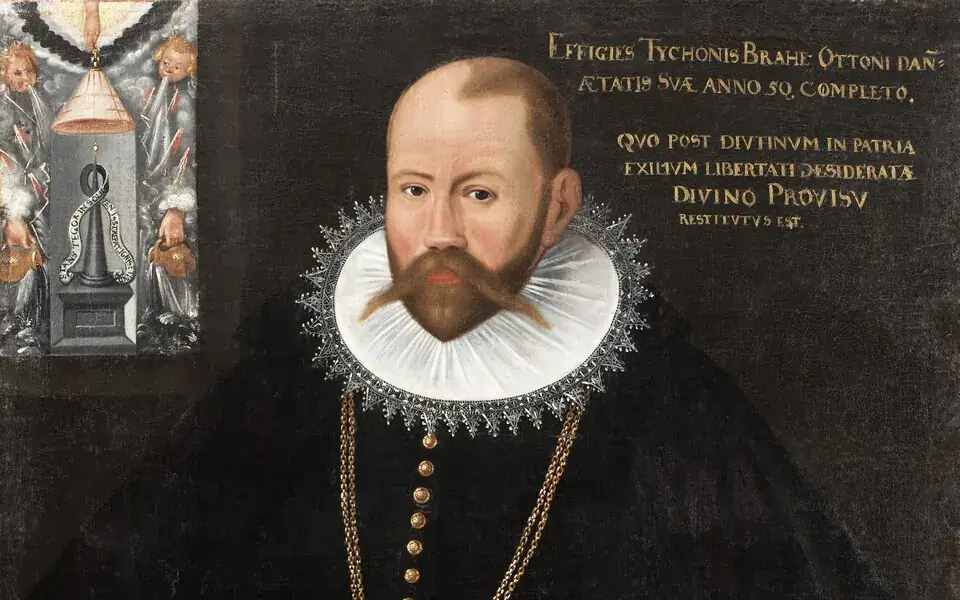
Tycho Brahe used large instruments to measure celestial positions, mostly before telescopes became widely used in astronomy. His observations later helped Kepler study planetary orbits.
He observed the new star of 1572 and studied comets. High-quality data can transform theories, and improving instruments involves more than magnifying an image.
Observational astronomy
Tycho's view of science was driven by his passion for accurate observations, and the quest for improved instruments of measurement drove his life's work. Tycho was the last major astronomer to work without the aid of a telescope, soon to be turned skyward by Galileo Galilei and others. Given the limitations of the naked eye for making accurate observations, he devoted many of his efforts to improving the accuracy of the existing types of instrument – the sextant and the quadrant. He designed larger versions of these instruments, which allowed him to achieve much higher accuracy. Because of the accuracy of his instruments, he quickly realized the influence of wind and the movement of buildings, and instead opted to mount his instruments underground directly on the bedrock.
He aspired to a level of accuracy in his estimated positions of celestial bodies of being consistently within an arcminute of their real celestial locations, and also claimed to have achieved this level. But, in fact, many of the stellar positions in his star catalogues were less accurate than that. The median errors for the stellar positions in his final published catalog were about 1.5', indicating that only half of the entries were more accurate than that, with an overall mean error in each coordinate of around 2'.
Although the stellar observations as recorded in his observational logs were more accurate, varying from 32.3" to 48.8" for different instruments, systematic errors of as much as 3' were introduced into some of the stellar positions Tycho published in his star catalog – due, for instance, to his application of an erroneous ancient value of parallax and his neglect of polestar refraction. Incorrect transcription in the final published star catalogue, by scribes in Tycho's employ, was the source of even larger errors, sometimes by many degrees.
Celestial objects observed near the horizon and above appear with a greater altitude than the real one, due to atmospheric refraction, and one of Tycho's most important innovations was that he worked out and published the very first tables for the systematic correction of this possible source of error. But, as advanced as they were, they attributed no refraction whatever above 45° altitude for solar refraction, and none for starlight above 20° altitude.
To perform the huge number of multiplications needed to produce much of his astronomical data, Tycho relied heavily on the then-new technique of prosthaphaeresis, an algorithm for approximating products based on trigonometric identities that predated logarithms.
Subsequent developments in astronomy
Kepler used Tycho's records of the motion of Mars to deduce laws of planetary motion, enabling calculation of astronomical tables with unprecedented accuracy (the Rudolphine Tables) and providing powerful support for a heliocentric model of the Solar System.
Galileo's 1610 telescopic discovery that Venus shows a full set of phases refuted the pure geocentric Ptolemaic model. After that it seems 17th-century astronomy mostly converted to geo-heliocentric planetary models that could explain these phases just as well as the heliocentric model could, but without the latter's disadvantage of the failure to detect any annual stellar parallax that Tycho and others regarded as refuting it.
The three main geo-heliocentric models were the Tychonic, the Capellan with just Mercury and Venus orbiting the Sun such as favoured by Francis Bacon, for example, and the extended Capellan model of Riccioli with Mars also orbiting the Sun whilst Saturn and Jupiter orbit the fixed Earth. The Tychonic model was probably the most popular, albeit probably in what was known as 'the semi-Tychonic' version with a daily rotating Earth. This model was advocated by Tycho's ex-assistant and disciple Longomontanus, in his 1622 Astronomia Danica, that was the intended completion of Tycho's planetary model with his observational data, and which was regarded as the canonical statement of the complete Tychonic planetary system. Longomontanus' work was published in several editions and used by many subsequent astronomers. Through him, the Tychonic system was adopted by astronomers as far away as China.