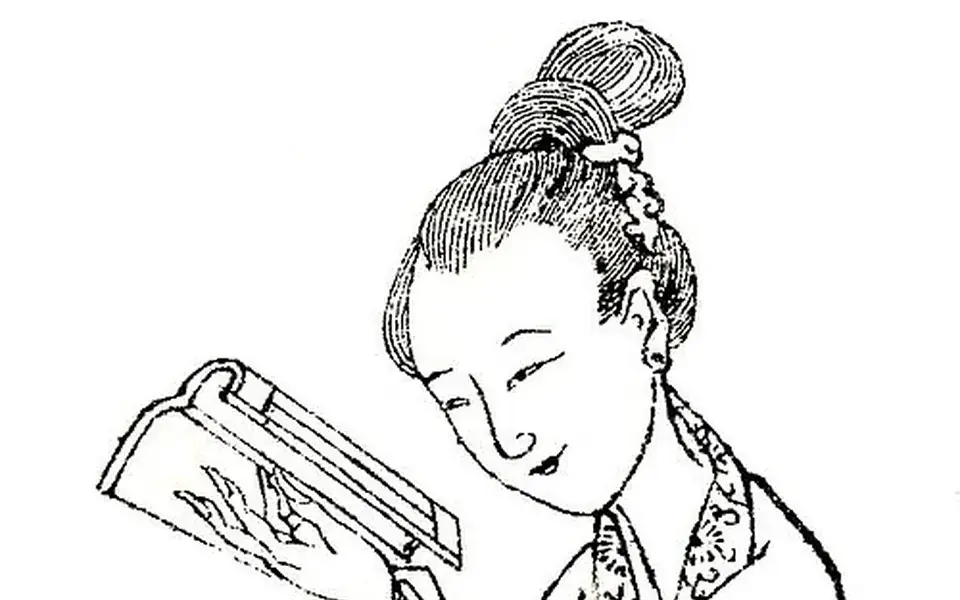
After her brother Ban Gu died, Ban Zhao helped complete parts of the Book of Han, particularly work associated with its tables and astronomical treatise.
She also taught and wrote. Lessons for Women reflects the gender and family norms of its time and should be read within the social context of the Eastern Han dynasty.
Family
Ban Zhao was born in Anling, near modern Xianyang, Shaanxi province. At age fourteen, she married a local resident named Cao Shishu and was called in the court by the name as Venerable Madame Cao. Her husband died when she was still young. She never remarried, instead devoting her life to scholarship. She was the daughter of the famous historian Ban Biao and younger sister of the general Ban Chao and of historian Ban Gu. She was also the grandniece of the notable scholar and poet Consort Ban.
Work
Ban Zhao contributed greatly to the completion and transmission of Hanshu (literally the "Book of the Han"), the official dynastic history of the Western Han. After Ban Gu was imprisoned and died in 92 because of his association with the family of Empress Dowager Dou, Ban Zhao helped finish the work by making up for the missing part of the Babiao ( Eight Tables). She added the genealogy of the mother of the emperor, providing much information which was not usually kept. Later, Ma Xu added a treatise on astronomy, making Hanshu a complete work.
Ban Zhao also wrote the Lessons for Women. This treatise on the education of women was dedicated to the daughters in Ban Zhao's family but was circulated immediately at court. It was popular for centuries in China as a guide for women's conduct.
Some modern interpretations of Lessons for Women claim that it is a founding text of Confucian feminism. One study asserts that it establishes a "different concept of agency... forged out of the powerlessness of individual women, which is familial, communal, indirect, and conferred by others." Such attitudes towards Zhao's work have roots in the Qing Dynasty, in which some praised Zhao as an example for Chinese women to get an education. Others, however, have argued that Ban Zhao's assertions of the value of a woman's mediocrity and servile behavior in Lessons for Women are incompatible with feminism and that attempts to present her as a feminist are misplaced. Since her text presents a woman's main task as submission to a husband or father and dismisses the significance of women's intelligence or talent, this has been seen as a Confucian endorsement of injustice against women.
She taught Empress Deng Sui and members of the court in the royal library, which gained her political influence. The Empress and concubines gave her the title Gifted one and the empress made her a Lady-in-waiting. As the Empress became regent for the infant Emperor Shang of Han, she often sought the advice of Ban Zhao. In gratitude, the Empress gave both Ban Zhao's sons appointments as officials. Ban Zhao was also a librarian at court, supervising the editorial labors of a staff of assistants and training other scholars in her work. In this capacity, she rearranged and enlarged the Biographies of Eminent Women by Liu Xiang. It is possible that she supervised the copying of manuscripts from bamboo slips and silk onto a recently invented material, paper.
In 113, Ban Zhao's son Cao Cheng was appointed an official in Chenliu Commandery. Ban accompanied him to Chenliu and wrote about the journey in Dong Zheng Fu, which has survived. After her death, her daughter-in-law, née Ding, gathered her works in the three-volume Collected Works of Ban Zhao, but most have been lost.