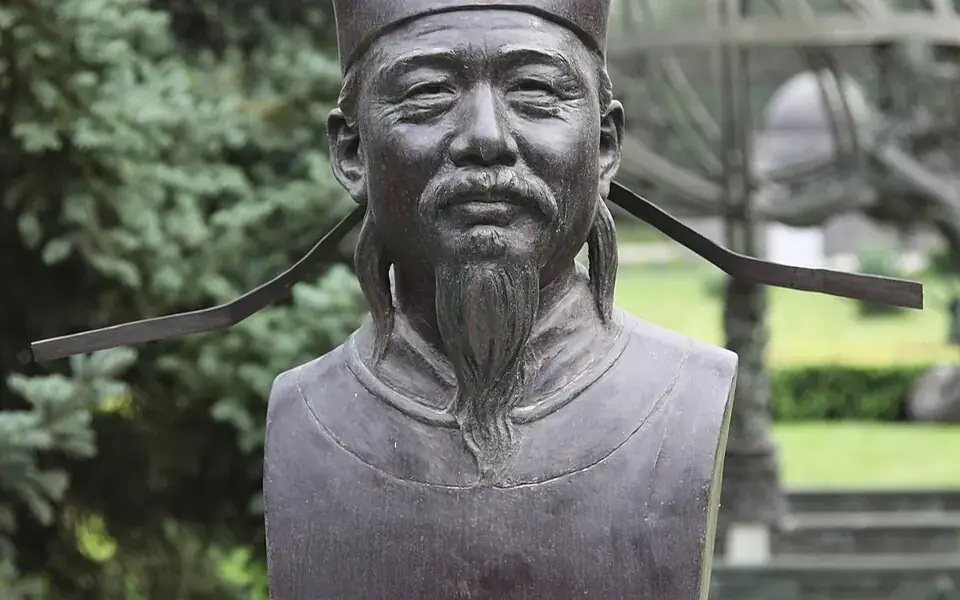
In Dream Pool Essays, Shen Kuo discussed astronomy, geography, medicine, crafts, and more. His subjects included Bi Sheng's movable-type printing and observations of a magnetic needle's direction.
Rather than a textbook of a single discipline, the collection gathers experience, commentary, and observations. It helps later readers understand the world of knowledge in the Song dynasty.
History
Because I had only my writing brush and ink slab to converse with, I call it Brush Talks.
As the historian Chen Dengyuan points out, much of Shen Kuo's written work was probably purged under the leadership of minister Cai Jing (1046–1126). For example, only six of Shen's books remain, and four of these have been significantly altered since the time they were penned by the author. The Dream Pool Essays was first quoted in a Chinese written work of 1095 AD, showing that even towards the end of Shen's life his final book was becoming widely printed. The book was originally 30 chapters long, yet an unknown Chinese author's edition of 1166 AD edited and reorganized the work into 26 chapters. There is one surviving copy of this 1166 edition now in Japan, while a Chinese reprint was produced in 1305. In 1631 another edition was printed, but it was heavily reorganized into three broad chapters.
In modern times, Zhang Jiaju's biographical work Shen Kuo (1962) contains selected translations of the Dream Pool Essays from Middle Chinese into modern Vernacular Chinese. The Dream Pool Essays has also been translated from Chinese into various foreign languages. Various volumes of Joseph Needham's Science and Civilization in China series published since 1954 contain a large amount of selected English translations of the Dream Pool Essays. The Brush Talks from Dream Brook is the first complete English translation, presented in two volumes by translators Wang Hong and Zhao Zheng, and published in 2008 by the Sichuan People's Publishing House, China. A Japanese translation of the 1166 Chinese edition was prepared by the History of Science Seminar, Institute for Research in Humanities (Jimbun Kagaku Kenkyusho) for Kyoto University, and printed by the author Umehara Kaoru in his 3-volume edition of Bokei hitsudan (1978–1981).
Quoted excerpts from the Dream Pool Essays in French were printed in the written works of J. Brenier in 1989 and J. F. Billeter in 1993. A complete German translation is offered in Shen Kuo: Pinselunterhaltungen am Traumbach. Das Gesamte Wissen des Alten China, translated and edited by Konrad Herrmann, and published in 1997 by Diederichs Verlag Munich (Gelbe Reihe Magnum, vol. I).
Content
The text addressed scientific knowledge in areas including physics, astrology, mathematics, and medicine; it contended that there was no contradiction between technology and Confucian precepts.
Astronomy
If they were like balls they would surely obstruct each other when they met. I replied that these celestial bodies were certainly like balls. How do we know this? By the waxing and waning of the moon. The moon itself gives forth no light, but is like a ball of silver; the light is the light of the sun (reflected). When the brightness is first seen, the sun(-light passes almost) alongside, so the side only is illuminated and looks like a crescent. When the sun gradually gets further away, the light shines slanting, and the moon is full, round like a bullet. If half of a sphere is covered with (white) powder and looked at from the side, the covered part will look like a crescent; if looked at from the front, it will appear round. Thus we know that the celestial bodies are spherical.
I answered that the ecliptic and the moon's path are like two rings, lying one over the other, but distant by a small amount. (If this obliquity did not exist), the sun would be eclipsed whenever the two bodies were in conjunction, and the moon would be eclipsed whenever they were exactly in position. But (in fact) though they may occupy the same degree, the two paths are not (always) near (each other), and so naturally the bodies do not (intrude) upon one another.