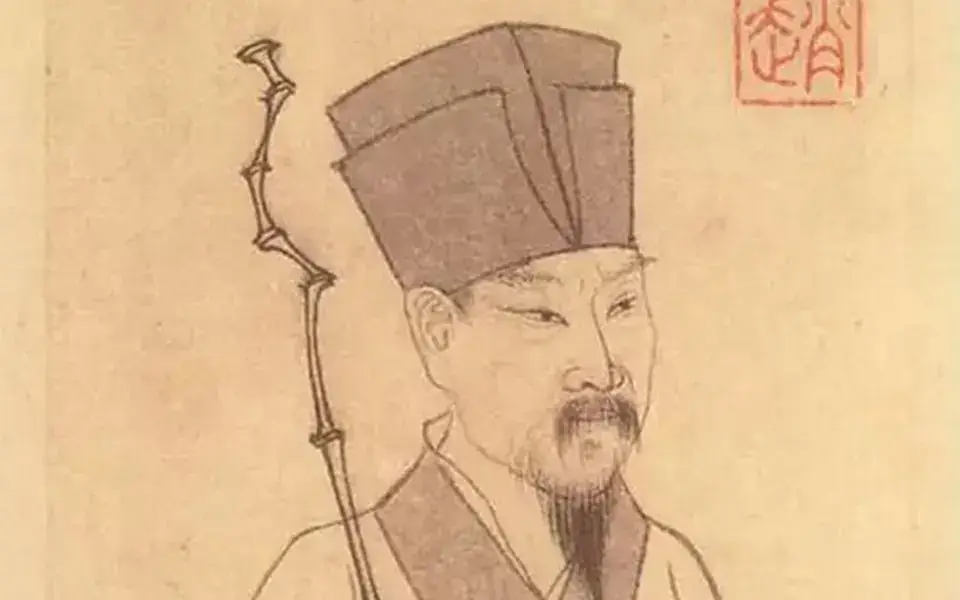
During his years in Huangzhou, Su Shi wrote the two Red Cliff rhapsodies. Through excursions, dialogue, and scenery, he connected his personal experiences with reflections on time and life.
The Red Cliff in the works should not be automatically equated with the precise site of the Three Kingdoms battlefield. His Huangzhou years also produced poetry, calligraphy, and painting.
Historical context
The "Former Ode on the Red Cliffs" ( pinyin:) is a piece of writing written by the Chinese poet Su Shi in 1082, describing a trip that Su Shi took with his friends on the Yangtze River, which took them past the purported site of the Battle of Red Cliffs. It is in the fu form.
Background
After Su Shi was arrested for his poetry satirizing policies of the Song court, known as the Crow Terrace Poetry Trial, he was demoted to serve as the deputy of the regiment of Huangzhou.
Synopsis
The author and his friends took a boat trip by the Red Cliffs. He sang a song, and one of his friends accompanied him with a xiao, a traditional Chinese flute. The tune was sad, so the author asked why. The guest said that the place reminded him of Cao Cao, who had been a hero of an era, but was no longer there. This made him realize the insignificance of human beings in comparison to the river and universe. Su Shi, however, considered the matter from a relativism aspect that both an individual and nature can be constantly changeable or immortal. He also pointed out that everything has its own owner, so one should not take what does not belong to him/her, except those eternal treasures of the creator like the moon or wind which everyone can enjoy.
The guest was delighted at last and fell asleep along with the author.
The author and historical setting
Su Shi ( 8 January 1037 – 24 August 1101), courtesy name Zizhan, art name Householder Dongpo, was a Chinese literatus, scholar-official, poet, writer, calligrapher, painter and gastronomist of the Song dynasty. Born into a prominent literary family in Meizhou, he was the son of Su Xun and brother of Su Zhe. Despite ambitions for high office, he became a repeated target in factional struggles between reformers and conservatives at the court, and he spent much of his career in exile, periods during which his literary output flourished.
A towering figure in Chinese literature and arts, Su left a prolific body of work that exerted enduring influence across the Sinosphere. His prose, ranging from philosophical to technical to culinary, earned him a place among the Eight Masters of the Tang and Song. His poetry is marked by vitality and boldness. In calligraphy he is counted among the Four Masters of Song Calligraphy. As a painter he was known for bamboo and weathered rocks, championing the capture of spirit over outward likeness.
Su Shi was born in Meishan, near Mount Emei in Sichuan province. His given name Shi refers to the crossbar railing at the front of a chariot. His father Su Xun remarked that the railing, despite being an essential component in the carriage, appears low profile and unassuming. He hoped that the talented and outspoken Su Shi would learn self-restraint. Unfortunately, Su Shi did not fully heed his father’s counsel, and his conspicuous nature led him into a tumultuous career.
Approximately 2,700 poems and 800 letters penned by Su Shi have been preserved to date. His mastery spanned across various forms, including the shi, ci and fu styles of poetry, as well as prose, calligraphy, and painting. While a significant portion of his poetry is in the shi format, it is his 350 ci style poems that largely cemented his poetic legacy.
Su Shi's repertoire also includes a substantial body of essays, with many focusing on politics and governance. One of them being Liuhoulun. He is recognized as one of the most esteemed essayists of the Tang and Song dynasties, earning him a place among the Eight Great Prose Masters of the Tang and Song.