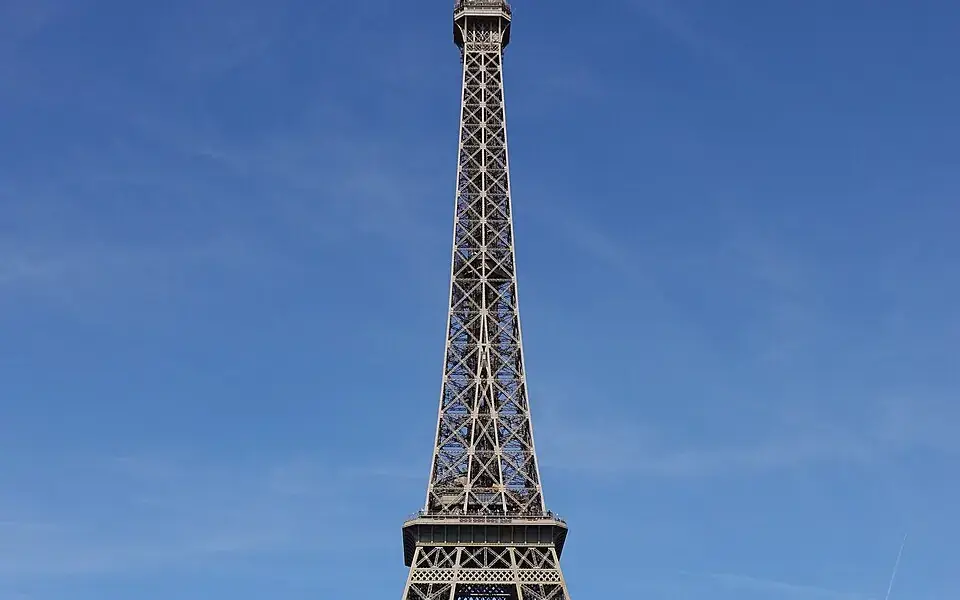
The Eiffel Tower was built for the 1889 Paris World's Fair. Some writers and artists objected to its iron appearance, but it later became a symbol of the city.
Prefabricated components and riveted connections were used in construction. Later purposes, including communications, helped secure its survival, showing how judgments of new buildings can change over time.
Construction
Work on the foundations started on 28 January 1887. Those for the east and south legs were straightforward, with each leg resting on four 2 m (6.6 ft) concrete slabs, one for each of the principal girders of each leg. The west and north legs, being closer to the river Seine, were more complicated: each slab needed two piles installed by using compressed-air caissons 15 m (49 ft) long and 6 m (20 ft) in diameter driven to a depth of 22 m (72 ft) to support the concrete slabs, which were 6 m (20 ft) thick. Each of these slabs supported a block of limestone with an inclined top to bear a supporting shoe for the ironwork.
Each shoe was anchored to the stonework by a pair of bolts 10 cm (4 in) in diameter and 7.5 m (25 ft) long. The foundations were completed on 30 June, and the erection of the ironwork began. The visible work on-site was complemented by the enormous amount of exacting preparatory work that took place behind the scenes: the drawing office produced 1,700 general drawings and 3,629 detailed drawings of the 18,038 different parts needed. The task of drawing the components was complicated by the complex angles involved in the design and the degree of precision required: the position of rivet holes was specified to within 1 mm (0.04 in) and angles worked out to one second of arc.
The finished components, some already riveted together into sub-assemblies, arrived on horse-drawn carts from a factory in the nearby Parisian suburb of Levallois-Perret and were first bolted together, with the bolts being replaced with rivets as construction progressed. No drilling or shaping was done on site: if any part did not fit, it was sent back to the factory for alteration. In all, 18,038 pieces were joined using 2.5 million rivets.
At first, the legs were constructed as cantilevers, but about halfway to the first level construction was paused to create a substantial timber scaffold. This renewed concerns about the structural integrity of the tower, and sensational headlines such as "Eiffel Suicide!" and "Gustave Eiffel Has Gone Mad: He Has Been Confined in an Asylum" appeared in the tabloid press. Multiple famous artists of that time, Charles Garnier and Alexandre Dumas, thought poorly of the newly made tower. Charles Garnier thought it was a "truly tragic street lamp". Alexandre Dumas said that it was like "Odius shadow of the odious column built of rivets and iron plates extending like a black blot". There were multiple protests over the style and the reasoning of placing it in the middle of Paris. At this stage, a small "creeper" crane designed to move up the tower was installed in each leg.
They made use of the guides for the lifts which were to be fitted in the four legs. The critical stage of joining the legs at the first level was completed by the end of March 1888. Although the metalwork had been prepared with the utmost attention to detail, provision had been made to carry out small adjustments to precisely align the legs; hydraulic jacks were fitted to the shoes at the base of each leg, capable of exerting a force of 800 tonnes, and the legs were intentionally constructed at a slightly steeper angle than necessary, being supported by sandboxes on the scaffold. Although construction involved 300 on-site employees, due to Eiffel's safety precautions and the use of movable gangways, guardrails and screens, only one person died.