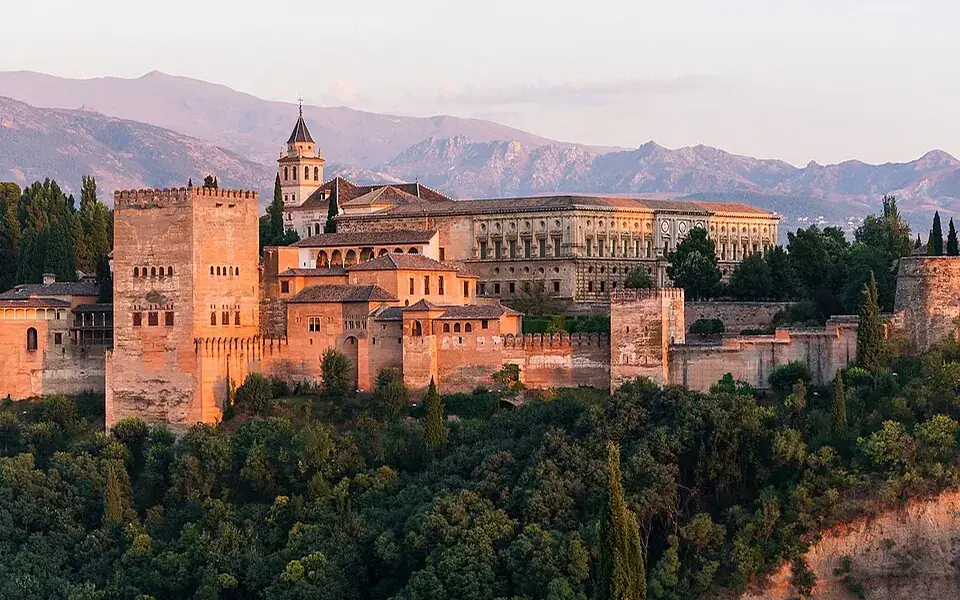
Granada's Alhambra is known for its courtyards, water features, and intricate ornament. Arabic calligraphy, plant motifs, and geometric forms work together across its architectural surfaces.
It is primarily associated with the Nasrid dynasty, with later additions from other periods. Running water, shade, and courtyard planning also respond to the local climate.
Decoration
Carved stucco (or yesería in Spanish) and mosaic tilework (zilīj or zellij in Arabic; alicatado in Spanish) were used for wall decoration, while ceilings were generally made in wood, which could be carved and painted in turn. Tile mosaics and wooden ceilings often feature geometric motifs. Tilework was generally used for lower walls or for floors, while stucco was used for upper zones. Stucco was typically carved with vegetal arabesque motifs (ataurique in Spanish, from Arabic:, romanized: al-tawrīq, lit. 'foliage'), epigraphic motifs, geometric motifs, or sebka motifs. It could be further sculpted into three-dimensional muqarnas (mocárabes in Spanish). Arabic inscriptions, a feature especially characteristic of the Alhambra, were carved along the walls and included Qur'anic excerpts, poetry by Nasrid court poets, and the repetition of the Nasrid motto "wa la ghalib illa-llah" (Arabic:, lit. 'And there is no victor but God').
White marble quarried from Macael (in Almeria province) was also used to make fountains and slender columns. The capitals of columns typically consisted of a lower cylindrical section sculpted with stylized acanthus leaves, an upper cubic section with vegetal or geometric motifs, and inscriptions (like the Nasrid motto) running along the base or the top edge.
While the stucco decoration, wooden ceilings, and marble capitals of the Alhambra often appear colourless or monochrome today, they were originally painted in bright colours. Primary colours – red, blue, and (in place of yellow) gold – were the most prominent and were juxtaposed to achieve a certain aesthetic balance, while other colours were used in more nuanced ways in the background.
Inscriptions
The Alhambra features various styles of the Arabic epigraphy that developed under the Nasrid dynasty, and particularly under Yusuf I and Muhammad V. José Miguel Puerta Vílchez compares the walls of the Alhambra to the pages of a manuscript, drawing similarities between the zilīj-covered dados and the geometric manuscript illuminations, and the epigraphical forms in the palace to calligraphic motifs in contemporary Arabic manuscripts. Inscriptions typically ran in vertical or horizontal bands or they were set inside cartouches of round or rectangular shape.
Most major inscriptions in the Alhambra use the Naskhi or cursive script, which was the most common script used in writing after the early Islamic period. Thuluth was a derivation of the cursive script often used for more pompous or formal contexts; favoured, for example, in the preambles of documents prepared by the Nasrid chancery. Many inscriptions in the Alhambra were composed in a mixed Naskhi-Thuluth script. Bands of cursive script often alternated with friezes or cartouches of Kufic script. Kufic is the oldest form of Arabic calligraphy, but by the 13th century Kufic scripts in the western Islamic world became increasingly stylized in architectural contexts and could be nearly illegible. In the Alhambra, there are many examples of "Knotted" Kufic, a particularly elaborate style where the letters tie together in intricate knots.
The extensions of these letters could turn into strips that continued and formed more abstract motifs, or sometimes formed the edges of a cartouche encompassing the rest of the inscription.
The texts of the Alhambra include "devout, regal, votive, and Qur'anic phrases and sentences," formed into arabesques, carved into wood and marble, and glazed onto tiles. Poets of the Nasrid court, including Ibn al-Khatīb and Ibn Zamrak, composed poems for the palace. The inscriptions of the Alhambra are also unique for their frequent self-referential nature and use of personification. Some inscribed poems, such as those in the Palace of the Lions, talk about the palace or room in which they're situated and are written in the first person, as if the room itself was speaking to the reader. Most of the poetry is inscribed in Nasrid cursive script, while foliate and floral Kufic inscriptions—often formed into arches, columns, enjambments, and "architectural calligrams"—are generally used as decorative elements.