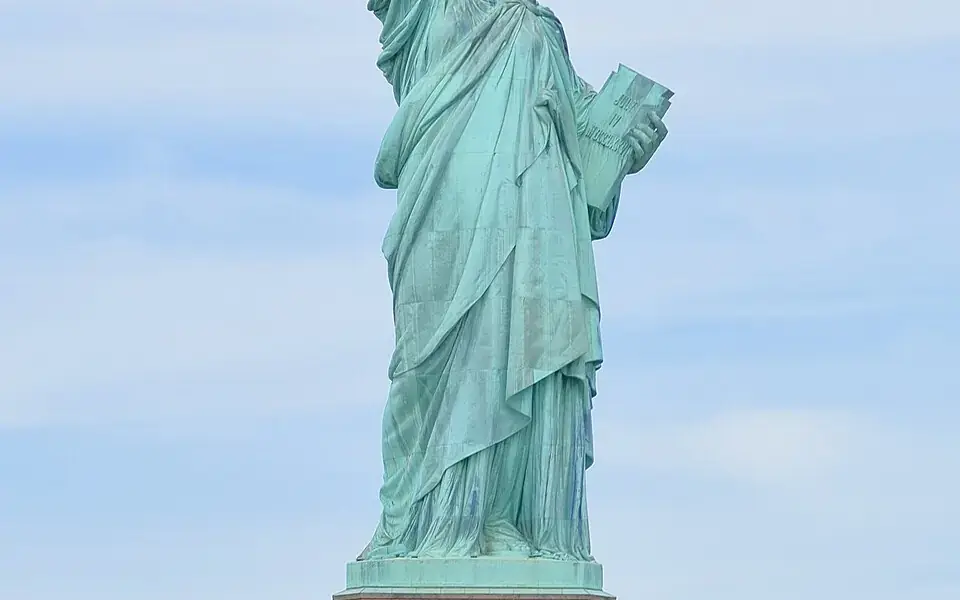
France gave the Statue of Liberty to the United States. Its surface is made of copper sheets, while an internal metal structure supports its enormous body and raised arm.
Unveiled in 1886, the statue symbolizes liberty and French-American friendship. Projects such as its pedestal required separate fundraising, and its completion involved cooperation across countries.
Origin
According to sculptor Bartholdi, who later recounted the story, Laboulaye's alleged comment was not intended as a proposal, but it inspired Bartholdi. Given the repressive nature of the regime of Napoleon III, Bartholdi took no immediate action on the idea except to discuss it with Laboulaye. Bartholdi was in any event busy with other possible projects. In 1856, he traveled to Egypt to study ancient works. In the late 1860s, he approached Isma'il Pasha, Khedive of Egypt, with a plan to build Progress or Egypt Carrying the Light to Asia, a huge lighthouse in the form of an ancient Egyptian female fellah or peasant, robed and holding a torch aloft, at the northern entrance to the Suez Canal in Port Said. Sketches and models were made of the proposed work, though it was never erected.
There was a classical precedent for the Suez proposal, the Colossus of Rhodes: an ancient bronze statue of the Greek god of the sun, Helios. This statue is believed to have been over 100 feet (30 m) high, and it similarly stood at a harbor entrance and carried a light to guide ships. Both the khedive and Ferdinand de Lesseps, developer of the Suez Canal, declined the proposed statue from Bartholdi, citing the high cost. The Port Said Lighthouse was built instead, by François Coignet in 1869.
Upon his return from Egypt, Bartholdi visited Giovanni Battista Crespi's sculpture Sancarlone, a 76-foot statue of St Charles Borromeo in repoussé copper covering an iron armature at Lago Maggiore in Italy. He was also familiar with the similar construction of the Vercingétorix monument by Aimé Millet; the restoration of Millet's statue a century later would call international attention to the Statue of Liberty's own poor state of preservation. Bartholdi chose copper over bronze or stone due to its lower cost, weight, and ease of transportation.
Any large project was further delayed by the Franco-Prussian War, in which Bartholdi served as a major of militia. In the war, Napoleon III was captured and deposed. Bartholdi's home province of Alsace was lost to the Prussians, and a more liberal republic was installed in France. As Bartholdi had been planning a trip to the United States, he and Laboulaye decided the time was right to discuss the idea with influential Americans. In June 1871, Bartholdi crossed the Atlantic, with letters of introduction signed by Laboulaye.
Arriving at New York Harbor, Bartholdi focused on Bedloe's Island (now named Liberty Island) as a site for the statue, struck by the fact that vessels arriving in New York had to sail past it. He was delighted to learn that the island was owned by the United States government—it had been ceded by the New York State Legislature in 1800 for harbor defense. It was thus, as he put it in a letter to Laboulaye: "land common to all the states." As well as meeting many influential New Yorkers, Bartholdi visited President Ulysses S. Grant, who assured him that it would not be difficult to obtain the site for the statue. Bartholdi crossed the United States twice by rail, and met many Americans whom he thought would be sympathetic to the project.
But he remained concerned that popular opinion on both sides of the Atlantic was insufficiently supportive of the proposal, and he and Laboulaye decided to wait before mounting a public campaign.
Bartholdi had made a first model of his concept in 1870. The son of a friend of Bartholdi's, artist John LaFarge, later maintained that Bartholdi made the first sketches for the statue during his visit to La Farge's Rhode Island studio. Bartholdi continued to develop the concept following his return to France. He also worked on a number of sculptures designed to bolster French patriotism after the defeat by the Prussians. One of these was the Lion of Belfort, a monumental sculpture carved in sandstone below the fortress of Belfort, which during the war had resisted a Prussian siege for over three months. The defiant lion, 73 feet (22 m) long and half that in height, displays an emotional quality characteristic of Romanticism, which Bartholdi would later bring to the Statue of Liberty.