The large set of bronze bells excavated from the tomb of Marquis Yi of Zeng provides evidence for Warring States music through its inscriptions and construction. Some bells can sound different pitches, demonstrating sophisticated knowledge of bell-making and musical tuning. Other objects in the tomb also reveal the period's ritual and musical life.
Historical background
The Tomb of Marquis Yi of Zeng is an archaeological site in Leigudun Community, Nanjiao Subdistrict, Zengdu District, Suizhou (during the Spring and Autumn period called Sui County), Hubei, China, dated sometime after 433 BC. The tomb contained the remains of Marquis Yi of Zeng (sometimes "Duke Yi"), and is one of a handful of ancient Chinese royal tombs to have been discovered intact and then excavated using modern archaeological methods. Zeng was a state during the Spring and Autumn period of China. The tomb was made around 433 BC, either at the end of the Spring and Autumn period or the start of the Warring States period.
The tomb comes from the end of the thousand-year-long period of the burial of large sets of Chinese ritual bronzes in elite tombs, and is also unusual in containing large numbers of musical instruments, including the great set of bells for which it is most famous.
Discovery and layout
The People's Liberation Army accidentally discovered the tomb in 1977 while destroying a hill to build a factory at Leigudun. The tomb was constructed of large wooden timbers and covers an area of 220 square meters. The date "jiayin 3rd day" written on an astronomical diagram on a lacquered clothing chest from the tomb is believed to be the date of the Marquis's death or an important date in his life, and has been extrapolated to the evening of the 3rd day of the third lunar month of 433 BC.
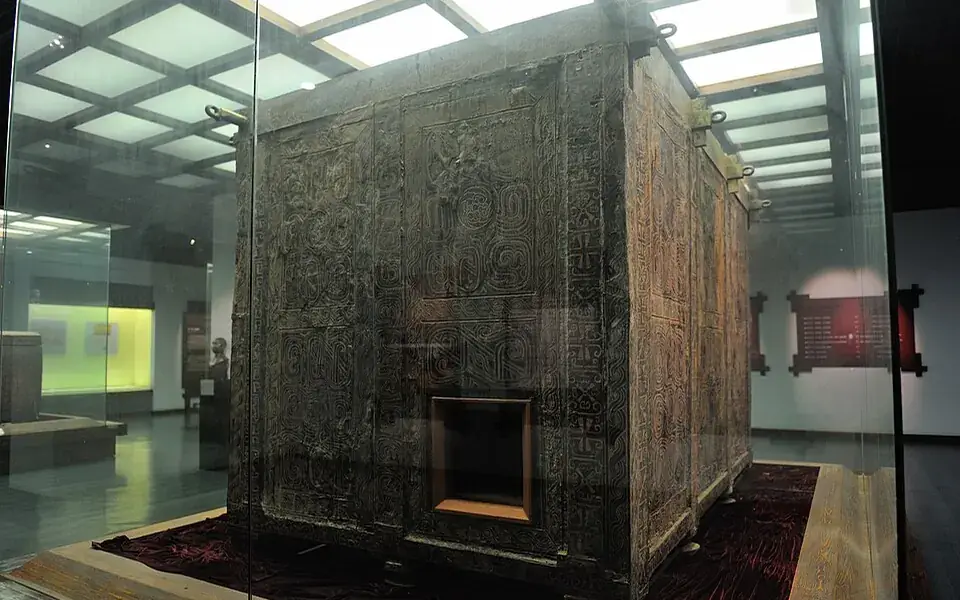
The tomb is divided into four separate chambers, resembling the layout of a palace of the day. The northern chamber is the smallest and contained military artifacts. The eastern chamber contained the tomb of Marquis Yi, who was buried in a wooden lacquer coffin nested inside a larger lacquer coffin. This chamber also contained eight other coffins that held the remains of eight women. The western chamber contained thirteen coffins that held the remains of thirteen other women. The central chamber is the largest, and contained a large ensemble of ritual musical instruments, including a set of 64 bianzhong (bronze bells).
Musical instruments
The most famous discovery at the tomb is the large set of 64 bianzhong bells, mounted on an elaborate framework, which required a cast of five members to be played, and were struck with wooden mallets to produce music. The bells are two-toned, producing two distinct tones when struck at the center or the side. This property is due to the bells' almond-shaped cross-section. The bells cover a range of five octaves. The collection also contains a non-matching bell, a memorial to Marquis Yi from King Hui of Chu, recording King Hui's rushed trip from the west to create the bell and attend the Marquis's funeral during the 56th year of King Hui's reign; the inscription on the bell dates the event to 433 BC. The bells were inscribed with music notations that detailed the relationship among the pitch standards of Zeng, Chu and Zhou.
Other musical instruments in the ensemble include stone chimes. Various string instruments were also discovered in the tombs, including se, qin and zhu. The tomb also contained pan flutes (paixiao), flutes and special sheng, each made from a one-piece body through a time-consuming procedure; a gourd would be placed inside a mold that held the desired shape of the instrument. Once the gourd matured, it would take the shape of the mold that conformed to the desired musical properties of the instrument.
Ritual bronzes
Along with the Late Shang dynasty tomb of Fu Hao, the tomb represents one of the largest sets of ritual bronze vessels to be properly recorded at the site. Most of the large number of ritual bronzes extant are individual pieces, or pairs, with no archaeological context recorded, but it is becoming clear that most pieces would have originally come from large groups deposited in an elite tomb.